Rural communities in Colombia face a plethora of challenges. Inhabitants of territories that are rich in natural resources are being forced to leave their lands, either by the pressure of armed groups or by big “development industrial”
Diana Teresa Gutiérrez
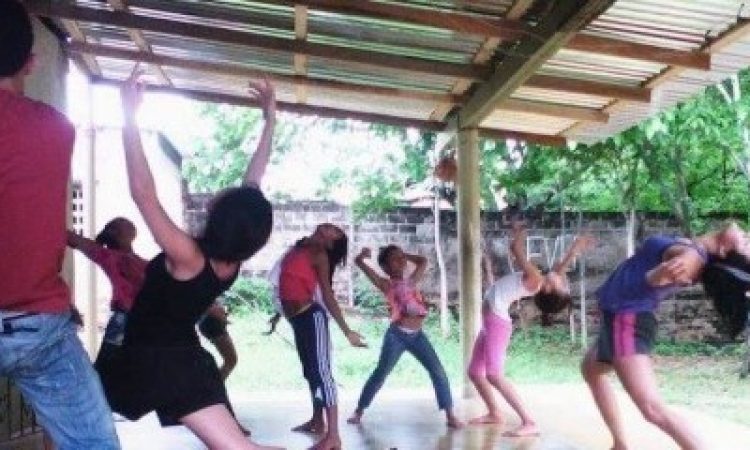
The aforementioned quote has been extracted from a conversation I had with dance anthropologist, Diana Teresa Gutiérrez as part of the thINKingDANCE’s Decolonizing Dance Writing series. Gutiérrez, whose artistic work aims to empower victims of violent situations, speaks of these “challenges,” saying they serve as inspiration for her Colombia-based organization, Embodying Reconciiliation – Cuerpos para la Reconciliación (ER-CR). This organization works with individuals to help them reconcile trauma through their bodies by using somatic techniques to access movement that emerges from repressed experiences. Ultimately, ER-CR promotes healing from past experiences. According to Gutiérrez, decolonizing starts with self. The rest of our conversation went as follows…
Lauren Putty White: When we first met on Zoom, you said you couldn’t identify your work through a decolonizing lens because of it having so many layers. Where do you stand now?
Diana Teresa Gutiérrez: At ER-CR, our creative approach to helping others allows us to look at ourselves in a reflective way in order to transcend who we think we are. A few ways that our work fits into a “decolonizing framework” are:
- Our somatic techniques help us move through things as an alternative to other ways of dealing with trauma. Recently, our organization held workshops that focused on sexual and reproductive rights. We wanted to tackle this issue while recognizing that we have human desires to procreate regardless of our gender. We used movement to access emerging ideas about sexual desires to start our participants on a path to facing their individual questions. We use guided improvisation to heal emotional pain, memories of trauma that we need to overcome.
- At ER-CR, we use a self-reflective process. The communities we are working with come from violent, traumatic backgrounds. One approach is inspired by “Living Pictures”- staged digital photos of people dressed in costumes portraying narrative tableaus centered around a certain theme. “Living Pictures’ ‘ is an intangible cultural heritage (ICH) of these communities and can be traced back to the 19th century where in the Caribbean Columbian Region, people were influenced by religious practices used by Europeans who used the living portraits as a mechanism to colonize the local population and transcend language barriers. I think that this self-reflective process inadvertently relates to colonial paradigms.
- Lastly, real transformation requires a process, an awareness of the biographies in our bodies and how we want to express them through art. These biographies represent the stories of our past that the body remembers and holds on to.
LPW: In your promotional video, Don’t Betray Yourself, you say to your son, “Don’t betray yourself, fight for what’s yours because it is yours. Don’t worry about losing or winning, you never really lose because any outcome always brings you knowledge.” Do you believe decolonizing fits into the idea of “winning a fight” in order to be heard or is the purpose for you to gain knowledge like you mentioned?
DTG: There was a moment when I wasn’t feeling at peace with myself. There were many personal struggles I hadn’t dealt with in my own traumatic experiences. I needed to see myself in an honest way. I needed to show the communities I work with that it’s not about winning or losing, but rather about being transparent and admitting your own flaws. My son is really competitive and he’s a reflection of me when I was younger. Sometimes [people] forget about the essential things, like dealing with personal struggles. It takes vulnerability to address these kinds of issues. Sometimes, you subconsciously try to fit into these colonizing ideas of how you are supposed to respond to life or society. I think that it’s important to admit, “I’m doing my best to be my best.” It’s important to keep making that message more powerful.
LPW: You talk about the body holding information, how does that serve the purpose of decolonization?
DTG: Life is in motion. We are not just omitting the past and starting fresh. I believe we move through the past, present, and future. The way we make sense and connect to our circumstances is storytelling. Our bodies give us insight…it has memories. If I want to transcend the effect of those memories, I can create my narrative through movement. I think the body naturally directs us in what we should do. The body doesn’t lie.
In the final minutes of our conversation, Gutiérrez described two exercises that her organization frequently uses to free its participants from their troubled existence. The first, Mapping Our Emotions, requires participants to move as they are being guided through a series of questions about their emotional state. This offers them a way to verbally and physically respond prompts represent who they are in the moment. The second, Mapping Heritage, has groups draw two maps: one of a human body and another of their town. Participants use these maps to indicate places where they feel safe, scared, happy, connected, lonely, and loved. Together they worked in their groups, creating a shared understanding of their own bodies, the bodies of others, and the places they live. This work allows for these communities to engage with their heritage using an embodied practice. Taken together, these exercises shed light on how bodily practices can be used as an outlet through which one takes on adversarial circumstances. At ER-CR, the body remains the vessel over which all participants take ownership, despite what may have been taken from them.
Maybe, Gutiérrez is right. Maybe, the body does not lie. It appears that ER-CR deals with social transformity, promoting practices that “foster the well-being of diverse populations on the individual and communitarian levels.” In other words, the organization works to decolonize the bodies of its participants from the violence that surrounds their lives with the intent to heal.