The warmth of the intimate space at Chi Movement Arts Center offers an environment of creativity and genuine passion. Headlined by four distinct choreographers, Evalina “Wally” Carbonell, Malcolm Shute, Nick M. Daniels, and Sarah Carlson, Crossing Paths Movement Collective presents a myriad of big ideas and even bigger risks, ranging from race and gender to motherhood.
The opening piece, Apple, choreographed by Carbonell, is an engaging, theatrical duet featuring Carbonell’s young daughter, Lina. The small child enters with a basket of apples, playfully distributing them to random audience members with glee and innocence, all whilst mom is frozen in a bizarre, contorted pose entangled in a chair. Lina exits and Carbonell abruptly moves as the music, an unadorned whistle, contrasts her now evident angst and frustration. Downstage we see an unattainable apple sitting perched on a tree branch, and it becomes obvious and a bit hilarious that it’s Carbonell’s object of interest. The chair’s function is versatile, sometimes serving as a trap and sometimes as a puppet. As Carbonell manipulates, maneuvers, and controls how she intertwines with the chair, she finally breaks free from its trap. She gets that apple!
Cascade is a group work by Shute featuring a light, projected from upstage, and a clump of dancers downstage creating silhouettes with their arms. The strings of “Adagio in G Minor,” by Albonini, guide every slowly calculated move as the dancers remain touching, stationary in space, only to end up separately sprawled out on the floor. It took them excessively long to get to this point. Though the title gives way to the analogy of a waterfall, I wonder if there was more room for choreographic investigation as to how that waterfall could look.
Daniels piques my interest with his solo African American, an excerpt from his larger work American Safari. A face appears on the projection with Tracie Morris’ voice repeating, “It all started when we were brought here as slaves in Africa.” There is static. As the phrase becomes distorted, birds fly free in the sky, soon becoming the landscape for bare bodies in chains. Images of the American flag appear, accompanied by a daunting rendition of The Star Spangled Banner as Daniels twitches and throws his body around like he is the waving flag. Though the power of the projected images often overshadow the choreography and dancing, Daniels plays narrator to the hard truth that Black Lives are still fighting to matter.
Carbonell graces us with her presence yet again in a “trio,” Sycamore, set to music by Hilary Hahn & Hauschka and Bill Evans. I first see the mother circling her daughter as she plays around in the silhouette. When she walks her to sit in the audience, two other dancers enter with flowing abandon. It is purely satisfying when their torsos and arms cut through the space, juxtaposing the high, chaotic notes of the piano. Hearing the rigor of their breath reignites my connection to the humanity of dance. This trio is followed by Carlson’s ensemble, In Our Hands, composed of playful partnering and manipulation of limbs, yet lacking in group unison.
Intermission ends abruptly with the introduction to Daniel’s second piece, Here’s the Story (Excerpt from Contrapasso Nonsensical desire for truth in understanding). I feel I’m engulfed in a virtual reality tour as the projection displays the walls and dimensions of a museum. A stark voice in the soundscape talks about seeing windows. I see more projected images of faceless, colorless people along the ocean. Daniels ferociously repeats a swimming gesture, tirelessly, as if he is drowning. The last image that resonates with me is a lingering question on the screen: “I am a Black non-gender conforming child of God….who are you?”
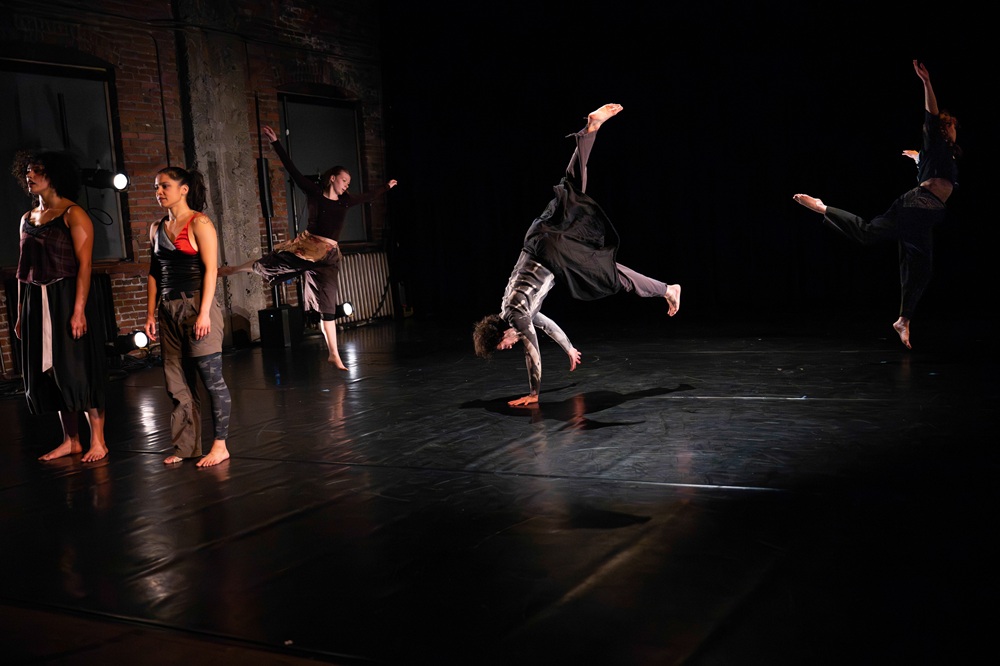
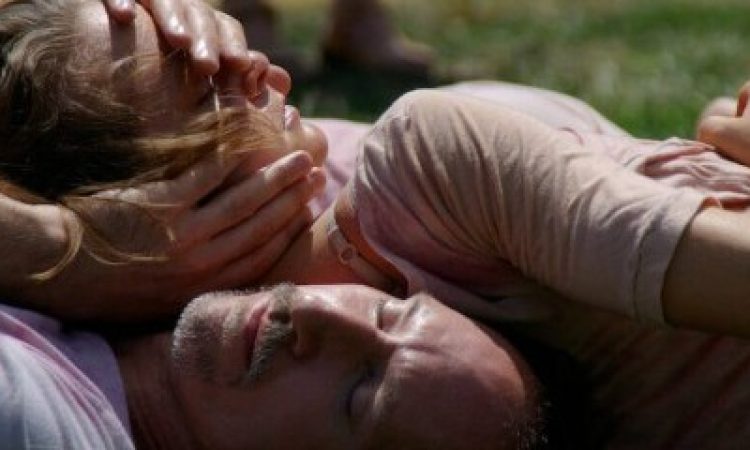
The final two pieces didn’t offer the full circle conclusion I was expecting. Carlson performed a solo, Imaging Her, dressed in medical garb cartwheeling and spiraling slowly to the sounds of an ultrasound machine and a doctor’s voice. Hearing Sybil Chamberlain repeat the phrase “don’t move” transported me to a cold, dark, isolated room where inevitable anxiety and suspense lie after an examination. In the last piece, Shute leaves us with a monotone “finale,” Personal Space, where a man and woman, intertwined on top of a table, never sever contact. Their swaying, shifting of weight, sliding, cradling, and comforting provide a beautifully intimate feeling but lack crescendo and resolve. This piece may have made more of an impact if placed in a different part of the show.
Overall, Crossing Paths Movement Collective crafts a diverse performance, with each artist embodying a completely different point of view. Though each concept never quite “crossed paths” with another, the artists showed thoughtful effort towards innovation and risk taking.
Crossing Paths Movement Collective, Chi Movement Arts Center, March 19-20.