The theme this year for the biennial dance on screen festival Moving Body – Moving Image at Barnard College and The Movement Lab was The Moving Body With Disabilities. It was an afternoon of screenings, an installation, and a panel discussion, curated to include a wide range of dance film styles, from experimental treatments of film itself to documentary approaches. The array of artistic choices, voices, and visions was a lot to consider.
Katrina Macpherson’s Uath Logans was the first piece that stuck out from the collection of shorts. A “physical and sensory exploration of place,” filmed in the Scottish Highlands, this work had an exquisite sense of quietness to it. The performer, Marc Brew, was seen laying, sitting, or using his wheelchair on a wooden path in a natural setting. He felt and interacted with water, light, and air in a way that can only be described as tender, employing elegant lines and small, gentle gestures of the hands to discover the elements of place. I was really stunned by this work’s gentle spirit.
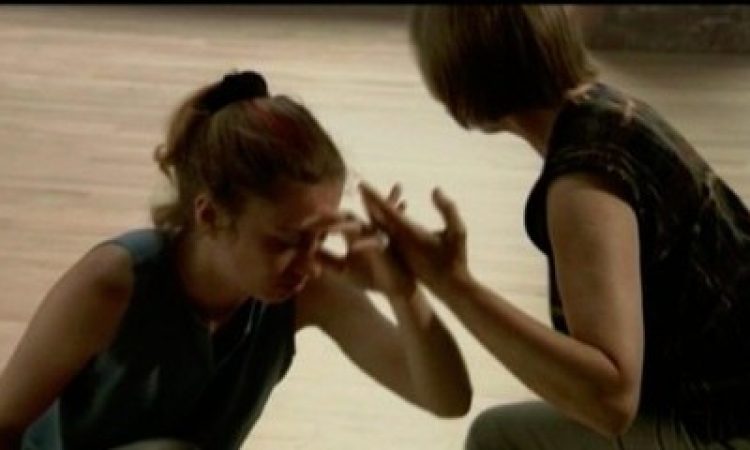
The power of Gimp Gait was found in its interconnected nature. In this “solo for two,” director and choreographer Pioneer Winter supported Marjorie Burnett through a solo choreography. Both of their voices, dubbed over the dance, spoke the instructions and needs of the movement. “Take My Hand,” “Lean Back,” “Show your face,” “Does this hurt?” It was slow-moving, intimate, and charged with authority, particularly in the performance of Burnett.
The installation portion of the festival showed another selection of shorts. There were three screens in a darkened room with cushions scattered on the floor. The films were projected onto these screens and the floor. One of the pieces, Exit Strategy #2, the work of Kym McDaniel, was a dance of hands or a single hand against a surface, with a story of trauma experienced in physical therapy dubbed over the movement. This piece in particular, seen on the floor, really filled the space, as hands reached across all surfaces, twisting, bending, stretching, and extending. Infusion No. 1, a work by visual artist Lauren Henschel, takes a silent look at impermanence and medicine. The film itself was treated with the artist’s bodily fluids and medications, shifting and distorting the single shot of the artist giving themselves an infusion and creating an image of the nature of living with an invisible disability.
Most of the shorts in the screening and installation featured close-up work with handheld cameras following the dancers’ gestures, which gave a feeling of intimacy with the artists. My frustration with the installation was with the placement of two pieces in the entryway. One had an audible monologue playing over a speaker right next to a silent work with captions to read. I found it challenging to engage with one while hearing the other, and it overlaid a violent narrative that was not present in the quiet work. I am curious about this choice and if I missed the point of these works being side by side.
The feature was a full-length documentary by filmmaker Rodney Evans. He tells his own story and follows those of three other artists (including dancer Kayla Hamilton) as they adapted their creative process to the loss of their sight. It’s an incredible journey through different ways of making and how it can be approached as something is lost that is typically thought to be required. Aside from the stories, I was very impressed with the audio description and how beautifully it was embedded into the film. It added so much to the experience and was artfully handled. The practice of audio description for film and dance was the central theme of the panel discussion by Evans and Hamilton.
One thing that struck me profoundly is how often the work of dance artists with disabilities is put to the side as though they are trying to mimic or strive for ableist and long-held dance standards. But there is nothing of ableism or ability-centered virtuosity in the definition of dance. Dance has everything to do with moving bodies and expressions of human existence. These films were made by artists performing their power, bodies in motion honoring the multifaceted beauty of how that happens and what that can communicate. The festival as a whole highlighted just how varied that is.
Moving Body – Moving Image: The Moving Body With Disabilities, Barnard College Dance Department and The Movement Lab, April 3.
Image descriptions: Two people wearing dark clothing lean against each other, making contact with their upper bodies. The person on the left has their back to the camera and has a tattoo on their upper back. The person on the right is facing the camera and has one leg.
Two people are crouched facing opposite directions with the backs of their hands touching and moving towards the forehead of the person turned more to the camera.