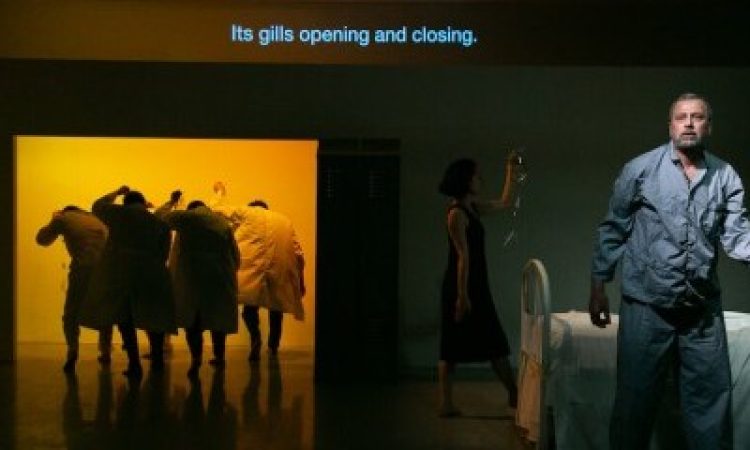
The set was a stark hospital room with an opening leading to a hallway upstage. From the start of the piece, two tones were put in place: one of death coming, and another of the chaos and perfunctory nature of a hospital stay. First, a serpentine creature, danced by Mohammed Smahneh, crept through the space and disappeared. A team of doctors emerged, played by Waseem Alzer, Joy Carlos, Kristin Clotfelter, Zoe Rabinowitz, and Arzu Salman. They pulsed and shifted and jerked side to side in a mechanized way, set to beeps and hospital noises.
In Last Ward, by Yaa Samar! Dance Theatre, the crisp specificity of gestures, unisons, and characters, down to the looks on each performer’s face, had me in a place where I could both see and hear implied dialogue. Perhaps this was partly because I have experienced the physical toll of the endless days and confusion of doctors whizzing past, treatments droning on, even the laughing and certainly the terrors of being with a loved one as cancer overtakes them. I would also say that the story was so clear because of the powerful and detailed imagination of the makers and performers of this dance and poetic theater work.
A man, played by guest artist Khalifa Natour, is dying. The only one to speak, other than one of the doctors at the beginning, he delivers an unfolding of monologues from a matter-of-fact approach about his diagnosis to heartbreaking to absurd and lost. He is visited by friends and family a few times, and you can sense nervousness and curiosity in their almost comical tip-toeing approaches and startles. One character, also danced by Mohammed Smahneh, turns the easy, awkward head nod of passive listening into a wild jerk and twitch that ultimately pulls him out the door, even as Natour asks “do you understand me?” The script, written by Amir Nizar Zuabi, was in Arabic with English supertitles.
Samar Haddad King‘s choreography was quick, detailed, and exceptional. Because this was also a play, it worked that different forms of dance and physical theatre were employed at once. The ensemble used pulses and repeats, landing ideas of monotony, confusion, and ritual on the scene. Most striking were the quick-paced hand gestures of the doctors, so sharp they were almost audible, an uncanny version of the way we move our hands while speaking. Typical hand movements were elongated, or else made small and frantic, held too close to the chest, or drawn way over the body out of reach. The repetition and the exact unison took it away from a general quotidien feel to something uneasy like a fever dream.
The woman who appears to be the dying man’s wife, played by Yukari Osaka, helps him put pajamas on at the piece’s beginning while he is being asked about his symptoms. She knocks dirt out of his shoe and sweeps it away, and it seems an insignificant gesture at first. The dirt returns later served to him for dinner, and it begins falling out of buckets, plants, and hands. Piling up, and while orderlies and doctors drop and spread out more, Osaka tries to clean it up with her hands. Natour softly lists the daily things she will do when he is gone, and she pulls all the dirt she can reach, but much more than she can visibly hold, into a spilling pile towards her chest. The soil metaphor is heavy but lends itself well, through multiplying in the space and in its scope not just to the motif of a burial, but to the work of those losing someone to clean and change and help and keep; and try and lose.
Sometimes, I felt like too much was going on. I couldn’t follow everything at once and it reminded me of being at my friend’s bedside, unsure of what to focus on or what information to keep, knowing there was nothing I could do, and often staring into the machines reading his vital signs, mesmerized by the hums and beeps. Things began to unravel, and energies, sounds, and gestures heightened. Speed increased. Desperation emerged, and Natour’s face pulled me into his experience of the overwhelm of dying, of having no control. Over time, the doctors became less and less doctor-like until they were no longer dressed as medical staff and were crawling on the floor or flowing through unisons softer than those they started with. Was this shift because there was no longer anything medicine could do? Was there no more job for them other than to be human alongside the loss?
By the end, the space is covered in dirt. Natour’s character stands over his bed, shovel in hand, and speaks of the “chaos of new life” that will replace him, and as the stage lights go down, his wife looks up into the light of the hallway, arms stretching painfully down towards the earth.
Last Ward very successfully integrated images, movement, and text. There are moments from this piece that will stay with me for a long time. The work honored loss in a way capable of holding what is funny or unwieldy or dull about illness and death. And it gently held space for the awkwardness and the desperation of the healthy toward the sick person as they begin to contain their grief. All you can do is fold a shirt, sweep, and go home.
This work was for those of us who have lost someone, which is to say this was for all of us.
Last Ward, Yaa Samar! Dance Theatre, Gibney Presents, May 5-7, 11-12.
Image Descriptions:
1. Pictured (L to R): Yukari Osaka and Khalifa Natour
In the foreground a female dancer with dark hair in a black dress sweeps dirt on the floor towards her in a pile. Behind her on a bed in blue pajamas in a man sleeping on his side. In the background is a gurney covered in white pots planted with white flowers.
2. Pictured (L to R): Zoe Rabinowitz, Joy Carlos, Arzu Salman, Waseem Alzer (in doorway), Yukari Osaka and Khalifa Natour
A man in a spot light and blue pajamas stands downstage left in front of his hospital bed. Behind him a dancer in a black dress walks slowly holding up an iv bag. In the background four dancers are turned away and leaning forward in long lab coats. Above all this a projection reads “Its gills opening and closing.”