The box office line of the MAAS building spills onto the street. Inside, there are beverages and appetizers for all, though not enough chairs for the crowded audience squeezing in to see Pasión y Arte’s 2022 student showcase, Celebrating Philadelphia’s Flamenco Community. This energy feels familiar. My attention goes to the women making space for everyone in the room. They set up extra seating for late guests, make sure all wine glasses are full, and set a picnic blanket for all the children in the front row. The room buzzes with both the performers’ pre-show nerves, hands fiddling with sashes and headpieces, and their families’ unyielding support, cameras propped and ready to capture the stage.
Elba Hevia y Vaca, Founder and Artistic Director, welcomes the audience with overflowing enthusiasm for this year’s showcase—the first in three years. Upstage, Barbara Martinez, Adrian Alvarado, and Adam Bailey fill the space with their vocals, guitar, and percussion; their music eases us into the performance, my introduction to Flamenco. I’m captivated by the singer’s hands. Martinez softly claps fast-changing rhythms, using her fingers, palm and heel to accent the guitar’s tempo. I notice her powerful and piercing voice contrasts with her fingers which float through the air. She is bold yet gentle, a duality that endures throughout the evening.
The Basic Beginner adult students flock the stage as the other performers encourage them, clapping the beat from the wings. Though I’ve never studied Flamenco, I grew up with ballet recitals every May and I resonate with the students’ wide eyes: deep focus on perfecting the steps, tempered by comfort in knowing that loved ones in the audience will be thrilled by the bravery, regardless. The support in the room is as present as the vivid red skirts and the bellowing rhythm of the cante.
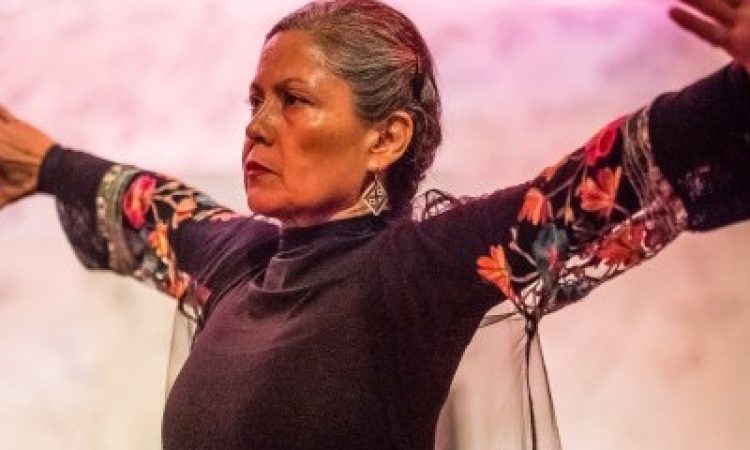
The Classical Spanish students, Advanced Beginners, and Intermediate students each bring another element of Flamenco to the stage. In every group, I’m struck by the array of movement qualities the dancers hold all at once. They harness force from the floor with each strong stomp, even as they gently weave their fingers and wrists through the air. The golpe, planta, and tacón are audible with every step, yet we really only see the dance when the performers lift their skirts, when they decide to let the audience witness the intricate footwork. I wonder—which parts of Flamenco are for the performer, and which are for the onlooker?
Pasion y Arte’s conservatory is a space that “provide[s] a disciplined environment for preserving and teaching the formal structures of Flamenco in a women-positive environment.” Hevia y Vaca’s choreography goes beyond a one-note representation of femininity. The gender on stage offers strength that is loud, direct, and bold, braided with vulnerability, care, and lightness. Whether the performers’ affect is severe or soft, they’re always in charge of the audience’s gaze; they choose how they’re witnessed.
Clarissa “La Gitanita” Marin, Elba Cena Zarate, and Liliana Ruiz perform next, three virtuosic professionals that have the audience cheering Olé! at every turn. These women have lifelong relationships with Flamenco. Their steps are faster and more advanced than the students’, and it’s clear their careers have honed not only their footwork, but also their confidence, power, and agency as performers.
After an evening of commanding performances, I’m left with gratitude for the learning environment Hevia y Vaca has created in Philadelphia. Pasión y Arte celebrates both the learner and the expert, the strong and the soft, the internal and the presentational. Brought together through community, this year’s showcase highlights the expansive complexities interweaving through Flamenco.
Celebrating Philadelphia’s Flamenco Community, Pasión y Arte, The MAAS Building, Philadelphia, May 26.