The premier of El Muro/The Wall, by National Portrait Gallery choreographer-in-residence Dana Tai Soon Burgess, marked the first in-person event for both the museum and myself since the pandemic started. It’s a measure of how difficult the pandemic has been and continues to be.
Burgess’s work draws direct inspiration from the painting Refugees Crossing the Border Wall by Rigoberto A. Gonzalez, a 2022 Outwin Boochever Portrait Competition finalist. The painting’s subjects – a man, woman, and two children – are life-sized, looking behind them as they climb a ladder, a threshold from one dangerous situation into another. The image is one of arrested movement and anticipation.
In a short speech before the performance, Burgess spoke to his desire to emphasize safety and community along with a “sense of magical reality.” El Muro/The Wall succeeded in that respect, but above all else, the performance created and embraced a shocking and overwhelming degree of tenderness. Its shock is as much a result of the stultifying realities of the pandemic as it is the creation of an efficient choreographic eye with a cathartic and universal narrative.
The story’s opening is simple: two young lovers with little leather suitcases, alighted with hope, friends and loved ones celebrating around them, offering marigolds and embraces for the journey they’re about to begin. The imagery is steeped in Latin American magical surrealism, nostalgia, and yearning — a woman in black represents Death and marigolds traditionally present during the Day of the Dead — and the resulting storytelling form was folkloric in its approach while still maintaining an expansive and romantic sense of wonder.
After the chorus left, the two lovers began their first duet, moving through a spectrum of social dancing such as flamenco, tango, and salsa. Their execution is exact, fluid, and graceful. The narrative’s tenderness and earnestness have taken deep root by this point, although there is a lack of variation in the broader choreographic choices throughout the performance. The choreography rarely explores the dynamics of levels (the dancers rarely move to the floor or above their heads), and overall the rhythmic flow does not vary much. On one hand, the relative minimalism of these choices is extremely effective in pathos and structure; on the other, the craft appears flat.
In the first duet, that flatness appears as a lack of sensual exchange or embodied romance. In other words, I didn’t discern much passion that typically accompanies this romantic narrative and its choreographic languages, but that ultimately wasn’t a detriment. The lovers, such as they are, perhaps aren’t here to speak of love between two people, but rather a love that encircles a broader community. It is a love which includes communing and dancing with Death, existential struggle and choice, and the simple joys of giving flowers to one another.
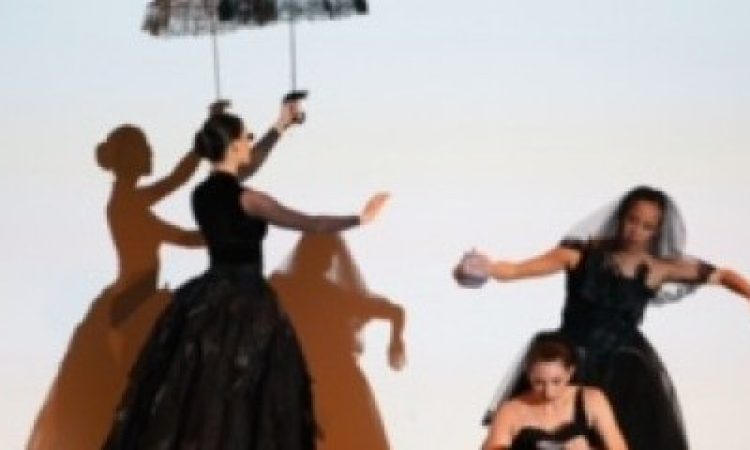
The expected troubles come in the form of the chorus dancers returning with Death herself under a black umbrella. The lovers are separated in this grand, carefully coordinated confusion. When they reunite, she is veiled, as if from the underworld, a parallel reality of grief and loss, or from generations past and future. El Muro’s sense of safety and magical reality rings fullest in the transition from this second duet into the reunification of both lovers on our side of the proverbial veil. Community once again surrounded them, everyone dancing and smiling, even audience members brought from the front rows to dance on stage, and of course, Death herself, everpresent.
El Muro/The Wall, Dana Tai Soon Burgess, National Portrait Gallery, May 17-19.