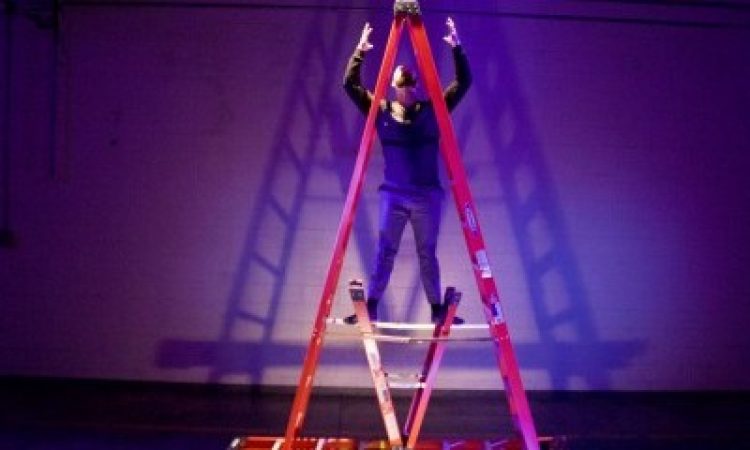
In You shouldn’t be doing what you’re doing on that Ladder, solo performer Peter Nicholls starts with a comically small orange ladder. He thrusts his hands through the gaps dramatically, throws it into a full summersault, and finally balances it on his chin (leaving ample time for applause).
The problems start when he reads the instructions.
“Do not climb up back section,” he reads, toes curled around one of the narrow rungs of the back section. He hastily climbs up to the top to find DANGER written on the front rungs. He wavers for a second, then perches precariously on the top rung.
“I guess I live here now.”
“Weird,” says a kid from the audience.
“Yeah,” he agrees. “Weird.”
He discovers a bigger ladder, then a massive one, and, in the grand tradition of circus, the tricks get bigger. With the unmistakable chords of The Final Countdown egging him (and us) on, he spins the enormous ladder upside down and balances it.
But when he tries to set it down, it falls with a very real crash right on top of where he lies unmoving. The lights go blue and Nicholls’ hands snake out from under it, transformed into strange demons.
The transition from clown show about ladders to introducing the inner demons of depression by way of hand-puppetry clunked heavily at first, a bit like the ladder coming down on Nicholls. But once I suspended my disbelief and let the hand-puppetry, acrobatic metaphor, and clown persona be tools to talk about mental health, I became emotionally invested in the journey, immersed in Nicholls’ all-in performance, impressed by a show that manages to be truly family friendly while depicting some of the darkest places our minds can lead us to.
We came to see THE TRICK, of course. But after several aborted attempts, Nicholls finds himself standing several stories above the ground. Lit from below, he’s accompanied by four shadow selves crowding in on the too-close ceiling, and he breaks down. “I shouldn’t even be here,” he weeps.
Precarity is built into the world of circus, where it’s often used to showcase superhuman control. But Tribe of Fools pairs the physical precarity of circus with a narrative of mental instability, giving Ladder the satisfying tang of the medium being perfectly complementary to the message, all the way to the ending image. The outside legs of the two largest ladders hover off the ground as Nicholls straddles between them, suspended but balanced. He hasn’t made it to his goal, but his creative solution in that moment makes him smile. He shrugs.
“I guess I live here now.”
You shouldn’t be doing what you’re doing on that Ladder, Peter Nicholls / Tribe of Fools, Icebox Project Space, September 9-18, Fringe Festival 2022.