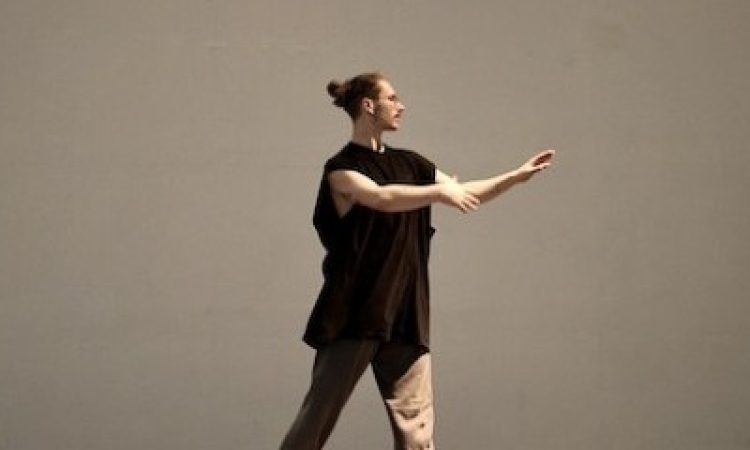
You are outside at the MAAS Building garden, birds sing, the evening sun and wood smoke from a fire permeate everything. In front of us, Rodney Murray prepared for his solo piece, Scoring the End, playing with equipment and warming up his body. A projection screen behind him flipped from live feed to cityscape to a scrolling text that reads, “This is my magnum fucking opus.”
This dance theater work is comedic, relaxed, and a witty mockery of the self-aggrandizing way artists can inflate their work and themselves. Alive with laughs, earnestness, and deliberately cringy art speak moments, Murray’s character begins at a microphone. Two angles of him are projected in real-time. You hear a sultry voice in conversation, one-sided like a phone call. When he breaks off that conversation, he speaks directly to us with a new caddy voice, a fireside chat of gossip. It is playful, making fun, with storytelling and punchlines. It’s marked with what appear to be profound moments — but then he asks, “did they get that on camera?”
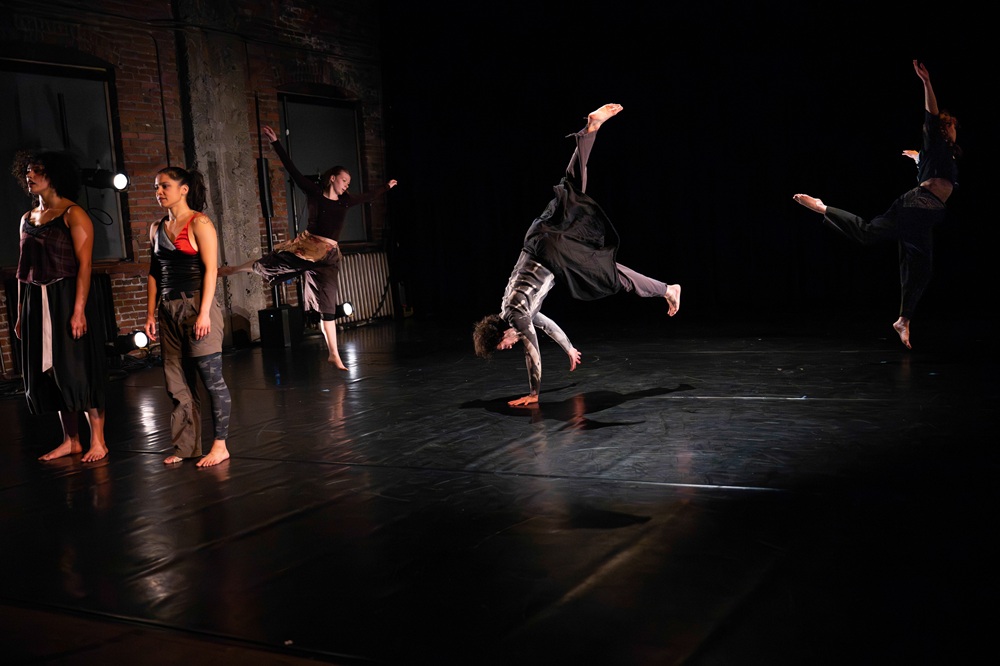
A section of dance emerged with a looped vocal sound score. The movement was sweeping gestures, reaching oppositions, playing with balances, finding ways to the floor and back to his feet. Hinged at the hips, he explored falls and catches, replacing his feet, and finally repeating a specific phrase into a tired frenzy. He is technically grounded, confident and beautiful to watch though I have questions about how this kind of practiced modern vocabulary adds to interdisciplinary work.
There were two sections of repetition where gestures were paired with words and broken down, sped up, or garbled. “Why do you always do this in your work?” “I don’t know what you’re talking about.” “I hate my work.” One such section uses a recording of two people’s breath, exclamations, and effort. He asked, “Why did you record us fucking?” His words and gestures became a formal repetition paired with a soundscape that gets into viewers’ comfort zones.
Murray calls this work a “slow-burning and urgent love letter to craft, individuality, movement, and aesthetics.” Yet overall, this piece felt more farcical than that, though indeed, an exploration of a theater artist’s process, life, and ego, looking for meaning and wanting to be moved. It ends with the artist taking a polaroid of us seated in front of him and asking for some audience participation. Murray is a craftsman who knows how to play with us and uses the very idea of theater art-making as a theme for his work.
Scoring the End, Rodney Murray, Cannonball Festival, MAAS Building Garden, Sept. 20 – 22