Sometimes the performers give you questions to ponder beforehand, and sometimes you leave a performance with your own questions.
“Are they the last humans left on Earth? Can they escape? Are they meant to become friends, more than friends, or perhaps enemies? And what’s the deal with the ominous doomsday clock which keeps appearing?”
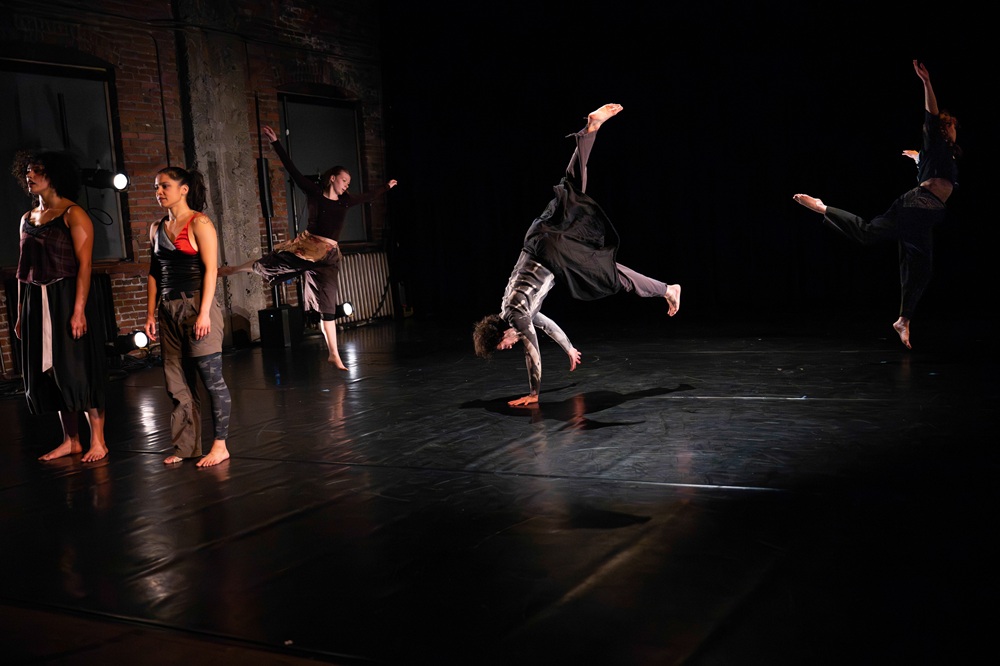
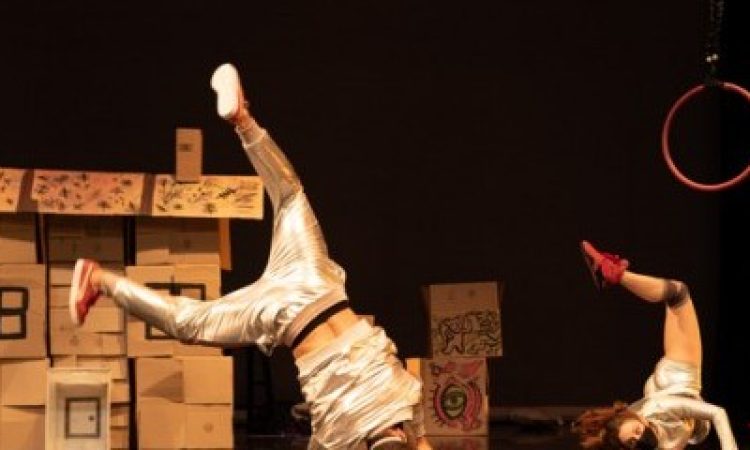
Mark Wong and Nicole Burgio of the surreal and sci-fi dance theater work, Myzrie House, wrote these questions into their show’s description. In the performance, part of the Cannonball Festival, they find themselves trapped in a dystopian world with no way out, dance moves they must perform on cue, and the occasional spontaneous appearance of new red shoes, shiny silver clothing, or an apple.
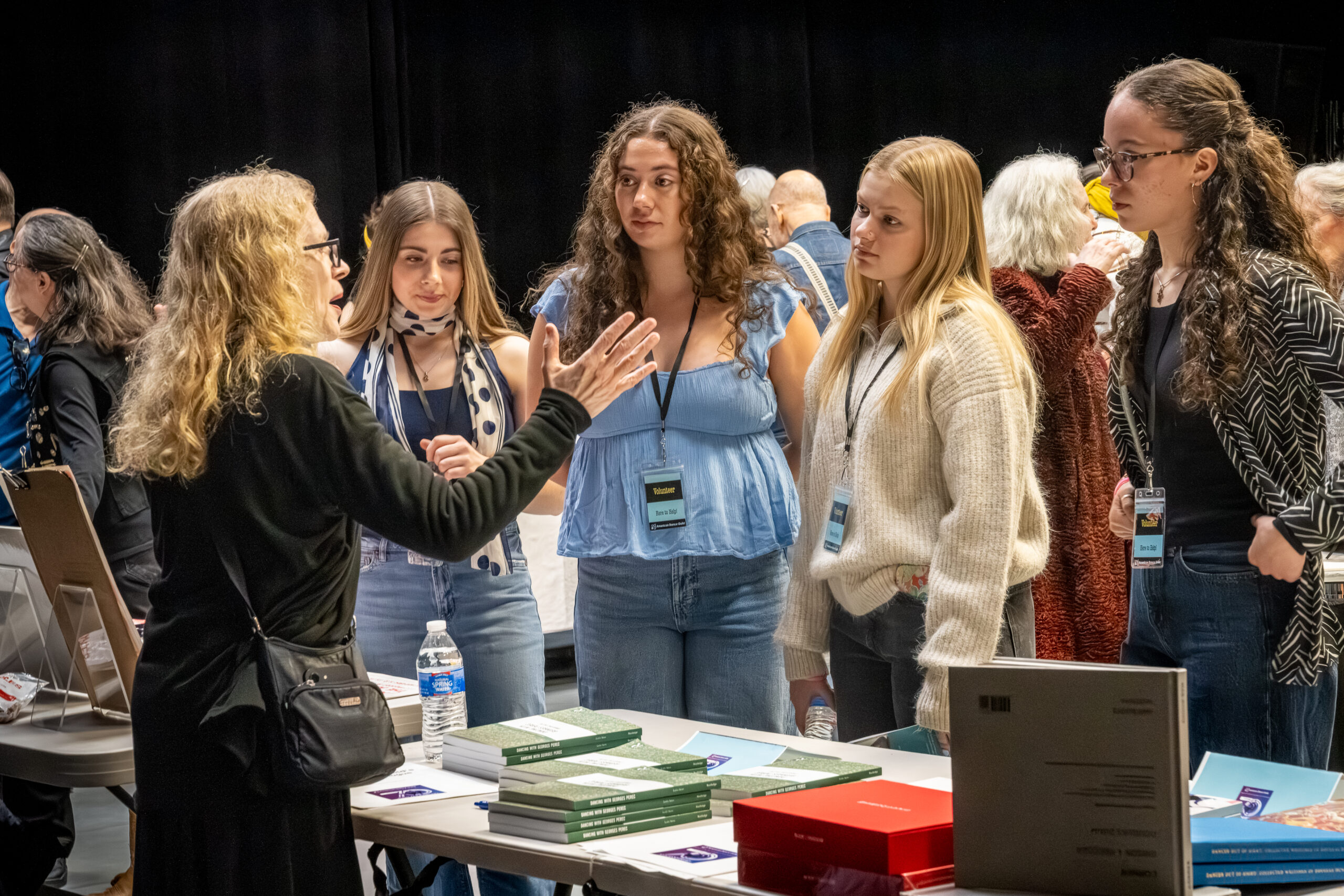
I met with audience members in the MAAS Building after the show for a Write Back Atcha. We started by recreating in our own bodies some of the shapes and gestures we remembered:
Burgio cheekily pointing over her shoulder at Wong’s impressive freeze, balanced on his hands with legs frozen in the air
Two fists thrust into the air, part of Wong and Burgio’s repeated flash dance
Burgio’s disgusted face as she tries to eat the strange beige paste Wong offers her
With these moments in our memories and bodies, we read through some of the performers’ questions and asked some of our own:
How does the retro alien abduction film at the beginning fit in? How did they get there? Do they have to do it all again at the end of the show?
These questions formed the basis of our reflections, which centered on the mysteries of the scenario and the strength of the relationship depicted in the show. Here is what we wrote:
I think the aliens were watching them, studying them, manipulating them, crossing the boundaries. They cannot escape, and will play all of the roles again, as the aliens manipulate their memories and repeat the experiments. Astounding storytelling with a total absence of text, written or spoken.
- Thomas Flaherty
Based on the video in the beginning, I thought most of humanity was killed by robots and either they escaped or were caught. The repetitive dance phrase revealed they were being controlled by something (either knowingly or unknowingly).
- Michelle Baker
Trapped in a video game.
There was so much joy and connection in their struggles to “level up.” It felt like they were existing in the “trapped” world. Then the clock would flash and they had a mission to complete. Then the mission would melt into their own agenda and then the clock would go again.
- Katherine Kiefer Stark
Are these aliens keeping them as pets? Are they a part of a game for entertainment? With each evolution of relating – aloneness, longing, discovery, unfamiliarity, playfulness, destruction, and euphoria– they play the humanity. With each offering–a bit of clothing, a bit of food–they discover who they are. Clamoring, and sweating, striving to stay as human as possible. Where is my humanness? In the throws, tosses, spins, and synchronized flash dances.
- Janna Meiring
What is their relationship?
Everything is fluid, nothing is static, change is inevitable. Witnessing so much push and pull– literally and figuratively– calls the nature of this relationship into question. Are they already a partnership living through stress and turmoil, seeing different perspectives yet ultimately loving one another? Are they strangers wrought with frustration upon meeting who come to appreciate a person with whom they can share their time? Are they cosmically connected? Their mirrored movements reveal how the two are bonded– through the fun and the highs as well as the fights and the lows.
- Sarah Moser
The entrance of Cole into the house is exciting to Mark, who has clearly been there for a really long time. He breaks her down and teaches her how to play, how to dance. She comes from an outside that is rigid, destroyed, and unimaginative. They create a world of magic by the constraints of their space. But it is also sad because they aren’t free. They are forced to be there and fighting over scarcity also creates turmoil between them. They are able to resolve this issue because of the compassion they have for one another. The intense physicality and skill brings my heartrate up and brings my body into the performance.
- Amalia Colón-Nava
Myzrie House, Nicole Burgio & Mark Wong, Cannonball Festival, Philadelphia Fringearts Festival, MAAS Building Studio, Sept. 22-25.
*Special thanks to tD’s Whitney Weinstein for preparing the prompts for this Write Back Atcha.