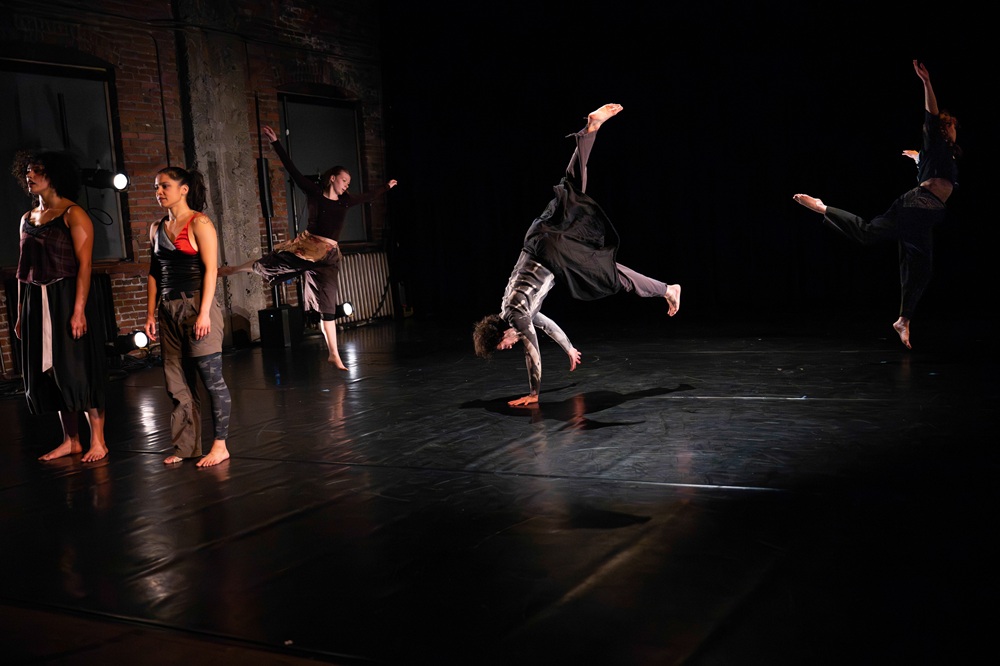
Shavon Norris’ latest solo work in the Cannonball Festival is a tour-de-force that is courageous, hilarious, and deeply moving. The mouthful of a title, Me and Jesus and Prince and Captain Jean Luc Picard in a One Bedroom apartment in the Bronx, captures Norris’ rigorous excavation and embrace of a multilayered selfhood.
We begin with home. A row of old cassette tapes, a Star Trek figurine, a wooden cross, family photographs, stacked Octavia Butler books, a candle, and a chair activate the MAAS studio space. Norris enters and slowly takes us in with her gaze. She welcomes the ancestors, the healing power of Vaseline, prayer, oxtails, durags, and the Black girl sounds and postures of her becoming. The breadth of inclusion becomes incantatory and elicits audible affirmations from the audience. Meeting us in her full context, she challenges us to acknowledge all of the pieces that bring us into being.
Norris embeds visceral memory and meaning into the ordinary details of a game of spades, Chinese food, a mother summoning you for dinner by yelling out the window. She somaticizes Prince’s music, which she feels sometimes in the neck, gut, or as an ache in her most tender parts. His “Joy in Repetition” summons in her a repetitive gestural language that slides into trance. She invokes Science Fiction and a Black futurity: “My people, we got plans!” She transports us to the pews of a dimly lit church and our heads bow as a deaconess leads prayer.
Norris has an unabashed truthfulness, made more compelling by a comedic precision that draws back the theatrical veil to comment on the moment. I laugh as she takes us to the Bronx, mapping her entire apartment on her palm. “It’s theater!” she quips. This solo is precious, but not too precious. Throughout, I found my eyes moist with tears, body leant forward, and murmurs of recognition on my tongue.
At last Norris delivers us to Uncle Timmy, who introduced her to dance and passed from AIDS complications. She must cross a well of grief that threatens to crack open the space. She must do this work with us—her grief, our grief. We are held in her labor as she crosses the stage, every movement sourced from a deep interiority. Her indelible dancing along this procession bursts and writhes with emotional force.
Norris is a masterful storyteller who uses memory, body, and breath to conjure ghosts of the past. I left the theater saying to my friend, “She is our Griot.” This is what art can do: make space for healing, a collective holding and cathartic joy. Norris reaches into and alchemizes her most intimate archives, and calls on us to bear withness. To quote Toni Morrison’s Beloved, “The pieces I am, she gather them and give them back to me in all the right order.”
Me and Jesus and Prince and Captain Jean-Luc Picard in a One Bedroom apartment in the Bronx, Shavon Norris, MAAS Building Studio, September 23-25,