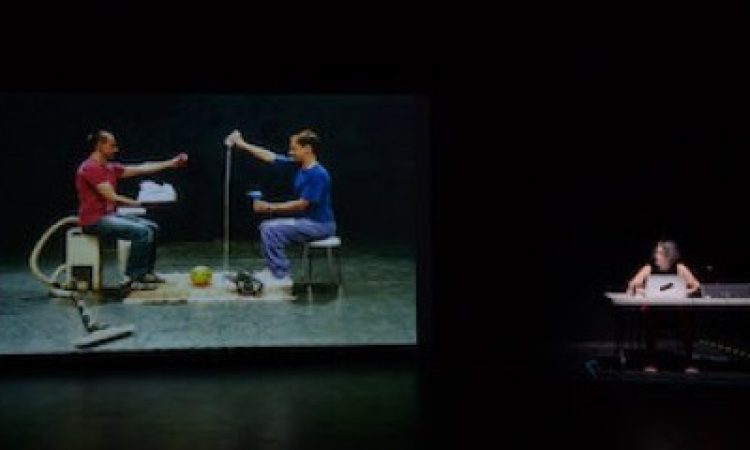
This new self-titled work by French choreographer Jérôme Bel consists of a lecture, archival footage of selected pieces from his body of work, and live dance performed by local Philadelphians. It is part of his portrait series and is experienced by watching Megan Bridge act in Bel’s place. She is seated at a table next to a projection screen with a lighting board and laptop. She speaks the first-person text and begins by introducing herself as Jérôme Bel. It’s a very candid and concise description of how he became a dancer and a choreographer and the genesis and progression of his work. He goes through a series of pieces and talks about how he made them, what he realized about himself, and dance in general. Like a lecture, Bridge gets up to demonstrate the text in images or join the live sections.
Bel’s practice feels more akin to a visual artist than a choreographer’s, and I can’t say why. Maybe it’s how he describes his process and the frequent absence of dance in his dances. His rigor and assertion that performance is the most beautiful thing on earth are consistent throughout as he grapples with keeping the personal out of his performances, only to find he is making work from his own experience all along.
The live dances included performers from the original premieres in previous years, new performers, and nondancers alike. They came out twice, the last time to perform his piece, Gala. With this one, you notice there can be joy in dancing. The tenderness of this joy caught me off guard, and I teared up. It sounded like the making of this piece is where he also found room for pleasure, for entertainment, even though he had been staunchly against entertaining. Bridge had self-assured energy and carried the two-hour piece through its parts seamlessly. Bel no longer travels by plane for ecological reasons. A side effect of this is a new method of making and showing. And here, the power of the spectacle he writes about for this piece is visible in the audience’s total acceptance of Bridge as Bel.
His text became more personal throughout, mirroring the trajectory of his work. In an honest interrogation of the self as a “choreographer, citizen, and person,” this piece worked through the desire to make performances and critique them simultaneously. It brought up how impossible it is to be merely formal and how humor is essential, along with joy, allowance, and childlike wonder. It was his retrospective in some sense and, to his consternation perhaps, a very entertaining one.
Jérôme Bel, Jérôme Bel with Megan Bridge, FringeArts, Philadelphia Fringe Festival, Sept. 29 – Oct. 2.
*Megan Bridge is a former writer and editor for thINKingDANCE.