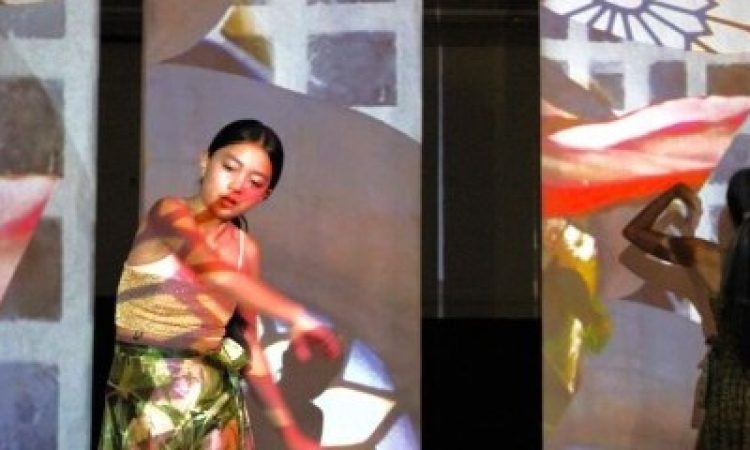
The world of Ani/MalayaWorks’ Tagong Yaman is colorful. Framing the entrance are large rectangular fabric banners featuring bright collages with images from the Philippines—fish, flowers, ancestors—swimming past each other over fields of neon pink. To the right is a long table of food—a mung bean stew, sweet buns that I think are filled with coconut. Next to the food, groups of children and adults are constructing parols: star shaped lanterns that hang in the window. During a gallery tour, Anito Gavino*, director of Ani/MalayaWorks, explains that parols are a holiday tradition across the Philippines.
Tagong Yaman, for Gavino, is about kapwa: community. It’s about the resilience and creativity of the community coming together to make something beautiful and true. It is also a response to colonization. Gavino specifically references the 1904 St. Louis Exhibition, which included a “model village” where Filipino people were instructed to perform a version of their lives for the entertainment of American viewers, shortly after the United States acquired the Philippines as a territory.
This reference is seen most directly in the use of the windows, one of which is now being activated by a Filipina dancer dressed in traditional garb. The entire installation and performance feels like a response, a retaking of the concept of the St. Louis exhibition. In this room a community of Filipino and Filipino-Americans come together to share their experiences of immigration, ancestry, and (be)longing. The stories and images are political and they are intimate.
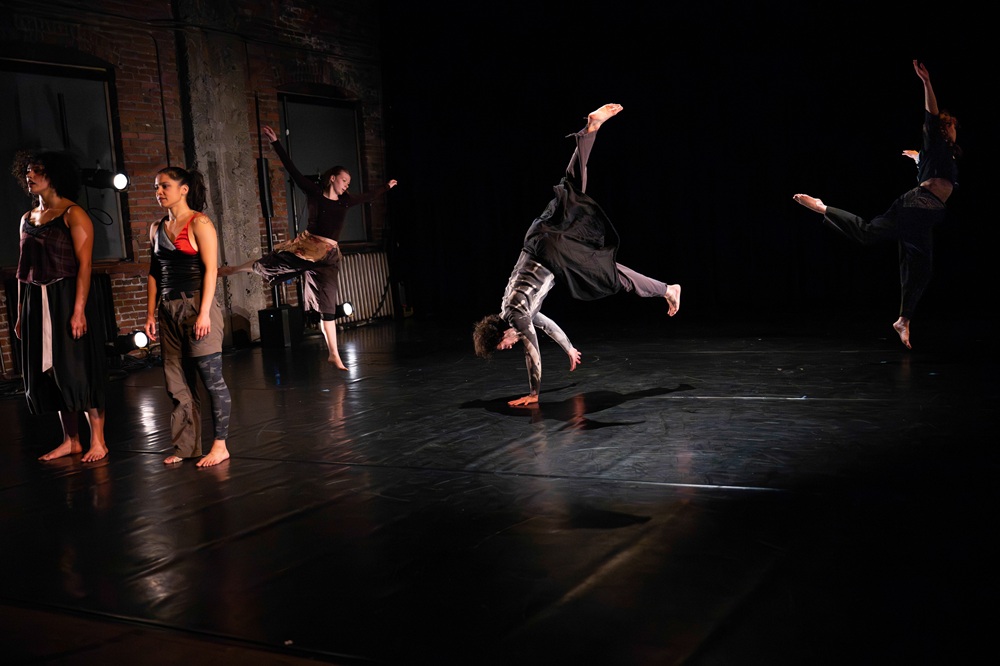
The performance begins casually. Gavino and their daughter/primary collaborator Malaya Ulan sit on the wooden dance floor that covers the carpet. Behind them hang several vertical panels of white cloth which are used as a surface for shifting projections by Brandon Aquino-Straus. Gavino, dressed in a camisole and bright wrap skirt, kneels at the front of the dance floor and begins to shake rice in a wide woven bowl. Ulan, dressed in a hoodie and ripped jeans, taps the edges of a stick broom against the floor. “Is it starting?” Ulan calls over her shoulder? “It’s been starting,” Gavino replies with a gentle laugh. They build a swishy, tickling rhythm and then kneel next to one another, facing forwards. Gavino performs a series of reaching gestures. Ulan watches and then repeats. As they continue this call and response, Gavino’s gestures grow frantic, emphasized with audible releases of breath. Ulan’s repetitions are more restrained—accurate re-embodiments of the pathway, but lacking the frenetic emotion present in her mother’s version. The intensity of Gavino’s offerings increase until a peak of propulsive waves of energy leave them spent, head laid on their daughter’s lap. Ulan strokes her mothers hair and begins to sing a lullaby. Gavino takes over the song, translates lyrics that affirm connection to the Philippines and to their native language. Ulan interrupts. “But I wasn’t born in the Philippines, I was born in the U.S.” “But I only speak English.” Gavino considers each point and then rewrites the lyrics, making room for Ulan’s experience. It is warm and funny and awkward; a family building a mythology that can hold their profoundly different experiences of immigration. Though this is just the beginning of the hour-long performance, the entire story is contained in this first movement. What comes next are beautiful, funny, and disturbing explorations of the nuances of this struggle to understand each other, America, and the Philippines.
A particularly notable moment was Gavino’s seeming possession by Sisa, a character from the Philippine author Dr. Jose Rizal’s revolutionary novel. As Sisa, they call for their murdered sons, recount their sexual assault by a Spanish priest, fling their body across the space and onto the floor. The words and movements seem to burst out of their skin, a compulsion to speak, a compulsion to show, their eyes scanning a landscape invisible to the rest of us. Ulan looks on, at first trying to call back her mother and then just witnessing alongside us. Her presence on stage attunes me not just to the story of Sisa’s trauma but also to the experience of descendants trying to make sense of their ancestors’ trauma, trying to understand the impact of these experiences on their parents and on themselves.
The piece concludes with the cast sitting on stage in a large circle. Gavino invites the audience to join the circle, to start a conversation. I am too full of thoughts and feelings to jump right into that invitation, and I think that many in the audience felt similarly. Rather than a circle, the event turns into something more like a party with the audience and artists moving about the space, getting second helpings of food, and processing what was shared. When I go to leave, there is still a crowd, or perhaps, as Gavino opened the piece with, a Philly kapwa. This village of sorts, a community of Filipino artists, came together to re-center their authentic experiences, to grapple with the impact of the American imaginary, and to extend an invitation to witness to the wider community of Philadelphia.
Tagong Yaman, Ani/MalayaWorks, Painted Bride West Philly, December 3 & 4.
*Gavino is a writer with thINKingDANCE.