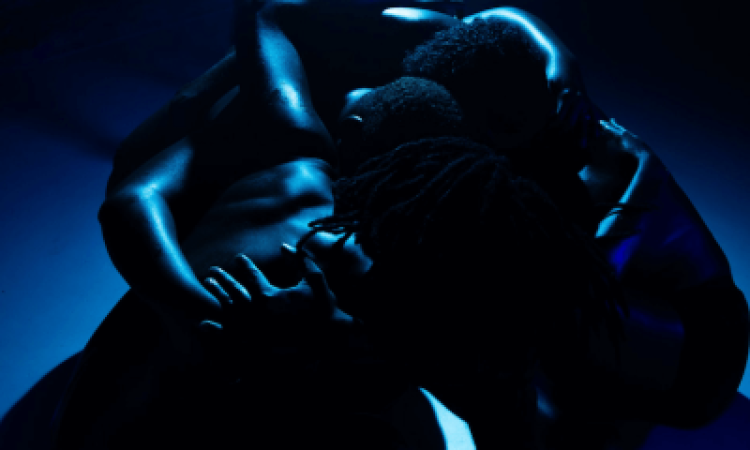
Everyone is given their own keychain flashlight as they enter the theater, and advised that they’ll need to use it. Little blue lights flitter about the space as I fiddle with the switch of my own. Audience members talk amongst themselves as they settle into the U of chairs that rings the stage, seemingly oblivious to the umbrous figure crawling in the upstage corner.
Fog and guttural sounds inaugurate the performance of Angel Shanel Edwards, Jonathan Gonzalez, and Marguerite Angelica Monique Hemmings ‘ xxJAMxx, gradually developing into whistles, laughter, ambiguous directions and wry commentary from the three performers who are dispersed around the theater: “Stop.” “Give it.” “That’s weird.” “Bitch.” Action, however opaque, is happening in the periphery, and in order to witness it, we must rely on our fellow audience members to light the scenes that don’t take place in our immediate vicinity. Even in moments when every flashlight is pointed toward a performer, they aren’t quite bright enough to offer transparency. The agency we were endowed with upon entering the space is quickly proven ineffectual.
An ongoing dialogue, both spoken and physical, runs through the piece alongside sporadic meta-commentary. We rarely see the performers’ faces, but their voices are full of personality, and manifest the instability of language as meanings change with the repetition of certain words and phrases. One performer tells us that we’ve all been “officially initiated,” and can no longer say we’re not part of it (reminiscent of the powerful Foucauldian notion that no one is outside history.) They lay on their backs and fling their legs in the air like overturned roaches, and in the shadowplay of their flashlights, they flip the bird and cross their fingers to the audience’s delight.
A projection of Fred Holland and Ishmael Houston-Jones dancing their “Wrong” Contact Manifesto from 1983 lights up a small rectangle of the back wall, and the physical turn of my head heightens the feeling of going back in time. The performers take their time rolling awkwardly down the center aisle, the projection seeming to bring them together both physically and aesthetically. Wearing street clothes and sneakers, they share weight and perform lifts that are more precarious and effortful than affected. Their intensity matches that of Holland and Houston-Jones, and they appear to be engaged in an internal communication that we can’t understand. It feels like anything might happen, but it doesn’t. Is this restraint or indulgence and must they be opposite?
R&B music comes in and the packed house bops. Two of the performers develop and rehearse short, playful dance phrases on stage. They groove through rows of chairs, their energy inspiring audience members to flash their lights in excitement. Soon clothes are coming off. The movement turns showy and hypersexualized, and the dancers grind on and hump one another and their surroundings. In one memorable moment, two dancers perform a duet so laden with innuendo that it’s more erotic than the piece’s other moments of direct contact.
“Don’t stop. More.” But it’s becoming less fun. A matador parody leads to a chest-to-chest mid-air collision, which culminates in a protracted simulated orgasm, the dancers’ bodies vibrating at exceptional speeds. The projection continues to loop behind the audience all the while, but no one seems to notice. “There’s more, there’s more, there’s so much more.” Among other things, I read this section as a representation of the chronic oversexualization of POC, and a commentary on the toxic expectation that Black people never get tired.
The performers huddle up, bare butts exposed to the crowd as they try to find an ending. “This is a responsive performance. Do y’all want more?” The audience says yes, thirsty (both literally and figuratively) for the performers’ sweat. The piece ends only because time is up and the space must be prepared for the next show. Standing ovation.
xxJAMxx, Jonathan Gonzalez, Angel Shanel Edwards, Marguerite Angelica Monique Hemmings, The Icebox Project Space, Cannonball Festival, Philly Fringe Festival, September 3,11,15.