A prologue: darkness.
One spotlight all the way downstage. Dancer Doug LeCours is at the edge of its beam, outside of the shape it casts on the floor. His torso melts over his legs, bending at the waist. Each time he comes up, he exhales vapor into the light. There is a voice-over that I can’t hear well enough to understand, but through repetition, I accept it as part of this ritual. Bend, stand, exhale, voice, bend, stand, exhale…Breath made visible. It leaves the body. There is a softly howling wind. The La Mama theater feels like a vault of air currents, and when he backs away and the light goes out, I have my first glimpse of Hebel, the Hebrew word for “vapor” or “breath” in Ecclesiastes: the fleeting nature of things.
HEBEL, Pavel Zuštiak’s interdisciplinary performance work in three scenes, was to have premiered in the spring of 2020, but the pandemic struck. After three years, the same creative team is back, and the energy and dedication to the work are starkly evident.
Scene one: A soundstage/life stage.
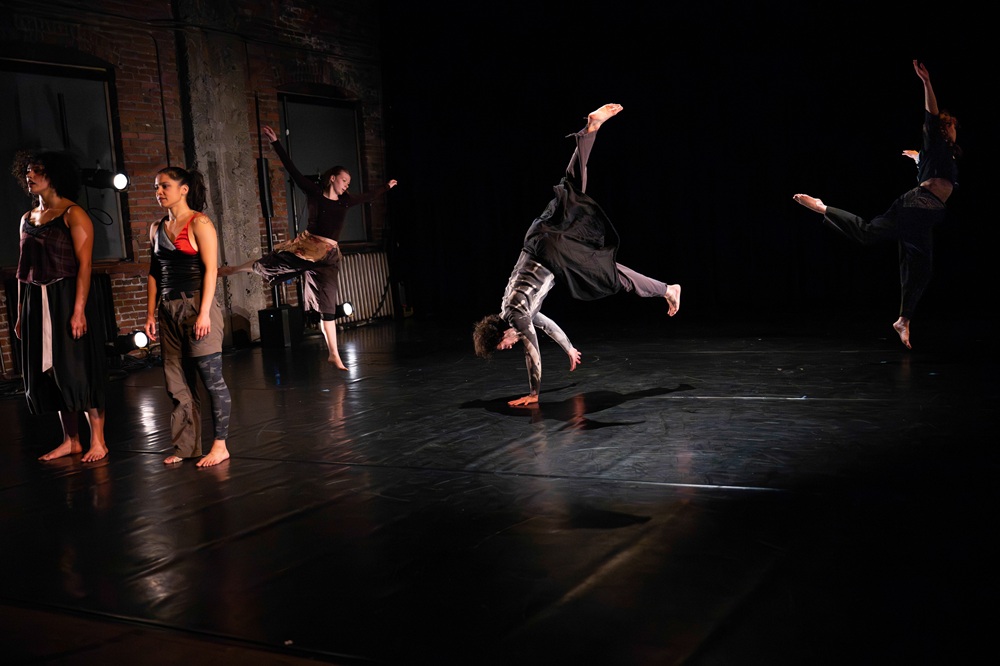
Layers of breath, movement, wind, and sound design build up over time. Dancers enter one after the other. Christine Bonansea, Wendell Gray II, Emma Judkins, and LeCours are all in blue full-bodysuits. Two giant blue pieces of fabric hang from above. A blue wall panel the size of a door is upstage and to the right. Recognizable objects are scattered about, all of them blue: hockey sticks, a cooler, something like a fishing pole. Initially, every time an object gets picked up or put down, a sound effect plays. The dancers explore what each object can do. They are playful and curious. They switch effortlessly between identifiable tasks and something more abstract. They pose, smoke, mime, pick up dishes like a waiter, and use the hockey sticks as guns or guitars. They also gesture, roll, create shapes, and repeat. Supertitle text is projected on the back wall at times, and a disembodied voice reads them out –“Ext Lunar Landscape Night” or “Int The Comfort of your Own Home.”The words contextualize the movements and play, the poses and asides, miming, and attitudes. The whole piece jumps between images of interior/exterior, day/night, task/futile gesture, and dance/posing.
A transition: the fabric falls.
First one and then the other. The dancers’ movement becomes increasingly more ritualistic, slowed down, as they form a procession moving downstage toward the audience. The phases within this first scene seem a microcosm of life’s trajectory, or a day even. It ends by nonchalantly losing the momentum it had built up.
Scene two: eclipse.
A large disk hanging above the stage begins to turn upright, one side gold, the other black. Around it is a large metal ring lit within. Their smooth and swirling rotations become trance-like. Then, mounting sounds of thunder rumbles and metallic slices. My notes read, “Something coming? Something destroyed? Slice rumble ring. Darker red, smoke or dust, the metal, slice, just darkness, and this thing, is it terrible or just powerful? Alarms sound.” But the alarms are actually the real fire alarms for the building, and blinking, we come out of our trance. We are ushered outside while the haze from the piece is cleared and the fire department does its due diligence. The dancers return and, unfazed, continue a work that had survived a prior three-year interruption.
Scene three: Golden light.
The dancers trickle in, new costumes of mismatched golds and sparkles, fringes, camo, and colors. Constant gentle rolling movements — crossing legs, large sweeping circular kicks and steps, hands making shapes around the body, opening and closing the arms and legs across the body, bending and reaching, folding, and unfolding, in various forms of plié. Sideways steps. Tiptoeing. There is less pageantry and purpose. Less of the energy of doing or completing. Every movement has a gentle patience, added to a structure that feels like unison but without it. Specific hands, shapes, and gestures pop around the space, a carefully constructed choreographic layering that is complex while still allowing for air, time, and this ceaseless quiet.
An epilogue: darkness.
Lowering lights. Wind sounds softly hollow. Dark forms melting, drifting, torsos softening over limbs, a dark garden of wilting bodies, becoming quiet.
What do tasks, pageantry, rituals, the majestic and mundane have to do with one another? How was it so tender and human while so abstract and leaning towards the symbolic? These exist simultaneously in the piece but without feeling disjointed.
All of it is true at once. All of it will be gone quickly and quietly. All is hebel.
HEBEL, Palissimo Company, Ellen Stewart Theater, LaMama, Oct. 19-22.