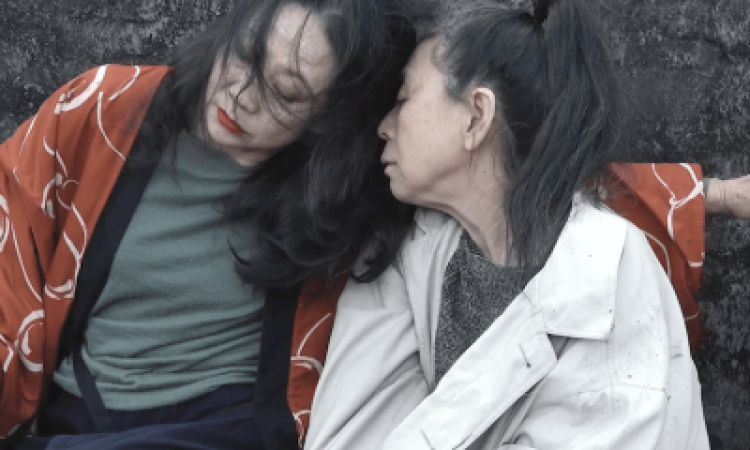
No Rule is Our Rule is a 73-minute film telling the life history, artistic interactions, and friendship between two Asian female artists, Eiko Otake and Wen Hui, through the story of Eiko’s two-week visit to China in January 2020. Born in postwar Japan (1945-) and during China’s Cultural Revolution (1966-1976), respectively, their distinct cultural memories intersect in the shared trauma of the Sino-Japanese War (1937-1945) and the Covid pandemic beginning in early 2020 China.
The film begins with a clip of Eiko sitting in a wheelchair on her arrival at Beijing airport to visit Wen Hui. The marble floor and the busy restaurants with Chinese names in the film recall my own numerous departures and arrivals at the airport, and engender a comforting familiarity and nostalgia in me. At Wen Hui’s home in Beijing, the two artists’ conversation becomes an oral history that introduces their lived experiences in China and Japan and how national politics impacted their artistic journeys.
While growing up in the dehumanizing violence of the Cultural Revolution, which emphasized the class struggle between socialism and capitalism, Wen Hui later studied traditional Chinese dance and choreography at Beijing Dance Academy within the context of China’s economic reform of the 1980s. Through the lens of feminism, her avant-garde choreography criticizes China’s sociopolitical movements from the One-Child Policy since the 1980s to radical urbanization in Beijing since 2000. Similarly, Eiko’s artistic experimentation after she moved to New York in 1976 also speaks to social, environmental, and gender issues as a way of promoting change and self-exploration. While exchanging their artistic journeys, Eiko and Wen Hui’s conversation becomes the voiceover to a montage of their old family photos and early dance productions.
By diachronically displaying Eiko’s trip to China, the documentary emphasizes Eiko and Wen Hui’s self-reflexivity through their private conversations, public speeches, and the embodiment of cultural memory. What struck me most was Eiko and Wen Hui’s visit to the Nanjing Massacre Museum, a place to commemorate the over 300,000 victims of the Nanjing Massacre during the Sino-Japanese War in 1937. As a woman who was born and raised in China, I was indoctrinated to believe in a Chinese history of humiliation which included a hatred of Japan from its military colonial rule in China. While neither I nor the two artists in the film had experienced this cruel war, the mass rape during the massacre became a national trauma inscribed in all Chinese and Japanese female bodies. As Wen Hui and Eiko note, “Our body memorizes” and “dance and art are transformative.” For me, Eiko’s proposal to visit Nanjing and her apology for the Japanese invasion helps to heal the deep wounds left by this shared history.
Toward the end of the trip, Wen Hui takes Eiko to her hometown in Yunnan, a province in southwest China. It is here in the Stone Forest National Park that Eiko and Wen Hui film their duet with Wen Hui’s mother also joining their improvisation. However, their creative schedule gets disrupted by the unpredictable outbreak of the Covid virus in China. The clips of the news on television intersect with phone messages about public spaces shutting down. The artists’ anxiety brings back my own pandemic memory and embodiment. Looking at the propagandist television program in the film that celebrates the government’s “excellent work” in controlling the COVID-19 virus, my tightened muscles and cramping guts embody the irrational lockdown in China during the pandemic, which contrasts the glorification on the television. The film ends with Eiko’s rapid departure from Yunnan airport to Japan and the emotional farewell between her and Wen Hui’s family.
The abrupt ending of No Rule is Our Rule echoes the way in which the pandemic disrupts our everyday lives. Although the film does not continue to tell Eiko and Wen Hui’s story after they separated, it leaves us an enormous reflexive space to recall our shared body memories during the pandemic.
No Rule is Our Rule, Wen Hui, Eiko Otake, Yiru Chen, Asian Arts Initiative, Nov. 4.
No Rule is Our Rule will also be screening in New York City at Asia Society, on Dec. 9, 2023, followed by a discussion with the artists.