In one of the most highly anticipated programs of New York’s fall season, The Rite of Spring / common ground[s] at the Park Avenue Armory delivers a powerful split bill housed within the massive New York City performance venue.
Pina Bausch’s Rite is preceded by the calm and gentle duet, common ground[s], performed by the acclaimed Germaine Acogny, whom is considered the mother of contemporary African dance, and Malou Airaudo, a former dancer with Bausch and Tanztheater Wuppertal. The performers, both in their mid-to-late-70s, begin with their backs to the audience, exposed by the deep cut of their black gowns. A long stick becomes a point of connection as the pair softly explores the space and one another. In the audience, we sink into the space, expertly framed by the expansive yet soft lighting design of Zeynep Kepekli, as we bear witness to the velvety somber duet. Seated about halfway deep in the crowd, I lean in to ‘zoom in’ to the duo. I squint, shift, and examine. I want to be closer, yearning for more intimacy with the performers than the massive space of the Armory will allow.
Bausch’s The Rite of Spring follows the duet. Restaged by Jo Ann Endicott, Jorge Puerta Armenta, and Clémente Deluy, the iconic work is performed by a remarkable cast assembled from 14 African countries. Before the start of Rite the intermission is filled with a choreography of its own. Several large bins of soil are wheeled onto the stage by a focused stage crew, and raked across the platform to form a neatly organized square of lush peat.
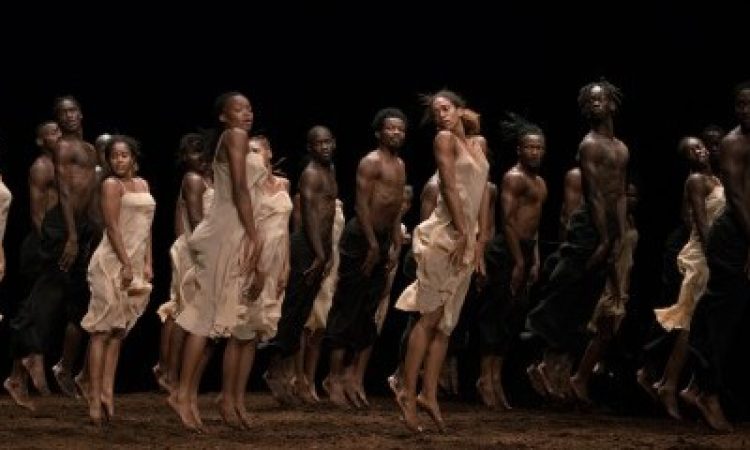
As the cast of Rite takes the stage, they tear their way through the space. Spilling onto the soil, the dancers build moments of organized chaos, which quickly dissipate. Assembling then vanishing, the dancers jump, shake, twist, and sprint through the space as they take command. Building in intensity, the group passes around a red slip dress, deciding who amongst them must be sacrificed. The men lurk as the women panic. Passing the garment off again, again, and again, the chosen one is finally selected. In her final moments of frenzy, she embodies Bausch’s driving question: “How would you dance, if you knew you were going to die?” Eventually, she collapses, consumed by the soil.
Bausch’s foreboding Rite, originally choreographed in 1975, feels more relevant than ever. In their fight for survival, the dancers expand and contract through the chaos, searching for a calm that will not come. Perhaps the preceding sereneness of common ground[s] was a premonition of just this. In conversation with one another, the works ask: When we cannot wait for an impossible calm, is our only choice to dance as if we know we are going to die?
Home Page Image Description: Germaine Acogny, a mid-70s Black woman with a tightly shaved head wearing a long black gown, is held from behind by Malou Airaudo, a mid-70s white woman with light brown tied back hair wearing a similar black gown. Acogny looks out into the distance while Airaudo looks downward over Acogny’s right shoulder.
Article Page Image Description: A large cast of over 20 Black dancers jump above a ground of soil, tightly holding their arms at their sides. They lean their heads over their right shoulders with a severe facial expression. The femme dancers wear light brown slips, and the masculine dancers wear black pants with bare torsos.
The Right of Spring / common ground[s], A Pina Bausch Foundation, École des Sables, and Sadler’s Wells production, Park Avenue Armory, Nov. 29 – Dec. 14.