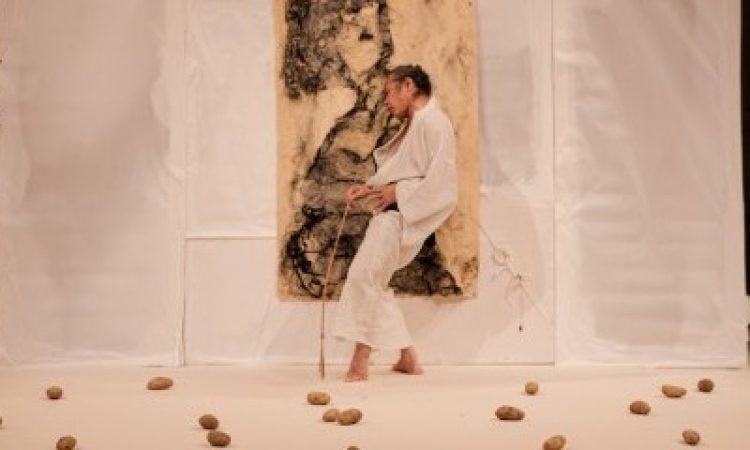
Koma Otake slowly shuffles backward from the shadows into the dance space at St. Mark’s Church. The floor is covered in stretched fabric scattered with potatoes. A warm, white light softens everything, including three panels of paper screens and a painting. Otake carries a burlap sack and lifts it over his head with great effort. When he reaches the center, he shakes it down his back. More potatoes fall out of the sack, hitting the floor with staccato thuds.
The recorded voice of Viviane Eng reads from Otake’s choreographic notes before he enters. We learn that the potatoes are bombs but also dead bodies. We learn that he has danced with various ‘you.’ What unfolds before us is an homage to all the You he has danced with throughout his life: alive or dead, real or imagined. He seems to be mourning but also making peace. He yells in Japanese, weeps, poses, and dances like one pretending to do a ballroom dance with a partner. It is not a waltz, though. We hear a tango. He plays at the edges of absurdity, balancing out the heavier places and the palpable nostalgia. I know there is pain here, loss, rage, and struggle. I see it in his face, the crumpled weeping shapes, the strained breathing, the yelling, the breaking apart of the set pieces, the way he slowly undresses and bares himself, removing the Kimono and Western shoes without laces.
He pushes himself to all his edges. His tired one, his angry one, the edges of his sorrow, the edge of his age which brings with it perhaps regret and longing, the places where futile behavior or tasks become funny even when you know they must feel quite hopeless and empty. He seems to be running through an intense series of memories, soaking in them, getting lost in them. He perches on the edge of the chair, supporting most of his weight with his legs curled under him. He tilts the edges of the painting off center, ultimately cutting it down. He grabs the corner of the fabric on the floor and pulls it from where it’s taped down, rolling himself up and destroying the edge of his performance space. He even seems to walk while favoring his weight to the outer edges of his feet.
The tango music, Ciego and Coqueta, fades in and out a few times. Otake slides and steps, placing his feet at angles that force his hips to tilt and his spine to twist, wring out, and straighten. Spiraling around the space, he nearly misses most of the potatoes, hitting others, sending them away from him, arms out to his sides, bending, stepping, turning, and shifting his weight. He dances a partnerless tango about who and what he has danced with. He dances with his memories and his shared stories, with his bombs, with his body, with the bodies of those not there. He looks very alone. There is a quietness in the space when the music isn’t playing. He interacts with the set as he destroys it. At one moment, he pats his body with a sponge soaked in white makeup–perhaps a nod to more traditional butoh performance. All of these moments look private, and I forget I am sitting in an audience, that he is being viewed. And each time I would think, “This is serious, sad, and pulsing with loneliness,” he would do something like tip himself into the hole he made in the panel and bare his bottom to us in a farcical gesture. He reminds us that it is possible to grieve, remember, and have humor simultaneously.
Maybe he is playing with our edges, too. What will we watch, and how much of his internal process can we experience? What will we nod to? What will we understand? What will cause a startled laugh? And what will we not at all understand but still accept?
Otake says, “You is a dance of ‘I have nothing.’” I believe him. He seems alone, but he carries so much from his life in his body, making it so visible. He is so full of all this, breathing it toward us, that I have difficulty not adding the word ‘here’ to the end of his sentence. “I have nothing here.”
It ends quietly with Otake moving like he is worn out and worn down. Somehow lost, everything a little broken, seeming to have unraveled. He lies next to his painting. The lights fade.
You, Koma Otake, Danspace Project, Dec. 14-16