Presented by The Leadership Network for Accessible Arts Education, Christopher “Unpezverde” Núñez’s YO OBSOLETE offers a meditation on imagination as survival. Núñez, a visually impaired choreographer and dancer, begins with eyes closed. He calls on an inner voice, Carlito, to help take the audience on a journey of survival. Acting as a guide in the near 30-minute film, Núñez immerses the audience through on-screen movement and continuous voiceover that combines narrative, audio description, imagination, and memory.
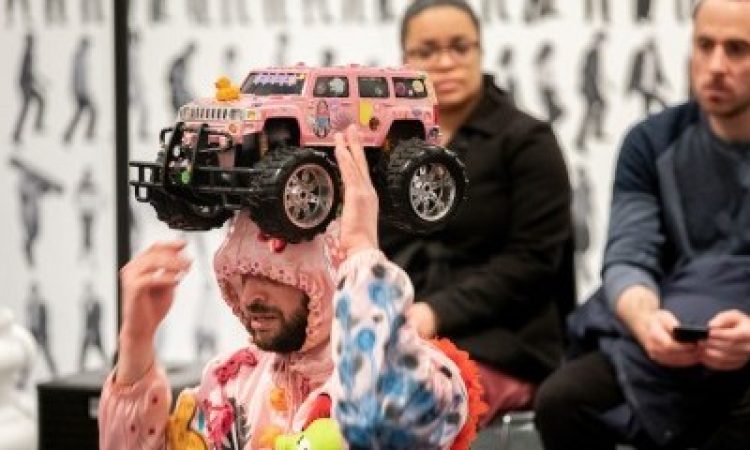
Wearing a light pink windbreaker adorned with patches, embellishments, and pop-art paintings, Núñez moves through a vast white room, framed by long strips of pink ribbon with eclectic personal artifacts lining the walls and floor beneath him. The collage-like installation of objects is abundant with references to a queer and disabled childhood. In this world, Núñez and Carlito become archeologists of their imagination and ancestral memory. Núñez balances a pink toy truck on his head, as he spins, expanding and contracting through the space; recalling memories of childhood trauma, violence, and desire. In conversation with one another, Christopher and Carlito (whose pointy high-pitched voice contrasts the deep silkiness of Núñez) offer one another memories, movement prompts, and sanctuary from the trauma through a voiced exchange. The narrative voice-over, interspersed with more literal audio descriptions of Núñez’s movement, acts as both a source of survival and inspiration. Spinning, reaching, and breathing.
As Núñez transverses through the room, he drags the toy truck behind him, knocking down the installation of hand-drawn images, posters, and trinkets. He recalls his childhood desires, I want to feel safe, to play, fried chicken, to be hugged, pink flowers, a pink dress, a barbie… but instead he remembers a childhood that gave him boxing gloves and violence. His final ask, I wanted to talk to my mom, conjures his mothers voice into the soundscape. She appears briefly as a raspy Spanish-speaking voice, before disappearing and leaving Núñez and Carlito alone to protect each other once again.
Núñez spins underneath himself, around and around and around and around, he breathes deeply, trusting his imagination to guide him. Here, he finds his own path to survival. Seamlessly blending together narrative and more traditional description, Núñez invites the audience to close our eyes with him, tapping into our own imaginative memory. Together, we survive.
YO OBSOLETE, Christopher “Unpezverde” Núñez, The Leadership Network for Accessible Arts Education, Jan. 19.
Homepage image: Ground level, two objects confront each other. On the left is a pink melodica and on the right is a pink remote control toy truck. Behind is a bright pink ribbon, leaving a trace of color. This image is from a live performance adaptation of YO OBSOLETE.
Article image: Christopher “Unpezverde” Núñez balances the pink remote control car on his head as a crown. In the background, two audience members admire him. This image is from a live performance adaptation of YO OBSOLETE.