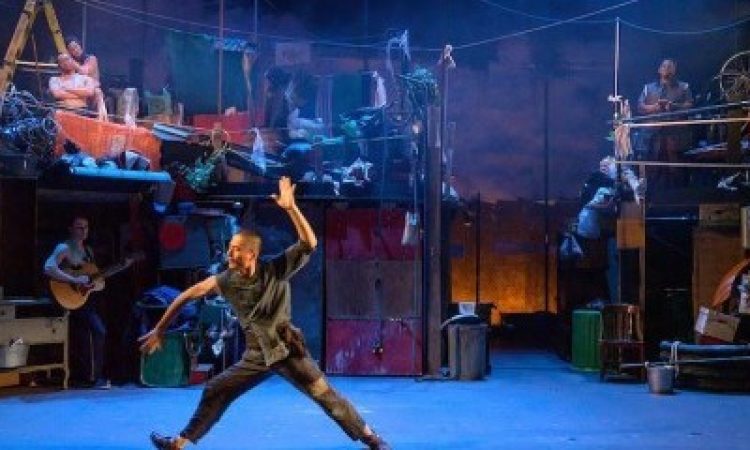
Director Justin Jain’s production of Bertolt Brecht’s The Good Person of Setzuan is a prime exemplar of the Wilma’s HotHouse company of performers, created by Wilma co-founder Blanka Zizka almost a decade ago, and stands as their inventive, 21st century response to Brecht’s work. Jain, an original HotHouse member, is the first company member to direct on the Wilma stage.
This was one of the best US Brecht productions I’ve seen in a long theater-going career. It was messy, loud, and long (just short of four hours). The volume and length were challenges but I was excited that it seems to have been particularly successful as an introduction to Brecht for younger audiences. I attribute this success to the HotHouse aesthetic, which is visually eclectic and boldly kinetic, willing to change styles from scene to scene.
Any production of Good Person depends in large part on the title role, the good-hearted sex worker Shen Te, who is forced to take on the role of an invented male cousin, the hard-hearted Shui Ta. Shen Te is an uncharacteristically sympathetic role within Brecht’s work — “in order to be a good person she must first be a real person,” he wrote in his journal. Shui Ta, on the other hand, must be macho enough to power through business dealings. Bi Jean Ngo triumphs at this challenging task, with distinct physical and vocal characterization. To further differentiate the two characters, Ngo has translated many of Shui Ta’s lines and speaks them in Vietnamese, a crisp contrast to Shen Te’s English. Her performance here propels her into the top rank of Philadelphia actors.
Backing Ngo is an ensemble of eight actors, two onstage musicians (and a couple of mannequins). Apart from Makoto Hirano and Jungwoong Kim, the actors are long-time members of the HotHouse company who perform a multitude of roles in a style full of bold, non-naturalistic movement and vocal choices. As a result of years of working together and with a wide range of noted US and international directors and teachers, HotHouse has produced a generation of Philadelphia actors who share a theatrical vocabulary and trust in one another that is very rare in US regional theaters. This allowed Jain and his company to create and perform such a highly stylized, physical production, including several ensemble dances, without a designated choreographer or movement director. In Good Person, this shared experience also results in an aesthetic vision as original as Brecht’s.
Kim’s performance was perhaps Jain’s boldest conceptual choice. Kim has led multiple movement workshops for the HotHouse company and has made his mark in the Philadelphia dance scene. He speaks almost all Wang’s lines in Korean (with another actor or singer providing the English translation). Both times I watched the production, I found the combination of words and movement worked most strongly when the actor was in closest proximity to Kim. But throughout, Kim’s sinuous and evocative physicalization –- sometimes an enhanced interaction with other characters, other times an abstracted illustration, as when he described a hovel “crawling with spiders” and the audience could “see” them teeming over his body–he carried the gist and engaged the audience’s attention. Like Ngo’s performance, Kim’s performance should draw much more attention to an extraordinary Philadelphia-based artist. It should be added that both these casting choices arose from Jain’s determination to center this production around highlighting Asian and Pacific Islander (AAPI) representation confronting Western orientalist stereotypes, something Brecht would have heartily approved.
Jain has succesfully brought about elements of Brecht’s play that are timely and urgent. One of Brecht’s pithiest summaries of his theatrical goals came in a note to the cast of a play he directed: “Our theatre must inspire joy in the act of realization, guide people’s pleasure in changing reality.” This production largely succeeds at the first half of this goal, but falls short at the more challenging second half.
At the heart of Good Person is the impossibility of living an ethical life under capitalism. For Brecht, being a “good person” individually is at best irrelevant, at worst (Shen Te as exemplar) self-abuse, and Shui Ta’s attempts to protect Shen Te by “rationalizing” her tobacco business makes things worse for everyone. Brecht does not show us an alternative within the narrative; instead he tries to draw the audience’s attention to the absence of collective action, of the ways in which enforced inequality leads to a “hustle culture” in which working people fight and undermine one another rather than identifying the root causes of their misery. Many of these moments felt undercut or buried by stylistic choices, particularly in the songs, where muddy mixing in performance often obscured the words. This is particularly true of the “Song of the Eight Elephants” and the scene preceding it.
In any thematically-charged production, audience members are most likely to take away basically what they bring to it. But Good Person of Setzuan ends with Brecht’s challenge to its viewers “to make it your jobs to defend/the good of the world . . .For the world must be happy. It must, must, must.” I have seen three productions of this play, the first of which had a strong influence on both my career and political values. In each production, these final lines resonated on the audience. Never have they felt so urgent. In the Wilma’s production, they are not spoken but sung (beautifully) by Jordan McCree in a melody so sweet that it felt like a bow wrapping up the evening, rather than Brecht’s refusal of closure.
Bertolt Brecht, The Good Person of Setzuan, Wilma Theater, live run closed, streaming to May 21.
(Walter Bilderback served as the Dramaturg at the Wilma Theater, 2004-2020.)