The latest cohort of dance artists in the Fresh Tracks residency at New York Live Arts takes the stage with four captivating choreographic works. For nearly 50 years this residency has shown a spotlight on emerging artists. This season, the residency features Julia Antinozzi, Liony Garcia, Symara Sarai, and Vinson Fraley.
Julia Antinozzi’s piece, THIRD VARIATION, opens the show with a rumble and a candle. A solo figure emerges, carrying a candlestick, and places it downstage on a stool. The piece builds gently, layering repetitive phrasework in different orientations and adding dancers until there are four: Sienna Blaw, Dasol Kim, Paulina Meneses, and Kelsey Saulnier. Two dancers move in unison with staccato exactitude between shapes reminiscent of soldiers, while the other two loosely reference each other’s movements with crisp, forward-presenting ballet motifs.
The somber music thrummed and reverberated with bass notes, creating a moody atmosphere. The dancers were clear and precise, yet soft, executing sharp little beats and finger details against larger extensions and ballet turns. Where is this land? Who are these figures, tied together by thematic material, acting out these repeating themes in a pulsing space? The piece ends with a dancer in her solo moment, blowing out the candle and taking low passe steps off stage into a light. The others reach toward her.
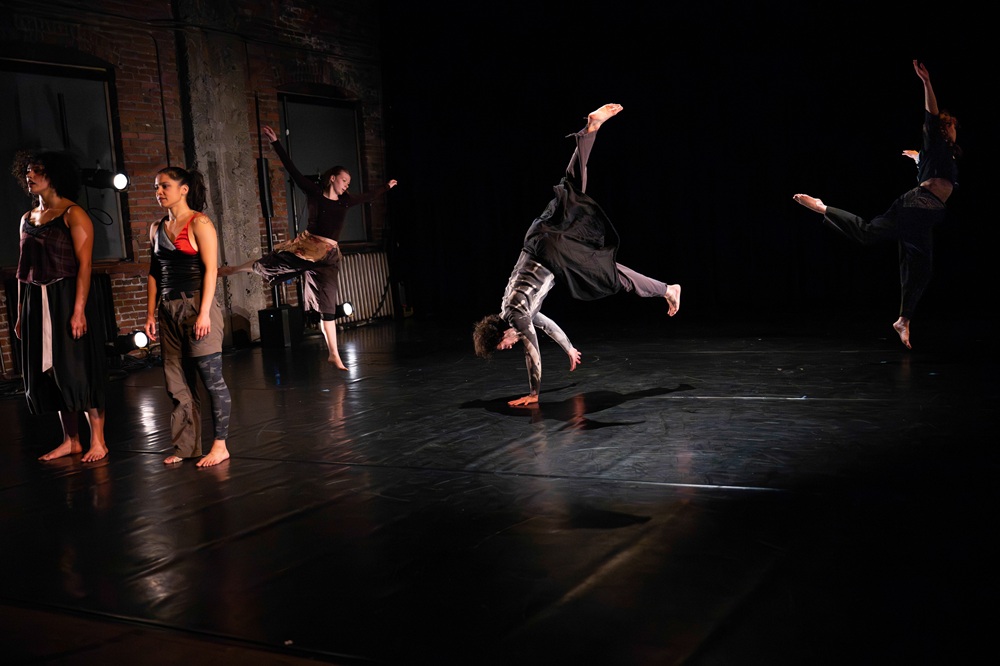
Liony Garcia’s work Fantasy Punctured transforms the space with bright costumes and a much quieter, maybe more introspective, sense of body movement. The dancers, Francesca Dominguez, Stella Jacobs, Jailyn Phillips-Wiley, and Joe Tennis, often hinge at the waist, folding, bending, placing, and stepping carefully through their solos and pairings.
Water balloons and a large clear ball enter the space, some carried in, one lowered on a rope. The dancers’ interactions are playful, curious, and odd. A hooded figure enters, picks up a cascade of sparkling streamers with his mouth, and moves downstage. This introduces a darker, more pressured energy mirrored by a change in the sound design. The playful pops, ripples, and trips are replaced with something more agitated and ominous, though not entirely so. The reason for this shift in energy is unclear. It feels like a stream of conscious exercise. In the most abstract of the four pieces, I found myself questioning the connections and reasons for each overlapping scene.
Vinson Fraley sets a minimal tone again with Alluvium. Light refracts against the upstage wall, illuminating his bare back, his breath visible as he rises from a fetal position. We hear a text by Natalie Cook that speaks to the search for rest and something about picking up their chair and walking. Fraley’s movements, characterized by a sweeping, rolling spine and torso and long extensions and curves of the limbs, exhibit strength and clarity. Occasionally, he dips into moments of tenderness, glimpses of vogue, and flicks of detail, yet he remains in almost constant motion. A projection of a water’s surface, with slight waves and ripples, covers the floor and walls.
Where is he striving from? What urges him to continue? What in-between space is this, where a man dances on water, and why is he alone? The relentless movement and laborious actions with the objects suggest a journey toward finding rest, although we see little of it.
For the final piece Batty Juice, by Symara Sarai, in the dark, a series of metronomes start at different intervals, each housed in small altar-like structures. The dancers gradually enter, staggering their movements until the final trio begins to build. They reach, react, respond, and repeat, their actions becoming more intense as the space gradually brightens. Their movements convey a sense of reaching and struggling together. A puddle of rest forms at the back wall, where they pause to breathe before rising again just as a storm begins. The sounds of thunder and rain overlap with the offbeat metronomes. The performers—Sarai, in collaboration with Mikaila Ware and Kentoria Earle—begin to speak, repeating phrases like “it wasn’t me” and variations on that theme. There’s playfulness, laughter, bravado, and repetition of phrases in different characters or tones. What can multiple senses of time tell us about who these women are? What aspects of friendship are revealed in their unison, breaks in unison, and chain reactions of movement or speech?
Four glimpses into four worlds. Each place has a story unfolding. With movement practices really finely honed already, I think we are looking at a group of emerging choreographers who are concerned with the stage being an aesthetic frame, not merely a floor or container. Abstract dance, in a lot of ways, seems to have had its day, and in its place, a hybrid is taking shape, one with moving stories about being, connecting, or the lack of connection as with Garcia, exploring, striving, and carrying on.
FRESH TRACKS New Works: Julia Antinozzi, Vinson Fraley, Liony Garcia, and Symara Sarai, New York Live Arts, NYC, May 17-18.