Chloe Marie and Leigh James Huster add me and the 19 other folx in the space to a group chat where the first question posed is: SUNRISE OR SUNSET?
me, sunrise. others, sunset. we continue on. oceans or lakes? do you think my phone can see me laughing? having a good time? Marie and Huster giggle and move about the stage the way we all do when talking on the phone. the notifications from all of our phones are the only sounds in space; our volume and brightness turned all the way up, we create a score through digital communication. eventually a rolling, dazed, techno pop begins to fill the air, marking the first phrase-like movement.
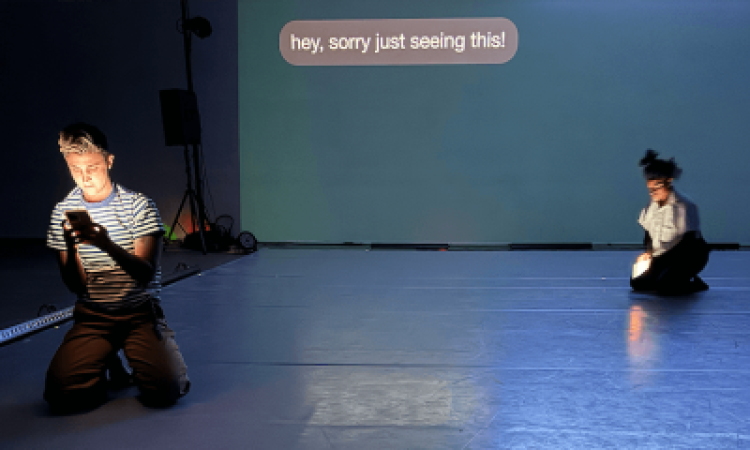
it’s fun. hopping, skipping, smiles, connection. Huster and Marie play with illumination, being both shielded by and interrogated by the light. it is easy to manipulate using a cellular device, such a small point of light and therefore expression. they put their phones down and a bright light washes the stage; too bright. it goes off and we illuminate them with our phones, softer, controlled, dimmer. this sequence, which we find out is their first date, ends as their text conversation is projected onto the wall.
Marie’s character sends a message Huster does not reply to for… too long. Marie journeys through what might seem an excessive roller coaster of emotions for anyone born before 1990, but those whose adolescence was defined by a chunk of metal documenting our likes, dislikes, romances, occupational history, sexual interests, and deepest fears understand. her self worth and connection to reality is altered by her perception of being ignored. the light shrinks back to that of her phone screen illuminating her, with the starkness of the projection backlighting with her deepest thoughts and crushed heart. the movement is disconnected from the music, and i am feeling her pain.
sorry just seeing this appears as the reply in the projection. Marie plays off the climax of the show with a few happy emojis. a breakdown and utter isolation reduced to “np:D”. Huster is completely unaware of this world-rocking sequence that Marie has experienced. the relationship carries on, with this secret in tow, and fragility as an omen of its trajectory. we must be wary of the depths centering technology can introduce into our lives.
sorry just seeing this, Icebox Project Space Gallery. Cannonball Festival; Philadelphia Fringe Festival 2024; September 2, 8, 29.
Image One Description: Two faces, each isolated in their own pool of phone light, look down at their phone screens.
Image Two Description: Two dancers kneel on the ground, illuminated by their phone screens. Behind them a projected text bubble reads “hey, sorry just seeing this!”