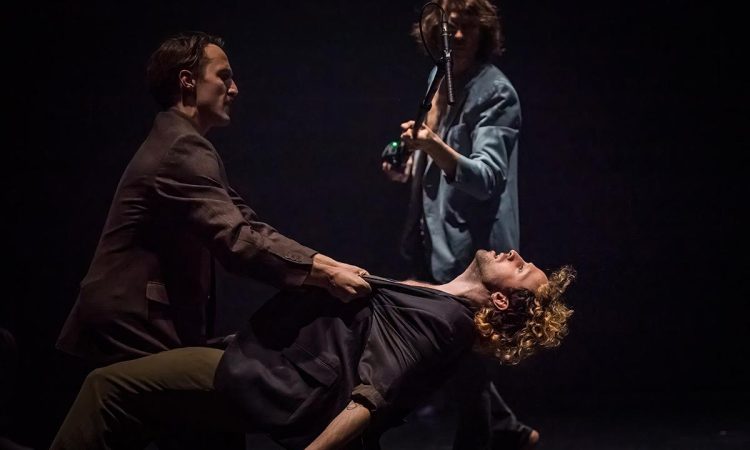
Fables opens with confrontation: twelve bodies collide and resist one another through struggle, competition, and physical force. A solitary dancer moves among them, microphone in hand, shifting between the roles of narrator and observer.
Choreographed by Virginie Brunelle, Fables gives way to live piano accompaniment, marking a shift toward a linear structure tracing a woman’s life journey from birth to motherhood. The dancers mechanically guide a child-figure, as she walks, cries, and plays, until she grows into adulthood. Humor surfaces throughout: the ensemble repeatedly joins the bride and groom’s hands together, yet each time their hands slip apart and fall—the gesture repeated until it tips into absurdity, eliciting laughter from the audience. The image is both funny and quietly devastating, speaking directly to the theme of women being led into marriage by forces beyond their control. Amidst the comedic tension, the structural pressures borne by women remain ever-present, never receding. In a subsequent striking scene, countless straps bind the dancer’s arms, legs, and torso, closing in from all directions. She advances through the darkness, resisting their pull.
In the final section, the dozen dancers appear in glittering costumes, sharply contrasting the preceding gloom. Movement becomes expansive and fluid, with broader amplitude and an upward, leaping energy. Freed from expressing resistance, they traverse the space with dynamism and collective momentum. Regardless of gender, all dancers share the same movement vocabulary, each revealing their own particular presence; uniformity does not erase individuality, but brings it forward, suggesting that equality allows each person to be fully themselves. Yet the utopian vision Brunelle presents invites pause. It is a tension the work is content to leave unresolved—and in that openness, the question stays with you long after the curtain falls.
Fables (2023) came to Philadelphia as Compagnie Virginie Brunelle’s only U.S. engagement—a rare point of encounter between this Montreal-based company and American audiences. Presented at Penn Live Arts this spring, just ahead of International Women’s Day, the work took on an added layer of resonance, inviting consideration of the body as a site of vulnerability and resistance. Unfolding through a fragmented narrative, Fables centers on figures that suggest both archetypal forms and contemporary women, navigating pressures that are both invisible and deeply felt.
The following is an edited interview with Virginia Brunelle, who considers the company’s Philadelphia presentation as a singular encounter both natural and special, noting it was their only U.S. stop with Fables. What stood out most was the exchange with the audience: post-show discussions brought together a broad range of perspectives, with audiences notably diverse in age, gender, and sensibilities. This exchange extended into workshops, which, as she notes, “became spaces of dialogue rather than simple transmission,” where participants engaged with openness and curiosity. She speaks warmly about audience diversity, yet she does not explain why she chose Philadelphia, nor the background behind the invitation. Could the response have come from any city?
When reflecting if feminist perspectives are central to her creative inquiry and how these ideas influenced her choreography, Brunelle notes, “Two of the main themes in Fables are utopia and feminist perspectives. These ideas emerged within a broader reflection present in the festival context where the work was created (2022 Lugano Dance Project Festival, Switzerland). I don’t begin with a fixed ideological framework, but questions around the body, representation, and power naturally bring me into dialogue with feminist thought. In the piece, these ideas are presented more as tensions than clear statements.”
When asked how Fables embodies resistance, and what reflections she hopes it might stir in audiences, Brunelle continues, “I’m particularly interested in how bodies are perceived, shaped, and sometimes constrained by narratives, especially those related to femininity. The forms of resistance are not necessarily direct; they can emerge through fragility, opacity, withdrawal, or states of suspension. If there is a form of resistance, it may lie in reclaiming complexity, allowing the body to exist beyond fixed categories or expectations. I hope the piece invites audiences to question how they perceive bodies on stage, but also in everyday life.”
For Brunelle, the live piano performance is more than musical support. The pianist’s collaboration is central to the piece, she explains, is not as accompaniment but as “a presence in its own right, almost like another body on stage.” More broadly, she understands stage elements as interdependent, noting that light, costume, and scenography “actively shape how the choreography is perceived,” guiding attention, creating contrasts, and at times entering into “friction with what the body is doing.” In Fables, she describes the aim of creating “an atmosphere both intimate and slightly unstable,” where all elements remain in dialogue, and where dramaturgy emerges from these relationships rather than a linear narrative.
In response to a question about the role of nudity in the work, Brunelle notes:
“For me, nudity is not about provocation, but about shifting perception. It allows layers of meaning to fall away while revealing others. In Fables, the nude body exists between vulnerability and abstraction. It resists a single interpretation: it can appear exposed, but also distant or even unreachable. At times, nudity supports the narrative. I’m thinking of a moment where, in a state of emotional excess, almost like a loss of control or a form of madness, a character undresses as if their clothes were burning their skin, as though garments carried the unbearable weight of meaning, particularly around masculine and feminine identities. More broadly, this reflects an ongoing interest in how we look at bodies, and what we project onto them.”
Speaking about her choreographic journey and the development of the company, Brunelle describes coming to dance relatively late, which perhaps contributes to her ability to draw audiences into a closer relationship with the work. Brunelle describes experiencing dance as a revelation. Perhaps this draws audiences into a closer relationship with the work. While her process is often structured with ideas defined from the outset, she emphasizes the central role of dancers shaping the work. As she explains, “Collaboration is essential. The dancers’ presence, sensitivity, and even their resistance continuously reshapes and deepen the work. It’s in this dialogue, between a defined vision and a shared experience, the pieces come to life.” It is within this ongoing exchange that Fables takes form.
Rather than offering closure, Fables leaves open a space for reflection. While some passages of movement remain difficult to decipher, the audience stays fully engaged as the dancers execute Brunelle’s choreographic vision with precision. Brunelle does not present feminism as a resolved position, but as a living tension between fragility and resistance, between constraint and liberation. What the work provides instead is a space to sit with these questions and the discomfort of recognizing how deeply they are felt. When bodies are finally laid bare, nudity feels neither shocking nor gratuitous, but inevitable—a quiet reclamation of the body on its own terms. This quality of openness extends to Brunelle’s own voice. Her answers are consistently poetic and reflective, mirroring a work that resists fixed meaning and invites multiple readings. When asked about feminism, she describes it as tension rather than position. Whether this is a deliberate artistic choice or simply the nature of the work itself remains to be seen.
Fables, Compagnie Virginie Brunelle, Philadelphia, Penn Live Arts, February 20-21