(((pomegranate))) shrouds the Icebox Project Space in a somber atmosphere. Walking in, the audience sees four mourners covered in black veils sitting on the ground. They breathe, barely moving. Low, ambient sound pulses. Fog creeps across the vast stretch of white walls. In the corners lie silver platters of lemons, watermelons, cherries, figs, and pomegranates.
Is the opposite of aliveness complete stillness? When movement stops, does life stop? Is “still life” an oxymoron?
One mourner brings their hands to their lace-covered face, gradual as ice melting, as though movement is painful. One needs to ease into it.
Is grief’s antidote expelling energy?
A steady escalation of limbs and bones and muscles awakens. When the shrouds slide off, dancers Raquel Rodríguez, Su Güzey, sarah ingel, and Song Aziza Tucker are sprouts pushing through the soil, finding new pathways to the light. Growing and quickening, the pulsing beat reverbs through the space. There’s loose limbs like low fruit. One mourner kneads a lemon on her kneecap. Another is luscious in their rebounds to and from the ground. Now the juice is flowing, the fruit rolling, the synovial fluid lubricating. Each mourner has their moment to wash away the stillness.
If your body swallows enough space, are you as alive as you can possibly be?
There’s joints like pruned branches, snapped stems, gnarled roots as legs. In one captivating, repeating moment, a seated mourner dives their head backwards and curls their spine toward their navel, over and over, until another mourner breaks the ritual and holds the crown of their head tenderly in their palms. The mourner is mouth-fed cherries, the smooth pits spit into a bowl. Her chest heaves as she swallows. Afterwards, they stand, revitalized in a rapid spiral, on and off the ground.
Is grief’s antidote being held in community?
A pomegranate is cracked open, exposing tiny, slick seeds. To be alive is to be juicy.
The mourners, now glistening in sweat and expanding rib cages, are as filled as the fruit they shove into their mouths. Standing in a line of four, their bodies are sensuous vessels, feeling every pore burst. Filled, released. Filled, released.
Can we ever feel more alive than in tired/full/satisfied bodies?
An invisible harvest held in weighted palms.
(((pomegranate))), sarah ingel, Icebox Project Space, September 19-29.
Homepage Image Description: A dancer covered in a bright array of tulle looks downward. The tulle fabric bellows around her covered lower half. Her shadow looms large behind her.
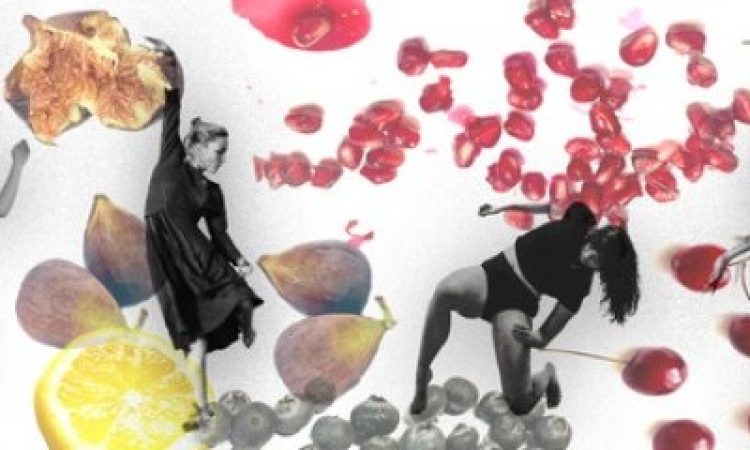
Article Image Description: Four dancers in loose, flowing clothing are edited on top of large photos of brightly colored fruit, including pomegranate seeds, figs, blueberries, and orange rinds.