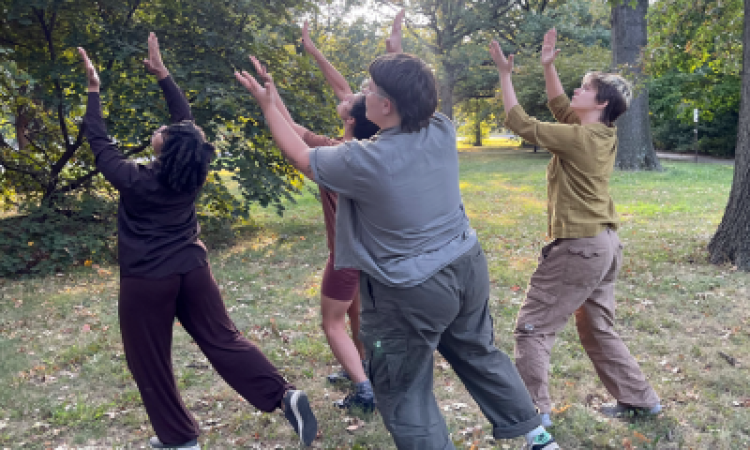
At Concourse Lake during golden hour, Leigh Huster led guests on a walking trail stroll which included mindfulness practices, sightseeing, and performance in Clapping for Nature. Throughout the walk, ambient music played on a portable speaker as Huster’s directives encouraged grounding, sensing, and expressions of gratitude.
After leading us in collective breath, a series of questions ushered our attention to aural and physical sensations: “What’s the farthest sound you can hear? And the closest? What feels good to you right now? Can you feel nature touching you back?”
When I looked up, Huster and fellow performers Shannon Brooks, Cedar Becher, Kimya Jackson, and Elizabeth Weinstein were standing single-file, close enough that their bodies may have been touching as they rocked forward and back. The movement was driven by the rhythm of their breath in sync. The repetitive motion allowed their chest cavities and heads to open and lift to the sky on the backward weight shift, then hunch over and tilt down on the rock forward. They cycled through this motion several times, slowly, before separating and continuing to lead us down the path.
We stopped at several spots along the trail to either engage our senses, witness a movement score, or clap for nature. As our personal tour-guide, Huster introduced us to the medicinal plants living there, inviting us to touch, acknowledge, and appreciate. Witch hazel, goldenrod, common ninebark, and other plants surrounded us. Our interactions were cued with prompts that encouraged curiosity about the plant’s characteristics and supported a sense of intimacy with what was growing there.
In another movement score, dancers indulged in their own connection to the environment. Some lay on the ground, surrendering the totality of their weight to the earth, while others chose to remain upright in a passive stance as if in a state of least resistance to gravity’s work. Gradually, their activity increased. In a flow state, they engaged with the ground, trees, the wind and eventually each other, expanding their bodies to far reach, using sticks and trees in their dance to hold, lean into, or hang from. They started to create rhythm by clapping and patting different body parts, and invited audience members to join.
“What does it feel like to clap for your body?”
Our attention was directed from self to nature and back several times throughout the piece. Later, guests were brought to the reservoir and asked to join in a prolonged applause while taking in the view. We clapped and sent praises to nature’s spectacle to close out the show. I noticed the program referenced Trans-corporeal Feminisms and the Ethical Space of Nature by Stacy Alaimo. In drawing connection between the performance and Alaimo’s text, I’m left with some lingering questions:
What’s the natural world’s equivalent to the dopamine boost that external validation (like applause) often serves the human ego? As nature relentlessly provides us with the riches for survival, how do we show appreciation in impactful ways beyond our own pleasure projections? How does our acknowledgment of nature’s value compare to our participation in sustaining it?
Clapping for Nature was a much needed practice in trans-corporeal appreciation. Now, what is the tangible investment that follows?
Clapping for Nature, Leigh Huster, Concourse Lake, Philly Fringe Festival, Sept. 19, 2024.
Image Descriptions: a group of four individuals stand together with arms lifted overhead making a clapping gesture with their hands. They are outside in the grass, surrounded by trees and other greenery. Their outfits are earth tones – browns, greens, and shades of grey.