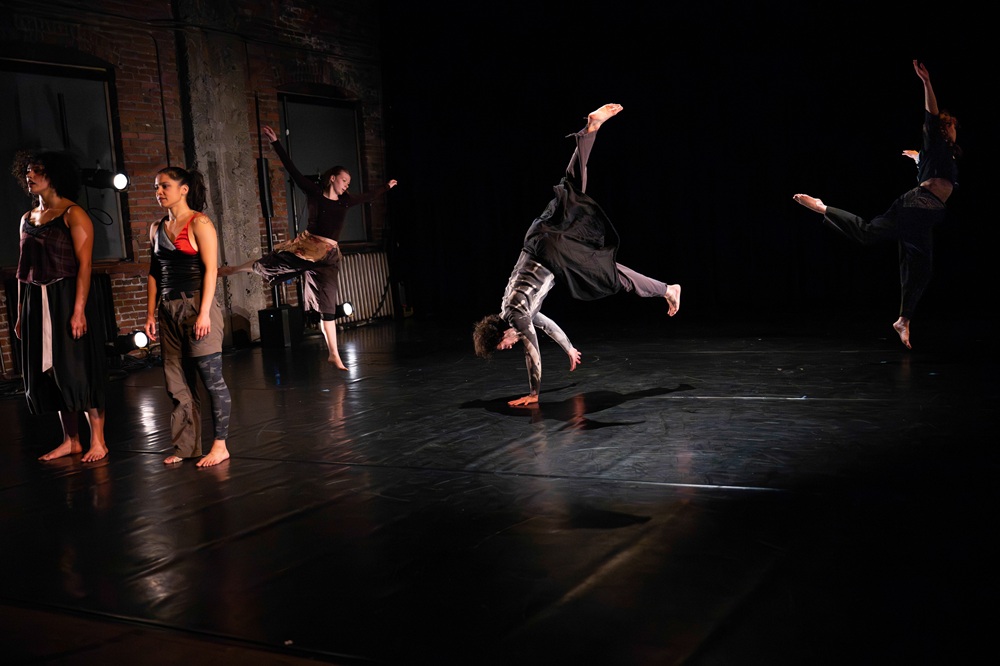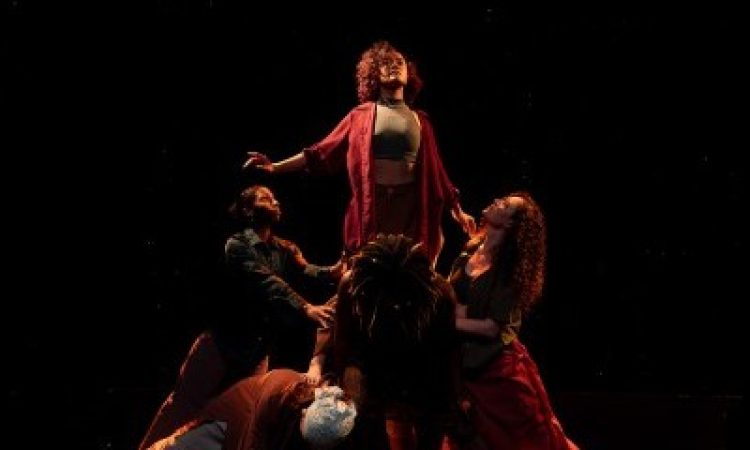
Kaleid Dance Collective Director, Rush Johnston, has a talent for creating images. On a stage framed with silver foil fringe curtains, the dancers of Where the Violets Bloom assemble (and reassemble) from one picturesque tableau to the next. With footsteps so soft they can’t be heard, even in the intimate space of The Tank theater, the dancers glide effortlessly through the space, moving from one image to the next. Combining pedestrian gesture, expansive modern phrase work, and spoken personal narrative, Johnston illuminates stories of queer love, joy, violence, and community.
The highlight of the work comes near the halfway point. A prerecorded voice emerges, sharing a story of a queer couple’s public encounter with a cruel stranger, positioning the couple as an object to be gawked at and judged. This moment of queer violence is actualized in the theater with the cast turning their judgemental gaze to the audience. A bright light illuminates the audience as the cast stares, some crawling over rows of seating and through the aisles to stare more intensely at individual audience members. With crossed arms and bobbing heads, the dancers stare – disgusted, intrigued, and unrelenting. Throughout the work, the complexity and nuance of the gaze continued to be investigated throughout the various choreographic sections.
The near 90-minute work expands to its limits, both literally as dancers transcend traditional boundaries of the stage and into the theater, and in spirit as it imagines and reimagines queer memory. While at times the work falls into the formulaic conventions of melding together crisp modern technique with postmodern approaches to narrative, the tenderness of its driving themes keep me captivated. Throughout the work, dancers Lucia Gagliardone and Katrina Manansala stand out for their supple approach to technique, and ability to swiftly move between a more quotidian improvisational score and expressive modern choreography.
Where the Violets Bloom demonstrates the expansive experience of a queer identity through community. Solo moments of despair do not linger for long before other cast members re-enter the space as a reminder to one another that they are not alone. They have each other’s back. Memories of finding queer community reverberate through each of the spoken narratives. Community, even in the face of adversity, persists.
Where the Violets Bloom, Kaleid Dance Collective, The Tank NYC, Sept. 17, 21-22.
Homepage Image: Two dancers are intertwined, reaching upwards with their arm while in a lunge. Behind them, two other duets of dancers are intertwined making similar reaching shapes. The lighting is dim and warm, and the dancers wear multicolored pedestrian clothing. They are soft, with open palms and gently bent arms.
Article Page Image: A dancer stands atop a group of other dancers, expanding their chest and focus upwards with an uplifted energy. They wear a maroon button-up shirt and don curly grown hair. The other dancers bend in towards this dancer, supporting and lifting them up. They wear multicolored pedestrian clothing and are lit by a warm, dim, light. They are soft with energy that extends upwards.