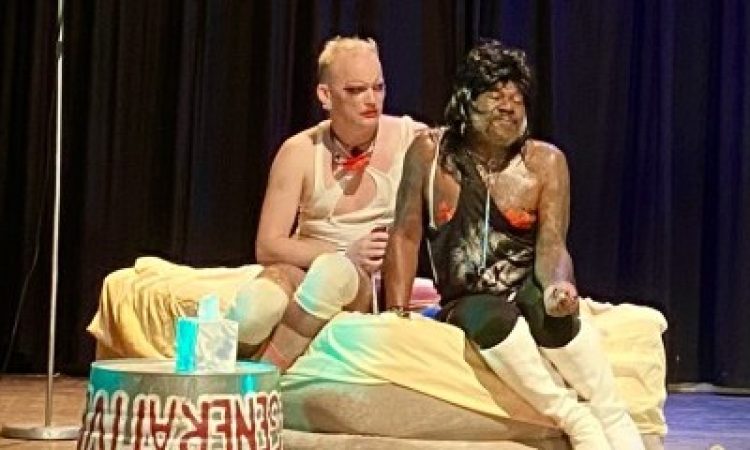
In an apartment, a dialogue between two actors is set in a disarrayed bedroom. Crumpled tissues on the floor, half-emptied soda bottles, and a raggedy wig tossed on the floor tell stories of sadness, various states of shambles, or even a night out gone wrong. In My Pussy Hurts Too, Paule Turner and Dane Eissler discuss this search for “nasty” intimacy amidst a society suffocating with rigidity. Through dance theater modes, they investigate a crossbreed of text and movement in an unapologetic display of sexy in queer performance, countering our Western heteronormative culture void of intimacy. Ironically, this display was set at a church space – Christ King Church, one of Cannonball Philadelphia Fringe Festival’s Venues.
My Pussy Hurts Too is a permission to say, “My name is Didi, and I’m a whore” or “My pussy is a voodoo.” It is permission to be nasty. It is a story of deep friendship between two gay men, Didi and Gogo. The work is a display of queer identities and a statement of one’s marginalization story that can be viewed as a privilege to someone else.
The piece begins with Paule Turner’s monologue, a “nasty” solo performance characterization of Didi and their interaction with a pink dildo. Didi does all the “nasty” with this pink dildo, shamelessly licking it and using it as a microphone. A dialogue between Didi and Gogo follows this monologue, showing a comparative analysis of nuanced experiences between many identities within queerness. When Didi says, “Blackness is a State of frustration,” she/they tell it how it is – their struggles are not only defined by their queerness but also by another layer of societal barrier, the navigation of their complex identities as a Black human in a White supremacist USA, which adds to this “pussy hurting.”
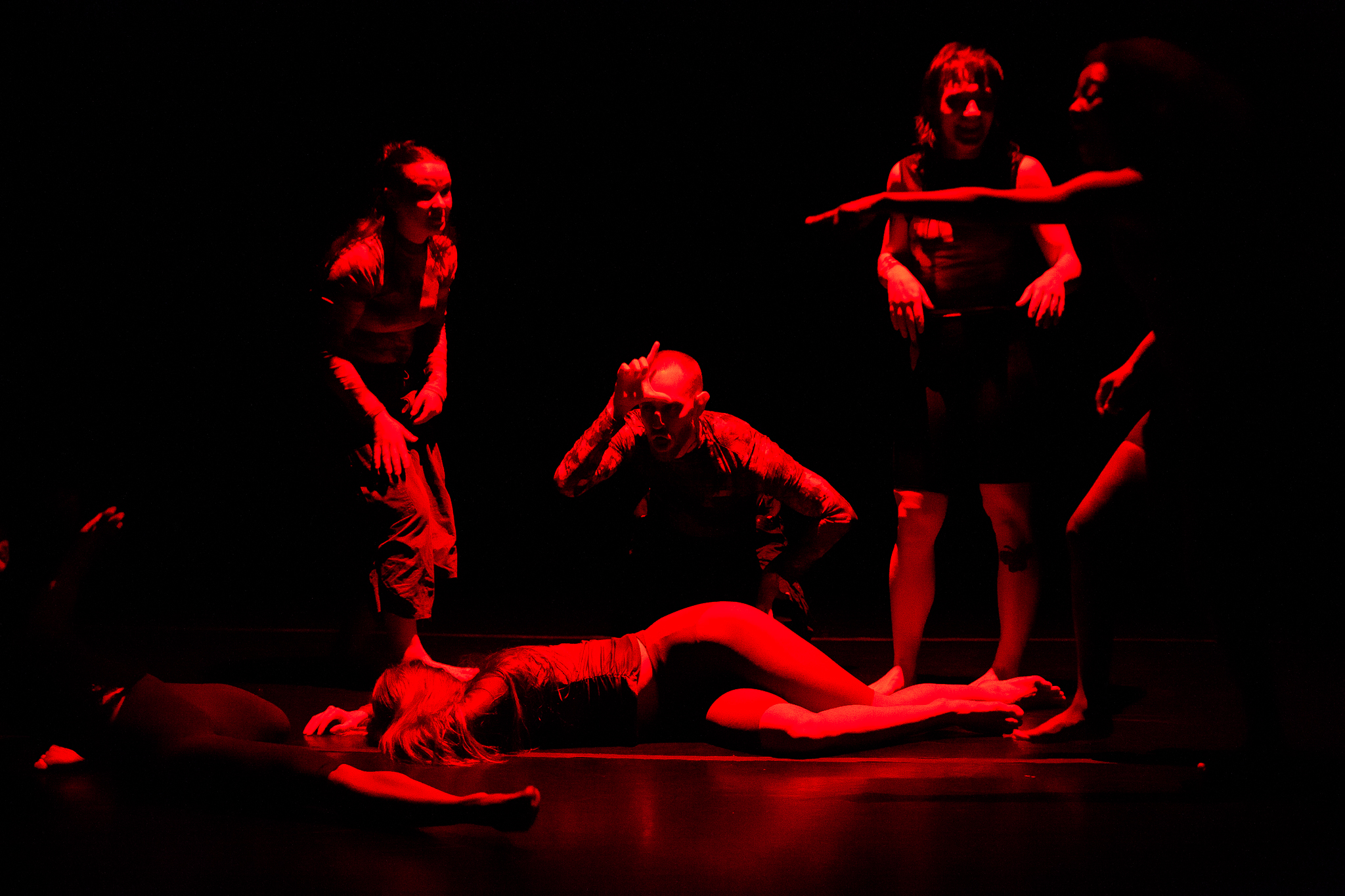
Dane Eissler continues her/their narrative as Gogo through another monologue. They reminisce on their coming-out story as a teen struggling for acceptance and retell a memory of tying necktie laces into nooses to end their struggles. Later, a shadowed figure holding a light source enters the scene. Gogo and Didi refer to this figure as the Gloryhole. Gogo’s reaction, “That is the gloriest gloryhole I have ever seen, and I think it wants us to repent for our sins!” gave me the impression that Gogo grapples with the conservative values of Catholicism.
The physical theater piece is quite wordy, but in hindsight, the text frames an important dichotomy within gay culture. My favorite part of the piece is the back-and-forth exclamation of their questioning dialogue, each question showing the stark difference between each identity, illustrating the two paradigms. As a queer Filipina, this resonates deeply with me and my understanding of another nuanced form of intersectionality that is often invisibilized.
The physical theater piece is quite wordy, but in hindsight, the text frames an important dichotomy within gay culture. My favorite part of the piece is the back-and-forth exclamation of their questioning dialogue, each question showing the stark difference between each identity, illustrating the two paradigms. As a queer Filipina, this resonates deeply with me and my understanding of another nuanced form of intersectionality that is often invisibilized.
My Pussy Hurts Too, Christ Church Neighborhood House, Sept 1-15.
Homepage Image Description: A white gay man lies on the floor, almost fully naked. A Black gay man dressed in a tropical dress with a hair scarf, sunglasses, and a floral bag stands next to them, extending their arms as if asking, “What’s the matter?”
Article Page Image Description: Two queer people sit on an inflatable bed. A metal basin flipped upside down is used as a table.