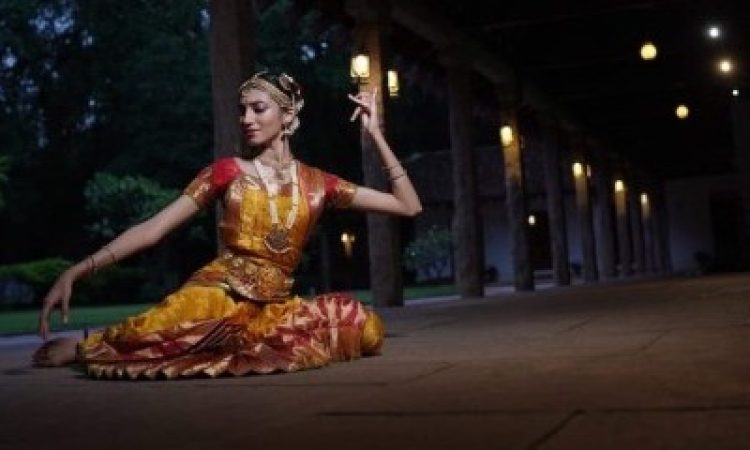
I am often drawn to Indian classical dance forms for their specificities of gesture, particularly with hands, and what those specifics can accomplish, mean, inspire, and perform. I am intrigued by the precise storytelling and rhythmic abstractions. Bharathanatyam: An Indian classical dance performance, a digital Fringe performance by dance artist Lakshmi Thiagarajan, is a rich example of a centuries old south Indian dance.
The four pieces are shot in different outdoor spaces (a small courtyard, a walkway by the sea, a garden path, and a dock), each captured by a single, stationary camera with a frame size and angle that keeps the full dance space and whole body in view. This choice speaks to performance and doesn’t attempt a screendance interpretation. Before each piece, a title screen appears that explains the story, translates the title and essential words, and touches on noteworthy aspects of Bharathanatyam. There are little to no notes on the music although each section has its melodies, percussion, and what sounds to me like the vocalizations of a Tabla player. Watching, I assume, perhaps wrongly, that each song and dance pair is inextricably linked.
Thiagarajan’s four dances touch on different aspects of Bharathanatyam dance. The first, Alarippu, is a short piece of rhythmic abstraction exploring the idea of a blossoming flower. Even without a literal storyline, the dance proves nuanced with specific movement vocabulary and performative clarity. Two narrative verses from a larger traditional work, Nachiar Tirumozhi, make up the second piece; Thiagarajan lays out the framework in the title slide notes. Theeradha Vilayattu Pillai, similarly narrative, is more conversational; Thiagarajan switches between speakers to illustrate the storyline. Surutti Tillana, a mix of non-narrative and narrative compositions, plays with rhythm and tells the story of the spirit Krishna.
Thiagarajan moves lightly and purposefully in the spaces, stamping her feet and ringing the bells around her ankles. Dropping effortlessly to one knee and then the other, moving through symmetrical and asymmetrical shapes and sequences. Feet stamping, framing, balancing, flexing, resting. Hands shaping, describing, placing, showing, reaching, grasping, pointing, echoing. Neck turning, shifting, angling, responding. Chin lifted. Face smiling, looking, knowing, longing, laughing, insisting, singing.
I’m no expert here, but she is. Whatever brings you to Bharathanatyam, Lakshmi Thiagarajan’s precise and detailed performance will keep you there, happy to rest a while in ancient stories and patterns of human invention.
Bharathanatyam, Lakshmi Thiagarajan, Digital Fringe, September 5-29
Homepage Image Description: A woman in bright purple and pink short sleeves with gold trim, kneels, her left knee on the floor, the other obscured by the pleats of fabric between the legs of her costume. She rests her right hand, palm drawn with henna, gently against her cheek, seeming to hold that arm up with her left hand. Her face is tilted up, her eyes closed, and her mouth drawn tight as though pleading or sorrowful.
Article Page Image Description: A woman sits on the stone floor of a long veranda at dusk, illuminated by hanging lanterns. The warm light makes her golden costume glow. Resting on her left hip, her right leg extends behind her, half bent. She looks down her extended right arm, letting her fingers drop toward the floor, while her left hand, at head level, pinches some fingers into her palm, leaving her ring and pinky fingers reaching up.