As J.S. Bach’s Cello Concerto No. 3 played, the curtain rose to reveal 15 dancers already in motion, transitioning swiftly through port de bras. This sudden, energetic opening to an excerpt from Dwight Rhoden’s Bach 25 ( 2019) immediately captivated me. Minimalist costumes – grayish fluorescent leotards for the women and tight shorts for the men – showcased the dancers’ elongated, sinewy forms. The female dancers’ high extensions, the men’s airy jumps, and the whole ensemble’s fluid partnering highlighted the company’s technical prowess.
Complexions’s contemporary ballet program at Penn Live Arts featured a diverse repertoire of six plotless pieces choreographed by Dwight Rhoden. In Rhoden’s choreography, I saw echoes of multiple “traditions” within contemporary ballet, a genre that has developed its own conventions through the deconstruction of classical ballet vocabulary. Rhoden echoed George Balanchine’s seamless music-movement collaboration and fast footwork, William Forsythe’s extreme lines, Twyla Tharp’s fusion of modern dance and jazz, and Crystal Pite’s emphasis on athleticism.
Two of Rhoden’s works, Choke (2006) and Gone (2000) stood out for their unique representations of powerful ballerinas and Black cultural history, respectively. Originally created as a duet for two men, Choke was restaged for two powerful female dancers, Christian Burse and Marissa Mattingly. Set to Vivaldi’s The Four Seasons: Summer, the dancers in emerald leotards showcased their physicality through their hyper-flexible extensions (often reached beyond 180-degrees), grand jetés, and pirouettes, reflecting the intensity of the music. The choreography shifted between competition and unity, adding layers of dynamic tension to the work.
Gone, a brief male trio set to Odetta Holmes’s ballad Another Man Done Gone, used minimal instrumentation, allowing Odetta’s voice and soft clapping to guide the audience through an exploration of Black cultural history. The dancers’ synchronized deep pliés and fluid torso waves amplified a sense of mourning.
This theme of loss continued in Rhoden’s solo Elegy (2020), performed by Jillian Davis in memory of the mothers of Complexions’ directors Rhoden and Desmond Richardson. Set to Ludwig van Beethoven’s Moonlight Sonata, Davis’s extraordinary long limbs filled the stage with her flawless technique, offering a performance that was both peaceful and solemn. Davis ended the solo with a recurring shape: she dropped into a deep plié, her arms held in an angular shape, then she slowly opened her chest, spread her arms to both sides, and lifted her body as her elbow reached behind her head. A small gasp escaped her in a moment when the music was silent, reminding me of the labor of her agile body.
The final two pieces, This Time, With Feeling (world premiere) and For Crying Out Loud (2023), featured the entire company in royal purple and lilac costumes. Both works featured a shifting array of formations in group dances, trios, duets, and solos. This Time, With Feeling employed innovative lighting, occasionally creating the illusion of parallel spaces and storylines. However, the fragmented choreography disrupted the interesting use of space, and an inconsistent theme throughout the symphonic score by David Rozenblatt made the score incoherent and interfered with the overall flow of the piece. The ending afforded a moment of fluidity: as the curtain slowly closed, a male-female duet spun gracefully at center stage, reminiscent of figure skaters. The final piece, For Crying Out Loud, although created a year ago, was like a second act of This Time. Set to U2’s pop songs, the group dance shared thematic and structural elements with This Time, including the reappearance of the spinning duet and many group dynamics.
Complexions Contemporary Ballet’s performance showcased a company of virtuosic dancers. While I found the choreography in most of this program predictable, I was captured by the innovative choreography of Choke and Gone. Merging the styles of contemporary ballet masters, Rhoden infused a unique personal interpretation rooted in his cultural background, contributing to the experimentation of contemporary ballet.
Complexions Contemporary Ballet, Zellerbach Theatre, October 18 and 19.
Homepage Image Description: The image features a powerful duet from Complexions Contemporary Ballet. A male dancer, dressed in shimmering green pants, supports a female dancer in a gold costume as she elegantly balances on his shoulders, demonstrating strength, balance, and grace in their contemporary ballet movement.
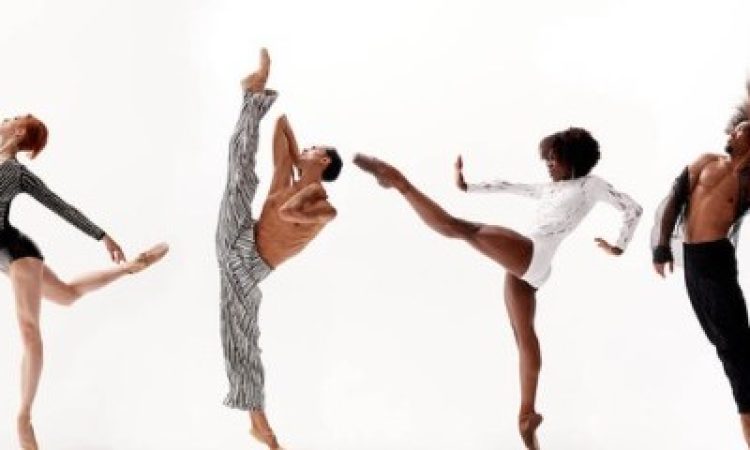
Article Page Image Description: The image shows four ballet dancers from Complexions Contemporary Ballet, each in mid-movement, displaying dynamic poses. The dancers, dressed in modern and minimalistic costumes, highlight their flexibility, strength, and fluidity in a