On Wednesday September 25th, the three artists of Philadelphia Dance Project’s TRILATERAL Dance Artist Exchange shared their movement research at the Christ Church Neighborhood House as part of the Cannonball Festival. The artists, hailing from Philadelphia, Sofia (Bulgaria), and Budapest (Hungary) have spent the past year in creative exchange, spending residency weeks in each artist’s hometown. For this showing the cohort was also joined by a Philly-based alumnus of the program, Gabrielle Revlock.
The presentation begins with much of the audience seated in a circle on the theater floor. Tamara Zsófia Vadas from Budapest sits on the upstage curve of the circle, an assemblage of crystals, shells, and greenery forming a Y in front of her. Holding a microphone she speaks briefly about having a life changing experience, about turning 40, about death and giving someone else a new life. She dedicates her dance to transformation.
Vadas begins by burning some palo santo, wafting the smoke over her body. She wears leopard print slides on her feet and her toes wear long nails, manicured talons.
She moves around the edges of the circle with soft shuffling steps and small adjustments to her posture. Her arms extend outwards from the elbow – something more elegant than a shrug – like a Virgin Mary statue but so clearly animated, taking stock of each of us in the audience and our collective presence.
As the dance progresses she slips her feet out of her sandals. She descends to the floor on all fours, shuddering through her thoracic spine. Rising back up in the center she shifts through larger shapes, a rasping from her long toenails accompanies each sweep of a foot.
At the end of the dance she spins, pivoting on flat feet, arms out to the side. The sprinning continues into an orbit around the center of gravity she has created with her keen attention. The spin ends. Her feet swivel in and out quickly, heel-toe, heel-toe, assembling her limbs back into her midline. She walks back to the point of the Y and sits.
We break the sense of ritual and the audience members seated on the floor migrate to the proscenium’s risers.
Next Christina Gesualdi from Philadelphia takes the stage. Dressed in goggles and a swimsuit under corduroy slacks she stands downstage in close proximity to the front row. She slowly pliés and rises a little quicker with a sharp inhale. After a few repetitions she unfolds a piece of paper with instructions and displays it upon her chest. I cannot make out the words but it leads to an audience member in the front row standing up, taking her hands, and joining the movement, coordinating the bending of knees, and the taking, holding, and releasing of breath. There’s a peacefulness observing two people synchronize in this rhythm and I notice my breath joining the pattern. The duet concludes and Gesualdi goes on to speak to us about getting into swimming, all while exploring movement that reminds me of treading water. At one point she interacts with a bag of carrots and I can make no sense of their inclusion, though I am delighted by the absurdity.
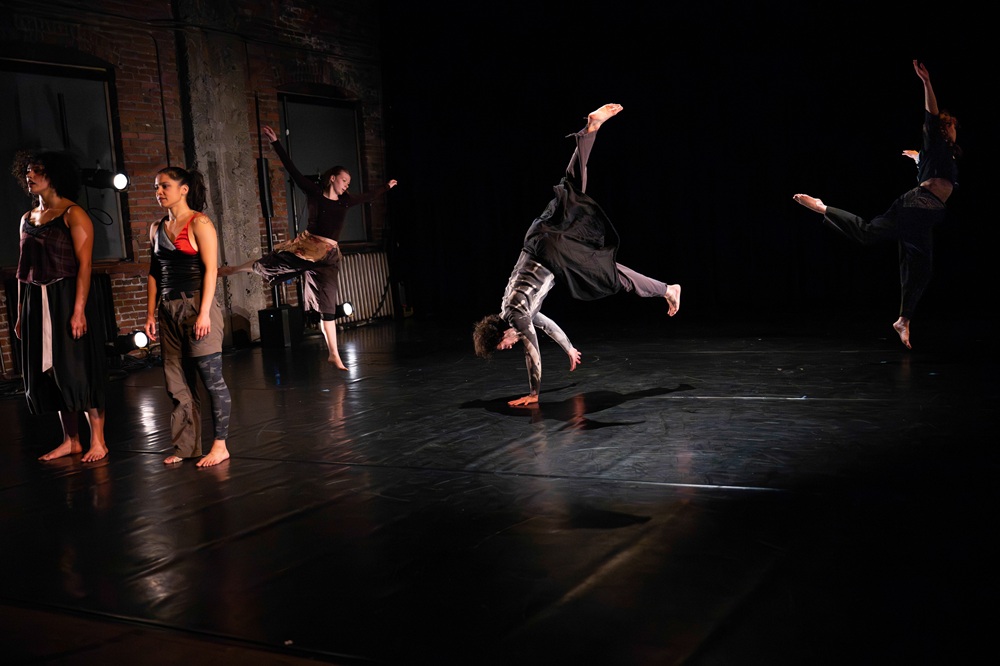
Gabrielle Revlock performs next, a duet in bright clothes with a sound score that shifts between solemn piano and Diana Ross’s disco hit “I’m Coming Out.” The movement is athletic and intricate, while the relationship between Revlock and her dancer is ambiguous. At times one dancer’s arm cuts off the other’s motion, causing a pause and redirection. At other moments they move in unison and it feels joyful with playful leaps and turns. Towards the end, the collaborating dancer is sitting, legs outstretched facing the audience. Revlock walks into her from her left side, Revlock’s pelvis bowling into her head and knocking her flat. Revlock continues her walk across downstage with no acknowledgement of her impact. A slight smile curling her lip as she peers out at us.
The evening concludes with a short TEDtalk style lecture by Silvia Cherneva from Sofia. Cherneva’s research is interested in play and architecture. How can she encounter the existing built environment and turn it into a playground? As she gives some examples of her process, she begins to play the stage she stands on, using the faded black lines of the basketball court that still mark the theater floor as a balance beam and jumping between spots of spike tape. She invites the audience to come join her for a play session on the floor and several people do. We observe them create the rules and structures of new games, trying to keep equidistant as they run the edges of the space and throwing bits of carrot, discarded from Gesualdi’s solo. As acknowledged by Cherneva, the bare theatrical space is not ideal for her project, which has taken place primarily in public spaces. Additionally the setup of the audience in the seated risers gives me a sense that I am watching people perform play, more than people immersing themselves in play.
The evening gave insight into the investigative processes of four unique artists. Still, I had little sense of what these artists gained through their exchange – either their time dancing in each resident’s home city or through conversation or collaboration with one another. The TRILATERAL Exchange is such an unusual offering and I hope that future events give some more insight into the exchange element of the platform.
TRILATERAL Dance Exchange, Philadelphia Dance Projects, Christ Church Neighborhood House, September 25, 2024
Homepage image description: A woman is standing profile, mid-step, in a black shirt and white pants. Her arms are outstretched, palms face up. In the background audience members are seated on chairs and on the ground.
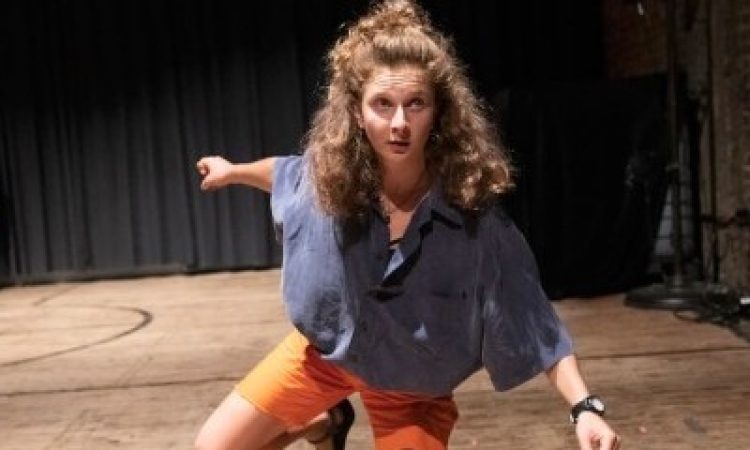
Article page image description: A dancer in a blue denim button down shirt and orange shorts is on one knee with her other leg raised and bent slightly behind her. She has long curly hair and peers out into the audience with her arms outstretched.