In its 19th year of establishment, BalletX takes a fresh step by expanding the number of company dancers, welcoming six new members, as well as moving into a new resident venue: the Suzanne Roberts Theatre. These changes reflect BalletX’s success and audiences’ appreciation of their contemporary ballet works. To celebrate this journey, the Fall Series 2024 features Irish choreographer Marguerite Donlon’s premiere of Big Wig and two restaged works: Mapping Out A Sky (2021) and Heroes (2019), by Matthew Neenan and Takehiro Ueyama, respectively.
Before the performance of each piece, BalletX introduces choreographers, their choreographic ideas, and the making process in a short video. These clips give audiences a taste of the backstage production and display moments of how dancers achieve their physical virtuosity under the choreographer’s direction. At times, the jolly dialogue between the dancers and the choreographer is used to delight the audience. These short films not only introduce the pieces but also play as an educational tool to direct the viewers’ focus throughout the performance.
In the preview video of Mapping Out A Sky, Neenan emphasizes the impact of Stephen Sondheim’s intricate piano music on his choreography and his desire to reveal the “beauty of human flaws” through dance. While his bold use of cannon and geometric changes corresponds to the complexity of the live music played by Grant Loehnig, the dancers’ accurate positions in line and virtuosic technical delivery seem flawless.
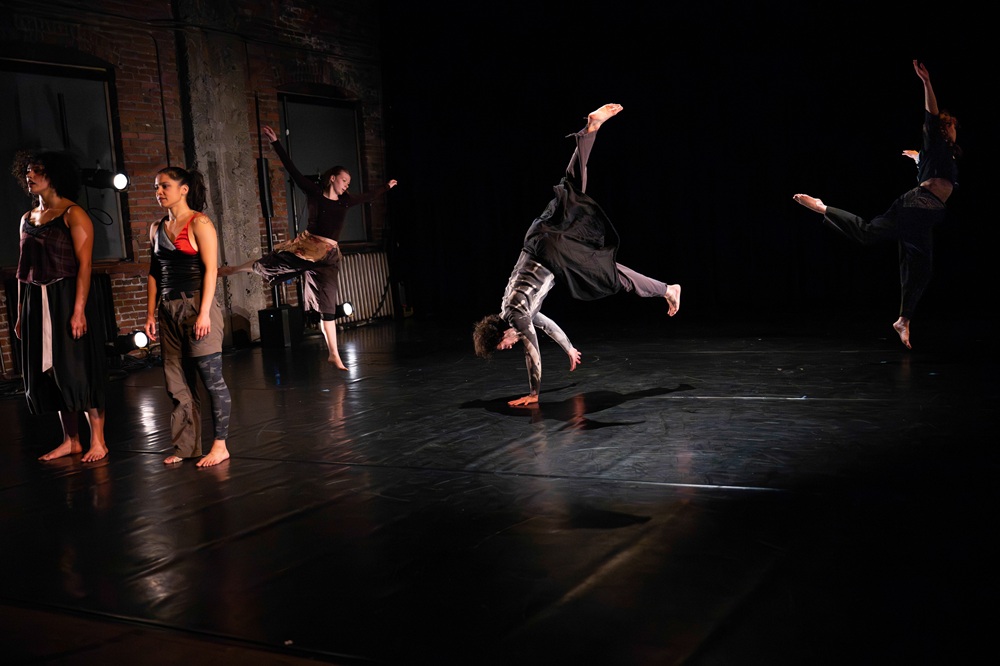
Reflecting the white and black keyboard of the piano, Sky dancers wear black and white corset-like tops, dresses, leggings, and leotards. Standing in a vertical line, they swiftly bend their torsos one at a time, echoing the play of a musical scale on the piano. In a cannon, they strike to the side, and their individual moves smoothly develop into different frozen poses. They become an elegant 19th-century oil painting. In the last section, the dancers prance across the stage in a delightful jazzy melody and leave an uplifted energy.
When explaining Heroes in the video program, Ueyama notes the dance celebrates the hard work and sacrifices of Japanese people in the post-World War II period and honors his cultural identity rooted in Japan. The dynamic piece begins with a mourning duet on a dimly lit stage. A male and a female dancer, dressed in cardinal wide-leg pants and white sleeveless tops, slowly walk towards the audience. By only occupying stage left, the duet executes a limited range of motion–they lean towards each other through heavy lunges or shoulder crosses. A whispering woman’s voice counting numbers in Japanese creates the soundscape that interweaves with the burdened bodies on stage. Behind them two red suits hang, continuously swinging side to side as invisible ghosts.
To align with his cultural roots, Ueyama invited avant-garde Japanese composer Kato Hideki to create the music for the mourning duet. For the rest of the pieces, however, as more dancers crowd the stage, he adopts John Adams’s renowned score, The Chairman Dances. This music is an offshoot of Adam’s opera Nixon in China, in which Chinese leader Chairman Mao and his wife dance the foxtrot. It is interesting how Ueyama uses this music that initially portrayed the authoritarian leader in China to reflect the hardworking Japanese community. Later in the piece, all the dancers wear floppy red suits and pants. Within the repetition of small rhythmic and melodic fragments, they march onto the stage. I read their rapid and unified running arms and fast-walking steps to signify a tough Japanese community in developing their post-war country. Ueyama’s choreography reminds me of Ruth Benedict’s landmark study of Japanese society and values in The Chrysanthemum and the Sword (1946). Benedict argues the emphasis on discipline and collectivity in Japanese culture could support the adoption of democracy and economic modernization.
Donlon’s world premiere, Big Wig, attempts to blend Irish traditions with contemporary pop culture, which becomes another experiment of cultural hybridity. The dance opens with several female dancers executing tap dance movements on pointe within the Irish whistle music. Their minimalist nude-colored sports bras and shorts, along with their restricted upper body motions, accentuate the big red wigs on their heads. To enhance the humorous effect of the wig, male dancers also wear the wig on their shoulders, chests, and hips and show off their “hairy” body parts.
Big Wig’s thirty minutes of patching of different music feels disjointed. In the video clip, Donlon describes a desire to develop her Irish tradition to “a new end.” While she might have achieved that, I had a hard time following a smooth trajectory. In the last section, this “new end” takes me to an entirely different world. With techno-pulsating beats, the dancers wave the wigs above their heads. They bend their knees and sway their bodies along with the music vibe, as if dancing in a nightclub. The less dynamic exploration of the wigs along with the dance in this last section disrupts my sense of a hybrid cultural experimentation. Could this indicate a liberation from tradition?
The three choreographers of BalletX Fall Series 2024 render a dazzling evening for Philadelphia audiences. Neenan’s Sky brings the piano music alive through dancing bodies; Ueyama’s Heroes successfully combines contrasting characteristics between discipline and liberalism; Donlon’s Big Wig blends her Irish cultural heritage with pop music and dance.
Fall Series 2024, BalletX, Suzanne Roberts Theatre, Nov 13-17, 2024.