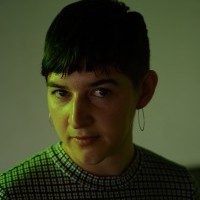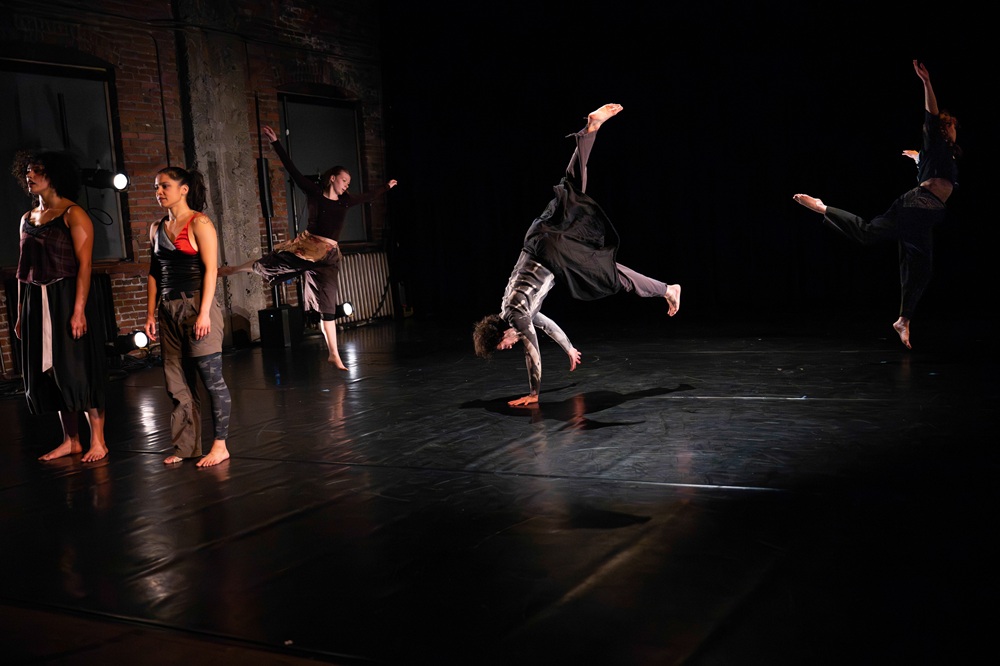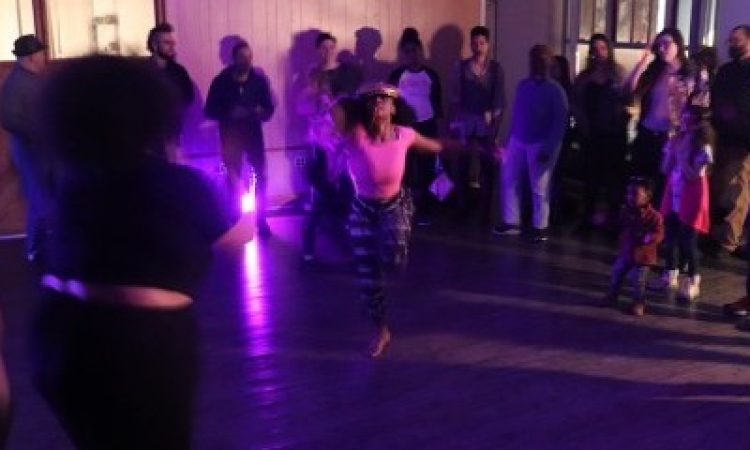
From the burst-into-the-crowd pre-show to the buffet and talkback following the applause (just enough time for the performers to grab a chair), Artist-in-Residence Sanchel Brown’s Home to Homeland was all about making us feel at home, now, in the halls and studios of Urban Movement Arts. As the dancers said: “We’ll take care of you, and you take care of each other.”
The show begins without announcement; performers Brown, Ama Gora, and L. Graciella Maiolatesi appear in the crowded lobby. They sing, “It don’t mean a thing if it ain’t got that swing” in tight harmony, moving in a tight circle, their feet and hands providing rhythm. I have a moment of reviewer’s dilemma, caught several feet away from my trusty notebook, but decide to roll with it, catching the curve or flick of an arm or leg above the heads of the crowd. The jazz age vibe circles into Brown spitting a rapid-fire rhyme, reminding us that these social dances were formed in the fire of oppression (she takes aim in a long lunge, hands cocked like a gun), born of “elastic lineage.”
“Home is beneath my feet,” she says. “You are home.”
We follow Brown to Baltimore (Studio A). We’re instructed to find a space behind the tape lines which cut the room into a force-perspective V. This is a practical constraint: the negative space allows for a projector to splash a graffiti’d Baltimore wall onto the studio wall. It’s also a spatial choice that fills the room with tension and depth, a sense of looking into the past, of Brown trying to reach us from her past, of small spaces both loving and hard to escape. At the widening point, in a corner, Brown sits on a box. She sings to a recorded beat:
“All those times on stoops, life lived in a loop… ”
A kid in the audience laughs in delight at one of her rhymes; Brown meets her eye, points. The connection is genuine and tinted with the stardust of Brown’s polished and generous stage presence. The stardust intensifies when she gets up to dance. She is on home turf, performing the house style she grew up with in Baltimore with speed, precision, and force that is powerful to see. (One of the kids has to pick her earrings off the floor when she’s done.) Brown does the Wu Tang; cheers of recognition spring from the audience. The beat melts into the drifting sound of waves. “She’s homeless,” Crystal Waters sings. Brown performs her movements again, slowed down, melding with lyrical reaches, runs, and tour-jetés. I want to follow Brown, see where she goes. Where does she go? N’awlins!
We pass into another room, dimly, purply lit. Brown blows a red plastic whistle, leading a Second Line dance to boisterous New Orleans jazz. The audience seamlessly folds in, the kids don masks, the line becomes a circle and the performers each take fierce solos, which morph into unison movement. The dancers, low to the ground, open up their stances, pulling an elbow back in stops and starts, stomping with each hit. This movement circles into stepping backward, faces turned upward—a recognizable gesture of marveling at being somewhere new—as Brown rhymes about finding herself in N’awlins. The city welcomes her with a “Heeeey Baby.” The transitions of this section—from solo to unison, abstract to representational movement, movement to rhyme, rhyme to song, song to improvisational dance to getting audience members to join in a virtuosic twerk-session—fill me with a formalist’s joy. Brown, Gora, and Maiolatesi flow seamlessly between medium and idiom, each form informing the others. Just as I’m thinking I could spend more time in N’awlins, learning what this in-between place is for Brown, we’re swept to the next room.
Senegal… or not quite yet. First stop, the Wendy Williams show with special guest Sanchel Brown! I’ll admit to feeling a little lost in this self-referential section, with Brown playing both herself and Williams. It did give me (a twenty-something white Jewish girl) the opportunity to look up the TV show and learn that Brown got her impression of Williams’ walk spot on. This interlude slows the pace a bit, adds a layer of persona to sift through to get to Brown. When we arrive in Senegal, it’s through a soulfully slow rendition of Amazing Grace. The dancers syncopate luscious floating arms and light steps to the vocalist’s rifts. Brown pulls out a large gourd rattle and scats out a new rhythm for the dancers to break out in West African solos—fast turns with arched backs and high-flying flexed feet punctuated by chest isolations. Brown reminds us of that elastic lineage that has brought her (and us) through this journey: “You can pull us, but you can’t break us apart.”
She asks us in the talkback after the show: “Did you feel like you went somewhere?”
Yes,” we yell back, grateful for the journey and the artist guides who brought us through.
Home to Homeland, Sanchel Brown, Urban Movement Arts, March 2-3