While the avant-garde enjoyed a particularly fertile period of experimentation in the United States during the 1960s-80s, its legacy remains pervasive within today’s dance landscape. Choreographers such as Trisha Brown (1936-2017) challenged tradition, introducing new qualities and possibilities to movement vocabulary itself, even inviting a dialogue with audiences about where a dance could take place (some of her early works took place on Manhattan rooftops and along the sides of buildings). True, one can experience some understanding through researching her vast body of work via the plethora of articles, books, and photographs available; yet a rewarding way to discover the challenges and delights of Brown’s “post-modern” approach is to engage with her dance directly–to see and feel it, live and embodied.
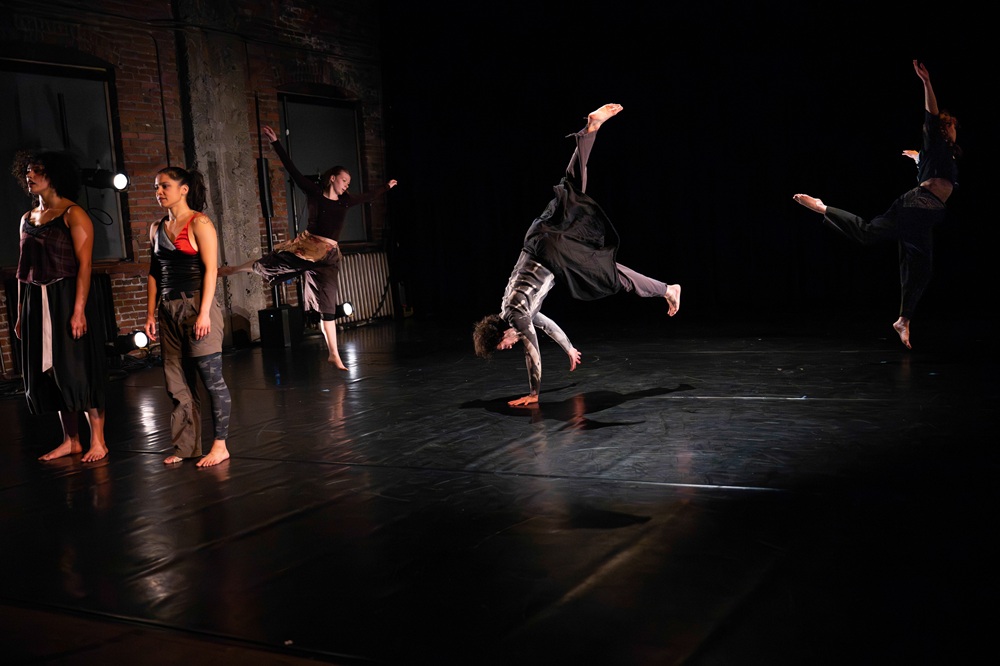
For their season at the Joyce Theater, the Trisha Brown Dance Company provided audiences with the opportunity to look back on her work as well as experience something new. The evening opened with Time Again, a mysteriously meditative work choreographed by Lee Serle in collaboration with the dancers. Serle is no stranger to Brown or her unique aesthetic; he took part in a mentoring program with Trisha Brown in 2010 (sponsored by Rolex), and has helped facilitate her work globally as an Education and Licensing Director since 2017. In this piece, dancers started seated on multiple panels of mats designed by Mateo López, which were then lifted and manipulated with reverence by the company during the piece, creating walls, screens, or even a tiny temporary temple, each gently obscuring some of the view of the dance unfolding onstage. Alisdair Macindoe´s sumptuous soundscore opened with what might have been birdsong before glacially shifting into layers of moody synthesizers. This evocative composition made each gesture onstage feel transcendent, as if the cyclical choreography were a ritual, the sound track charting each new state of consciousness. While Serle´s work highlighted the entire company´s talents, the performance of Burr Johnson stood out. Tall and muscular, he floated across the floor as he moved in multiple states of reverie, his articulation so complete that energy rippled through his toes, wrists, and fingertips. Such rich control of his moving body drew my eye to absorb more details of the rest of the company, all lit in a resplendent blend of light and shadow designed by Jennifer Tipton.
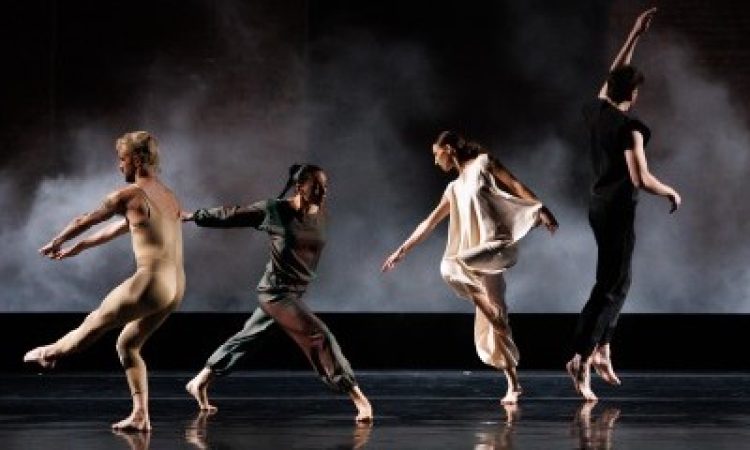
After intermission, TBDC dipped back into the past with two works over forty years old, each one accentuating the lasting powers of Brown’s legacy. The first was Opal Loop/Cloud Installation #72503 (1980), a quartet set within an atmospheric fog sculpture designed by Fujiko Nakaya. Save for the mist hissing into the space through hidden nozzles upstage, this dance was performed entirely in silence, a choreographic move that provoked the viewer to focus attention more closely onto the dancers´ bodies. At first, their long-limbed gestures seemed casual, even careless, as if the ensemble was a collective mind seeking to gather its thoughts. But as Opal Loop continued over twenty minutes, complex patterns began to crystallize. In this piece, dancers Ashley Merker and Spencer Weidie kept capturing my attention, demonstrating incredible precision within Brown’s signature vocabulary of liquid spine-rolls punctuated by a sharp, arm or leg line. Through the soft chaos of swirling fog, the orderly dancing exposed hidden geometries, inviting me to contemplate the vast degree of order and precision within my own body. During the final half of Opal Loop, the frequency of the choreography made a distinct shift: gestures slowed, and phrases proceeded in a presentational, almost instructional fashion.
Like Opal Loop, the final piece of the evening playfully stimulated new ways of perceiving a dance performance. Son of Gone Fishin´ (1981) began in darkness, providing a few moments to listen to the repetitive hum of music from Robert Ashley´s Atalanta (Acts of God). Leaning into the album’s pulsing phrases, a spirited tranquility filled the room, a gentle feeling that only deepened once the curtain rose, revealing the full company dancing on stage. The dancers gestured and flowed with joyful effortlessness, their joints seemingly liberated from any discernible tension as they moved across the space. Occasionally, the shoulders of two dancers knocked up against one another in a benign bump—not an accident, but merely another moment of kinetic delight. Of the three pieces on the program, Son of Gone Fishin´ displayed the most sheer pleasure in physicality for its own sake. The piece accumulated power through its intricate repetition, affirming that Brown´s glee for experimentation is alive and well, and perhaps more vital now than ever.
Trisha Brown Dance Company, The Joyce Theater, New York, April 29-May 4, 2025.