Blue, pink, purple. Black and white. Riots of cartoon-bright hues.
Verdi. Hindemith. Saint-Saëns.
Gracious regality. Thrusting angles and piercing lines. Mimicry, caricature, dramatic pathos.
Balanchine. Balanchine. Wheeldon.
Pennsylvania Ballet. Thursday, May 9th. 7:30 p.m.
The evening opened with Ballo della Regina, created for New York City Ballet star Merrill Ashley in 1978. Its gentle allusions to ballet’s origins—both royal and operatic—weave throughout the work’s virtuosic solos and duets (danced at this performance by Amy Aldridge and Zachary Hench). Hench was a generous cavalier, precise yet expansive, showing his partner to her best advantage amid the filigreed swoopings and groupings of ballerinas around the stage. Outstanding among them for their playful musicality were Abigail Mentzer and Gabriella Yudenich. The piece is unapologetically showy, with built-in bows for the soloists following their variations—she in balances, extensions, and pirouettes; he in leaps, beats, and spins.
The meat of the program came in the form of The Four Temperaments (1946), surely now as much a classic of the ballet repertory as Swan Lake or Giselle. Like those works, it was, at the time of its inception, both a crystallization of a form and a game-changer. With this work, Balanchine systematically laid out his neoclassical investigation of every tenet of ballet: verticality, turn-out, pointe, partnering, even gender roles. What didn’t he question here, explore, break open? Hips thrust, backs round and pull downward to the floor, feet flex, and bevies of battement-wielding ballerinas hedge in the male soloists. In this manifesto of ballet as American and contemporary, Balanchine voraciously absorbed and reworked not only the danse d’ecole but also modern dance and jazz, opening doors that current choreographers are still walking through. The work is stunning, moving, intricate, and puzzle-perfect, fitting canons, counterpoints, duets, solos, and choral encounters to the passionate precision of Hindemith’s score. Standouts in Pennsylvania Ballet’s performance were Brooke Moore and Jermel Johnson—she for her freedom in musicality and he for his fierce exactitude.
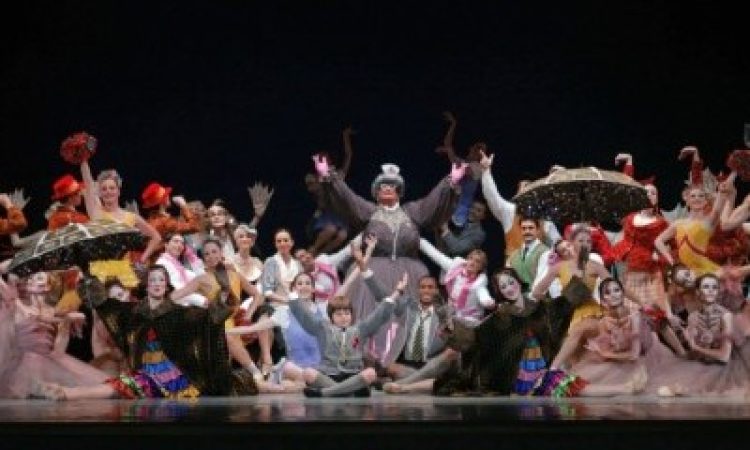
And, finally, who doesn’t love a bad-boy story? Carnival of the Animals (2003) is delectable and vivacious. In this highly episodic ballet, little Oliver Percy, danced by Lucas Tischler, sneaks into a natural history museum, falls asleep, and dreams up adventures with all the animals-come-to-life. Actor John Lithgow’s well-oiled narration guarantees that no interpretation is missed: hyenas are Oliver’s classmates, the baboon most certainly his piano teacher, the cocks and hens his friends’ parents, and—a pointed dance joke!—the dusty dinosaurs a corps of bone-thin ballerinas. Lithgow, waltzed around by a quartet of white mice, elicited laughs as he played the school nurse-turned-elephant, complete with bouncy bosom and bottom. Two particularly delightful scenes were the tortoises and the aquarium. In the former, Alyson Pray and Yudenich were a pair of aged Folies Bergère can-can dancers, transformed into tortoises as they relived their splits and ruffled kicks in cranking slow motion. The aquarium featured the lithe and sexy Lauren Fadeley as the school librarian-cum-mermaid floating amid a school of exotic fish. Some scenes were touching: Brooke Moore and Ian Hussey brought tenderness to their roles as Oliver’s anguished parents, missing their little boy. And Julie Diana, as Oliver’s aged aunt, danced a tragic remembrance of her days as the Swan Queen, her subtle gestures of despair eliciting a fleeting appearance of the Swan’s bourrées across the stage. In all of the episodes, Jon Morrell’s scenery and, especially, the costumes, were bright, funny, and fitting.I attended the show with my niece, not familiar with ballet. She loved Carnival. The audience gave it a standing ovation. I found it a tasty dessert after the Ballo appetizer and the soul-nourishing Four Temperaments.
Pennsylvania Ballet in Carnival of the Animals, Academy of Music, May 9–12, 2013, http://www.paballet.org/carnival