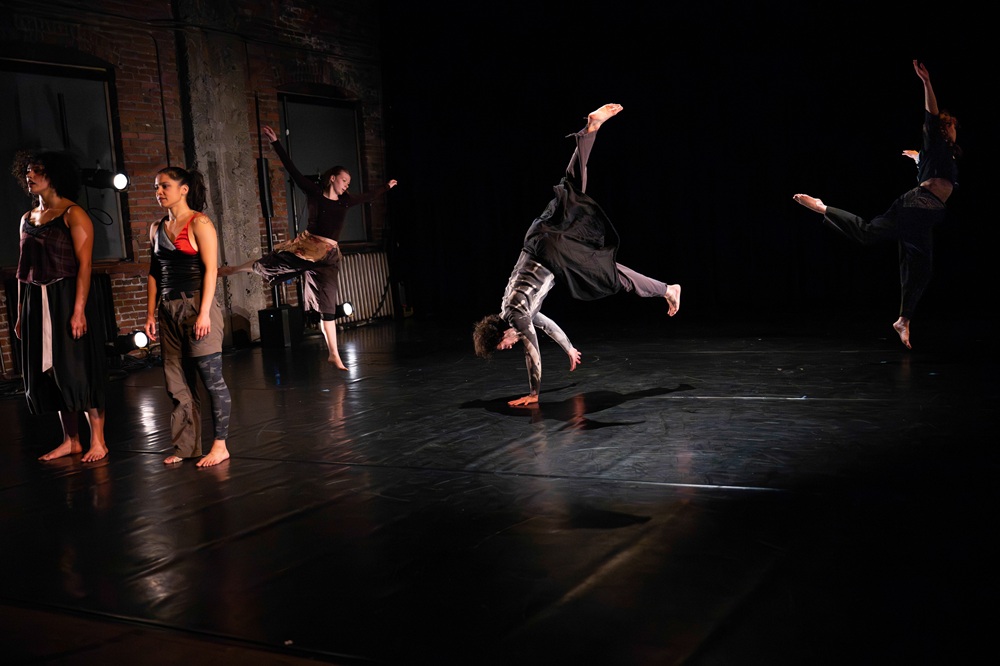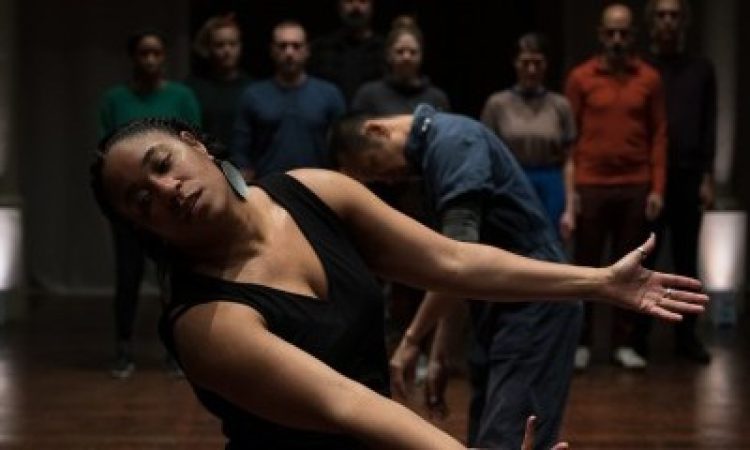
In all its honesty, vulnerability, and grief, CRONING (solo.duet 48:25) is a declaration of the discomfort and hard truths that accompany aging. Created by Shavon Norris and ensemble (Journee Lutz, Evan Mayorga, Matthu Minns, and vocalist Elle.Morris), this work acknowledges the initial avoidance and denial of aging, the grief in letting go of past selves, and eventually, the surrender and acceptance that allow the inevitable to unfold. CRONING makes space for the constant tug of death that becomes increasingly conscious as we age, to be recognized, complained about, and considered. Norris draws out the humor of it all through her embodied storytelling, which sends laughs throughout the performance space and reminds us that it’s okay to age – we all do it! We’re all going to die!
The Philadelphia Death and Arts Festival gathers artists, deathcare professionals, and community members at The Laurel Hill Cemetery to host events ranging from panels, performances, workshops, and experientials centered around aging, dying, and grieving. Over the long weekend event running from Thursday to Sunday, participants are invited to add their offerings to a community altar and mandala designated for honoring the dead. A selection of flowers, seashells, stones, and other natural tokens are laid out for guests near an outdoor lounge equipped with rugs, cozy floral furniture, and a sign that reads “your grief is welcome here.”
Ushers guide guests indoors just in time for Norris’ performance to start. Near the entrance, there’s an altar and materials for adding messages and mementos for ancestors, which invites folks to gather and mingle post-performance. I pass through white fabrics to arrive in the performance space, which is adorned with floral arrangements along the perimeter of the room. Once settled in, the lively audience’s chatter is silenced almost immediately when Norris enters the room. With a welcoming smile, her presence takes command as she arrives center stage to greet us, followed by a few grounding breaths, then a confession…
“I don’t know how to introduce this piece.”
“The things I have to welcome… they feel…” Norris squirms and makes a facial expression that lands somewhere between uncertainty and disgust. Wearing an all white two-piece pant and blouse set, she ponders out loud how to welcome this discomfort into the room in all its truth. She speaks of welcoming death and aging, and the grief they’re often paired with. As I sit in a room with windows that overlook acres of tombstones, Norris reflects upon the transition of live bodies to soil and stone, and particularly, “who gets to be in soil and stone.. who gets to rest.” Immediately, I think of identity and status; the garments that drape humanity …or rather distract us from it. What do I want to pass on to next generations? Wealth or dignity? The possibility of both feels fictional. I appreciate Norris’s words as a catalyst for these considerations.
Colonoscopy, blood sugar, air hunger, IBS – she reflects on the elements of aging as predecessors to death. “Lady”, “ma’am”, and then she yells, “MISS” in the matter-of-fact, attention-grabbing way that middle schoolers do when addressing the teacher whose name they forgot. She muses about what it is to witness beloved elders aging –assisting them in the process, caregiving, and in return, recognizing the aging elder in oneself. Accepting care and admitting to needing it. How to cope with the sense of diminishing desirability. How to sense one’s imminent fragility.
“We love to say ‘Black don’t crack’.”
With forefingers aiming at her own body, she begins poking. One jab at a time, body retreats from finger. Bit by bit, each staccato prod erodes her tall-standing posture down to a crouch. She descends until she’s near the floor, and suddenly both arms swing out and overhead. Straining frantically, she desperately gasps for air, as if she had been holding her breath the whole time. Rising to stand tall again, only to succumb to the same prodding motion. She repeats this several times. As a viewer, the movement motif makes me think about ways expectations of others are internalized and turned into standards that we hold ourselves to. The expectations become norms to which we then quietly agree, but didn’t choose.
The ensemble adds a depth to the work by symbolizing “past”, “present”, and “future Shavon”. They complement Norris’ storytelling with hums, a steady two-step, vocalized rhythmic respirations, and occasionally a synchronized, unifying gesture. Their simple and repetitive rhythms have a soothing, grounding effect. Elle.Morris sings lyrics from Kendrick Lamar, We Are KING, and Prince in timely moments throughout the work. Her resonant vocals amplify the tone of the piece. All together, they create a communal atmosphere for this grief work, which offers a supportive and affirming accompaniment in ways that mirror the kind of quiet, receptive presence one may need while grieving.
Norris’ storytelling is a vulnerable and courageous confrontation with her insecurities, judgments, and grief toward aging and death, which she alchemizes into acceptance by the end of the work. She does this by fantasizing about her funeral, unleashing inner feral urges, letting her hair down, laughing about it, crying a little, addressing it, even undressing down to a black sports bra and shorts. The work finishes with an air of freedom, acceptance, and allowing.
CRONING straddles fear and joy as Norris indulges multiplicity, humanity, and the ways that humor helps.
CRONING (solo.duet 48:25), The Philadelphia Death and Arts Festival, Laurel Hill Cemetery, May 29 – June 1.