Over two hundred chairs faced the steps to Grant´s Tomb when I arrived for Revival 9: Neighborhood Stories, the first of four free site-specific performances presented by Dances for a Variable Population (DVP) during June and August in multiple New York City boroughs. Behind where audience members had already taken their seats, an open salsa class led by members of DVP was just finishing up.
Before the performance, Myna Majors spoke about the company’s mission (translated into Spanish by Sofia Ameglio, a DVP Teaching Artist who also danced in the show), and how the focus of Neighborhood Stories was to gather some of the personal accounts from older residents living in different areas of the city: “To hear and learn from our local elders,” she said, “who have lived here for decades.” Using their collaborative “movement speaks” process, DVP Teaching Artists created the dances through a series of free workshop programs combined with these intimate narratives.
“But just because tonight´s dance is free, doesn’t mean it don’t cost nothin’,” Majors said to sympathetic chuckles from the audience. She concluded her pitch on how to donate to DVP and to get involved by saying, “We need you. And you need to dance.”
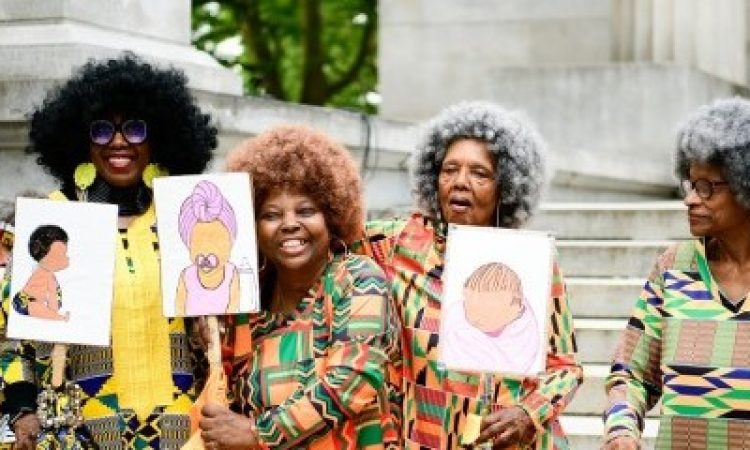
The opening dance set a festive tone that only grew over the next forty-five minutes. Choreographed by Audrey Madison and featuring music by Miriam Makeba, the dancers—ranging in age from 20something to 80something—in costumes exploding with vibrant color carefully took their place in front of the steps to the Tomb. Some sat in wheelchairs, and a few others used walkers or canes; their differences in ability mattered less than their connection through music and motion. They swayed in unison to the beat. The joy in their bodies and on their faces was infectious. Soon, audience members clapped and moved in time with them.
The culture of dance performance has long valued the young, the virtuosic, and the dexterous. But DVP´s event shifted the focus to something else no less extraordinary: the pleasure of moving, at any age, and the beauty of seeing multiple generations of people dancing together. Revival 9: Neighborhood Stories affirmed how all of us can dance, anywhere and at any time.
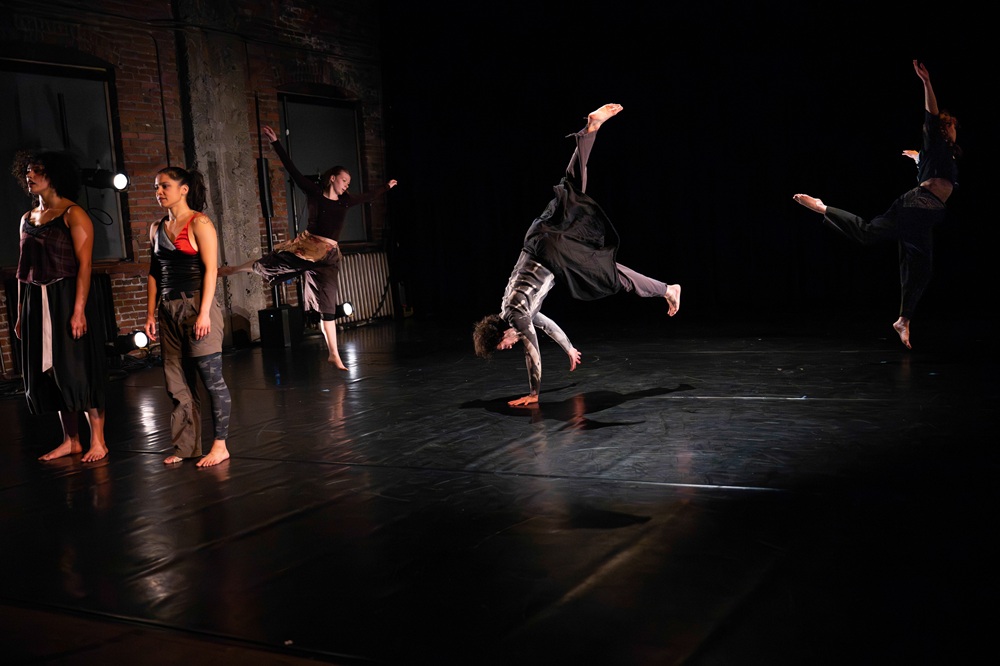
The varied program included a range of vocabularies and moods, framed within a delightful playlist that reflected the diversity of New York City itself. During Ellen Graff´s “Connections,” a jazz recording by Dave Brubeck played while her dancers walked in multiple directions together, evoking the isolation many feel despite living in a crowded city. After some near-collisions, they then pulled off red neck scarves, arcing fabric through the air in unison. Later, in Alfred Gallman´s enjoyable “A Block Party in Harlem,” fourteen dancers shook their hips, clapped their hands, and grooved to Aretha Franklin´s titular tune “Block Party” with more vitality than most people half (or one-third) their age.
As its title implies, Revival 9: Neighborhood Stories centered on community. Voice-over recordings of participants talking about their neighborhoods played between dances. “There are a lot of trees on my block and I really like that,” one said. Another talked about missing a jazz club that used to be down the corner from their building, and how sad it is that so many artists can no longer afford to live in New York anymore. But such stories were not only used to stitch the dances together, or to cover entrances and exits. In the piece “Save the Children,” choreographed by Majors, joy and anguish rubbed up against one another, illustrating the friction many residents feel in the face of seemingly endless violence impacting their communities. At first, fifteen dancers moved jubilantly to Heatwave´s 1977 classic “Boogie Nights.” When the music abruptly shifted to Marvin Gaye, the performers slowed, and clutched their heads in despair and raised their hands up helplessly to the sky. Each performer held a sign featuring an illustration of a young child. The two dimensional images of these lost children stared out, their faces remembered by this protective circle of octogenarians.
DVP concluded Revival 9: Neighborhood Stories with a buoyant salsa number choreographed by Kathy Sanson, which slipped into a finale by Naomi Goldberg Haas set to the Monkees.
By the end of the event, everyone was dancing–on their feet or in their chairs, it didn’t matter. The line between audience and performer had vanished. We were just a bunch of people from the neighborhood, dancing together and having fun. Isn’t that what every community should feel like?
Dances for a Variable Population, Grant´s Tomb Memorial Park, June 21, 2025.