For four evenings during a particularly steamy June week, audiences pile cozily into the Brick Theater in Williamsburg, Brooklyn to witness the Queer Butoh Festival 2025, facilitated in collaboration with Vangeline Theater/ New York Butoh Institute. The performances, spanning two different programs and just shy of three hours on some nights, become an endurance event. And yet, the energy in the overheated crowd remained unwaveringly focused.
Butoh originated in Japan in the late 1950s and early 1960s, largely as the result of a desire to break from both Western and traditional Japanese dance styles post-WWII. For the uninitiated, butoh tends to be a slow-moving practice, with dancers standing or sprawling in lengthy stillness, holding a single shape for sustained periods. Dancers’ hands and feet present in a similarly languid state, unstretched and paw-like, or protectively sickled toward the body. Alongside this bountiful slowness, the Queer Butoh Festival provides a rare generosity of access, cross-cultural inspiration, and narrative layering.
French-Cambodian dancer Ama offers a lush example of physical vulnerability and access in “Dove Of Dawn.” Clad in bird-like feathered epaulets, Ama spends a significant part of the piece curved forward to hide her face, executing small, delicate hand gestures as if picking whispered secrets from the air. Gradually tilting upright, her collarbones and face appear like luscious gifts when we finally see them. Ama offers first her open mouth for the audience to peer into, then the soles of her unpointed feet when she transitions to writhing motions lying on the stage.
“Fruit of My Woman” by Oxford-based Alice Baldock gives similarly intimate access. Sitting with her legs straddled and bent, spine exposed, Baldock presents as a sturdy, thoughtful triangle. In a violent hugging motion, she grabs at the flesh of her back, leaving reddish prints behind. The audience receives Baldock’s uncomfortable fingerprinted signature as a visual metaphor for what the program describes as the “suffocating pressures of ‘straight time’—to get married, to have children, etc.” Ultimately, Baldock bites open a pomegranate, sullying her dress with chunks of the fertile fruit.
Baldock’s pomegranate is not the only fruit in this still life. Scattering an explosion of citrus from a jaunty red suitcase, Brussels-based artist Quentin Chaveriat treats the audience to a stage full of lemons and limes in his richly layered performance of “Leonora,” — one of the weirder delights of the evening. Based on a story by painter and writer Leonora Carrington, “Leonora” takes the viewer on a ride through Carrington’s psychiatric internment in a Spanish institution after the arrest of her lover. Chaveriat dons sumptuous drag (a fluffy coat, jewel-green negligee, sensible flats, and a long brunette wig), then traverses the stage in escalating, eccentric paths: tentative knock-kneed steps, a jig, and hip thrusts. He ultimately slumps into an upstage corner, having lost his outfit and exhausted himself. References to horses thread through the performance in the form of wall projections, patterned bed sheets, and a jacket painted with an image of a horse. Chevariat finally dons the jacket and departs with his packed suitcase.
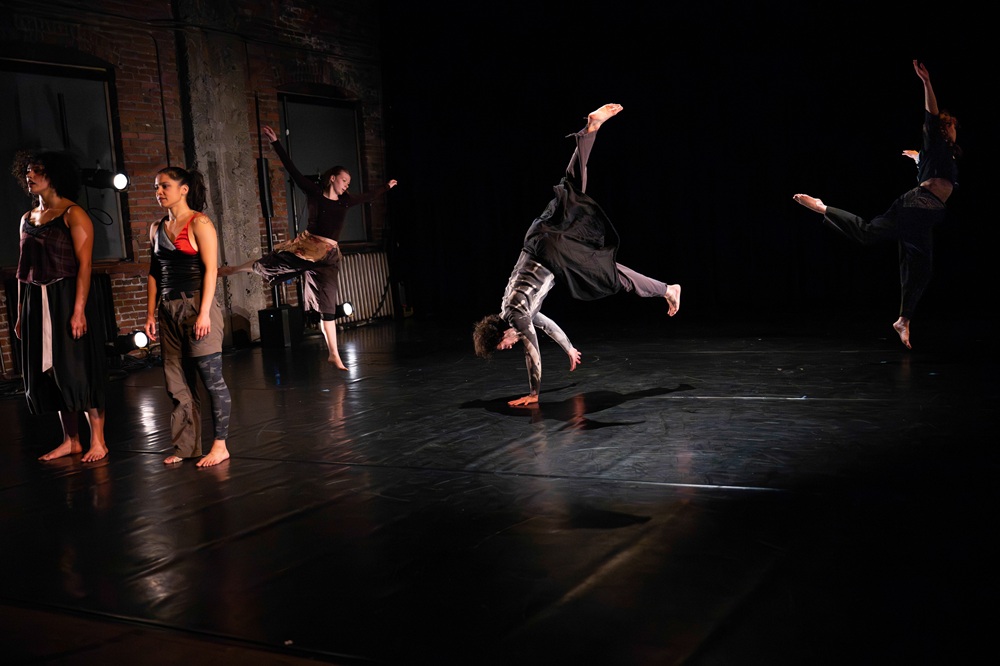
Vangeline, artistic director of the Vangeline Theater/New York Butoh Institute, presents two collaborations which mine painting for inspiration: “Down Amongst the Plants” (performed by England-based Surface Area Dance Theatre) and “Human on Human” (performed by the New York Butoh Institute, with Shahryar Shahamat). Projections on the back wall in “Down Amongst the Plants” point to Nerys Johnson’s bright floral work, casting vibrant colors onto the four dancers and their intricately ruffled and ruched white costumes. At one point the dancers form a tight circle and soloists peel off, performing chaotic turns around the group, alternating between athleticism and stumbling surrender. Brief flashes of clean balletic lines pass by, hinting at the classical training underpinning some of the dancers’ work. In contrast, “Human” presents radical stillness in which to perceive the dancers; they are nearly entirely motionless as they slump against walls and across the stage. Shahamat sits and paints slow circles on a pale surface in the center of the stage, providing an easy point of focus for an impatient eye.
By definition, queerness differs from the common, usual, or assumed. And so it follows that queerness is inherently aligned with butoh, given its departure from cultural and aesthetics norms, lacking the tense uniformity of many other forms of technical dance. But, beyond these points, Queer Butoh Festival 2025 lands as a celebration of queerness in its generous diversity of performers, costuming, and content, with or without its rainbow-hued paintings and fruits.
Queer Butoh Festival 2025, Vangeline Theater/ New York Butoh Institute, The Brick Theater, June 25-28