Bach Cello Suite Project, by dancer Megan Bridge and cellist Tristan Price, is a series of works by the mother-son duo that perform J. S. Bach’s acclaimed cello suites 1-3 at the Philadelphia Museum of Art. The project premiered in 2023 with Cello Suite No. 1, followed by Suite No. 2 in 2024. Bridge and Price gather audiences again this year in the Great Stair Hall of the PMA for their third exploration of dance improvisation to the third classic cello score.
Bridge is a Philadelphia-based dancer/choreographer, dance scholar, and co-founder of Fidget Space; an experimental performance venue in Kensington, as well as a professor at Temple University where she teaches improvisation and contemporary dance. Price is a local cellist and Bridge’s son. Mother and son take the stage, but the work’s production engages the whole family. Peter Price, composer and co-director of Fidget, is the dramaturg for the work, and Freya Price styled Bridge for the show.
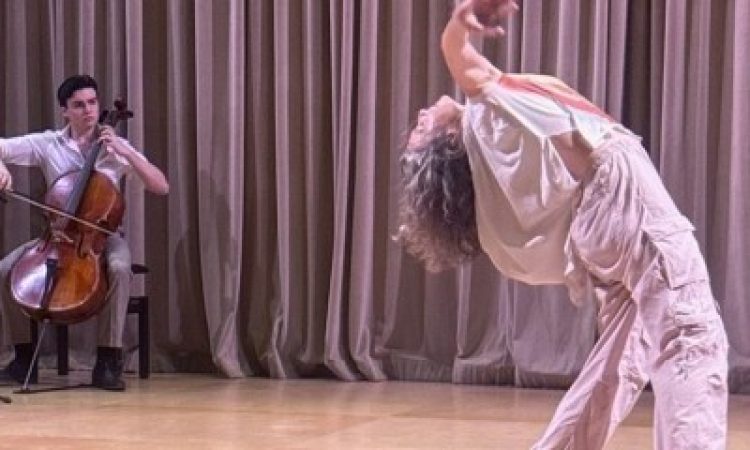
Price’s rendition of Bach’s “Cello Suite No. 3” resonates eloquently through the open stairwell while the quiet chatter of passersby and museum goers contribute to the casual ambiance. His musicianship paves the way for Bridge’s play. In her opening remarks, Bridge notes her affinity for experimentation and spontaneity in movement, deftly embodied in the performance. At times, her movement responds to Price’s staccato strings in the form of quick-witted isolations. Other times her movement bends low in harmony with deep cello notes, then gains momentum, ascending in sync with a quicker cadence, only to pause and linger in an airy suspension that tests her balance.
The exchange between dancer and cellist takes different forms throughout the nuanced score. The more upbeat measures summon a playful banter between the artists seen in hops and skips by Bridge whose affect brightens as she turns toward and away from Price in sync with the chipper tempo. Bridge’s play soon evolves to deliberate elongations of body that bask in the beauty of the song and mirror the drawn out strokes of Price’s cello bow.
Bridge’s focus catches my attention. Her gaze is either internally focused or looking outward, cycling from Price to the audience throughout the work. Her eyes are sensing and responding, information-gathering perhaps, or receiving stimuli for movement impulses. Bridge’s commitment to the embodied presence that improvisation requires is evident. Meanwhile, Price’s attention rarely strays from Bridge. Fixed, like the Bach score he renditions, his eyes follow the dancer while his music conducts her movement.
I can’t help but wonder how the personal relationship plays a role in the dynamic between these artists. From my bystander point of view, I imagine this creative exchange as symbolic: a parent responding to their child’s maturing agency with a willingness to follow and respond. Like an experiment in role reversal, or a transfer of leadership, of responsibility, and of trust.
Bridge’s attunement to both her son’s instrumental expertise as well as the gestural dances that the cello playing draws out of him is returned by Price through his responsive expressions and watchful gaze. The exchange indicates their presence and connection with one another adding character to the work, with a sense of mutuality and harmony.
Bach Cello Suite Project, Fidget, Philadelphia Museum of Art, July 12.