A square, white platform sits in a theater-in-the-round. Performers, standing behind the audience, begin to sing individual words. The words are disconnected, but harmonize, creating a soundscape. The cast of Weathering emerges, taking turns stepping onto the platform, which sinks under their weight. They cycle between singing and entering, exiting, until all return and climb aboard.
Prolonged silence. Performers gaze out, frozen. Their faces portray angst, contemplation. The lights have not dimmed; the audience meets their eyes. There is discomfort as the silence stretches. “Is this forever?” An audience member in the front row exits.
Realization: the performers are moving in hyper-slow-motion. One moment they seem to be frozen, and the next they are reaching; then gripping. This seems both uncomfortably slow and suddenly jarring. They clutch skin, jackets, faces. One performer’s finger hooks inside another’s mouth before sliding out, drool dangling in the disconnect.
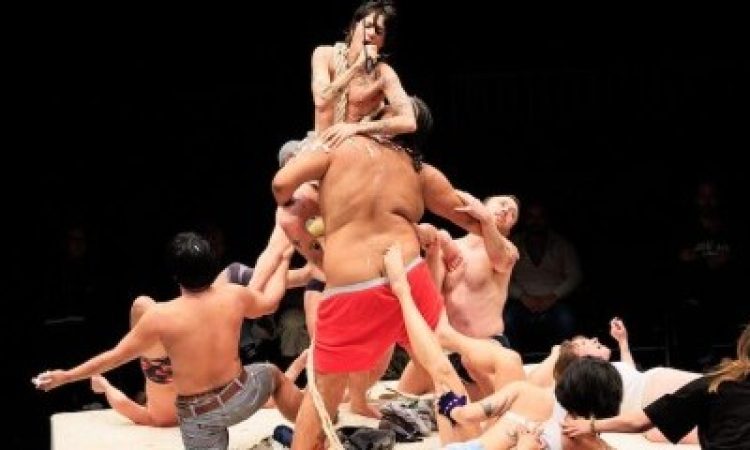
Two crew members descend several times to the platform’s corners and push. The third time they lay down, pushing only with their toes. Eventually, a few performers take their place. The performers atop begin to strip one another. Cory Seals pulls the puffy, brown coat from Mykel Marai Nairne’s body and over his own head. One performer, down to their underwear, tosses away what appear to be silicone ass cheeks.
Seals, in bright red boxers, lifts a shirtless Jo Warren to reach the microphone dangling above the platform. Warren grips it in their hand, a rope draped over their shoulder, and they… croon? cry?
The piece begins to accelerate. Each rotation makes visible something new. A performer peels an orange. Another rubs (water? lube?) down exposed skin. Another eats something green, perhaps cilantro? Spin, strip, spin.
Choreographer and director Faye Driscoll joins the melee, tossing discarded clothes out of the way and pushing the platform faster. Somewhere around this point, I ask myself if they are portraying zombies. Chaos; intimacy.
Audience: startled, horrified? Someone in the audience across from me crosses their arms over their chest and later holds their cheeks in their hands.
The platform slows. Performers sit. One drapes themself across the laps of two audience members. There is mild laughter at the couple’s apparent discomfort as they try to figure out where to place their hands. The lights go out.
Weathering shocks and jars. It asks us to slow down, look, and ask ourselves: Are we already too far gone?
Weathering, FringeArts, Fringe Festival 2025, September 4-6.
Note: Performer Cory Seals is also a writer for thINKingDANCE.