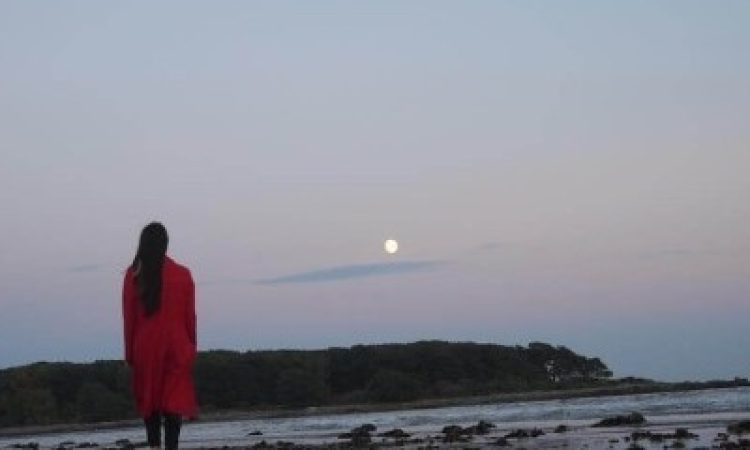
I felt disoriented as I walked through the damp field past the barn and the red sculpture dangling in a tree, toward the Studio Complex at Kaatsbaan Cultural Park. It had been a long drive, and there was a lot going on astronomically: a full moon and a lunar eclipse (not visible from North America but still felt—my astrology app told me—by everyone). I’d been reading about these celestial events in preparation for seeing Lunar Retreat, an immersive performance created by the Philadelphia-based dance artist Nichole Canuso.
Lunar Retreat, inspired by the distance that’s growing between Earth and the Moon, purposefully coincided with September’s Corn Moon. It was made in collaboration with ocean explorer and visual artist Rebecca Rutstein, sound designer Bobby McElver, scenic designer Anna Kiraly, and video/projection designer Kate Freer. I knew these facts while waiting in the lobby but had no idea what to expect once I was behind those wooden doors.
The show begins in the Black Box Theater. The audience sits in a circle of chairs on the marly floor. Canuso, barefoot and wearing breezy pants and a sleeveless top, joins us and introduces herself. She explains that what we are about to see is still a work in progress. “We are in this most delicious phase of discovery,” she says before telling us about the dream she had: being born through the earth’s crust, swimming to the surface, turning into a bird and floating up to survey the land. Her gestures are subtle at first, but as they grow larger, I understand that this is choreography, that Lunar Retreat has already begun. “I saw you there,” she says to a child, leaning forward. “And you, and you.” She points to all of us individually, calling us out and inviting us in. “We were all there.”
Canuso leads us to the Horses Studio, hung with sheer blue fabrics, where we stand on white dots. When the full moon reaches peak illumination at 2:09, she and six others slowly spin around the room and glide between us. Occasionally, a dancer touches my shoulder and gently guides me to a new place in the room. We are planetary bodies in orbit, rearranging ourselves to the sounds of waves and bird song.
Then we sit at lamp-lit tables and open a letter which reads: Think of someone you haven’t seen in a while. A person who is physically distant that you hold close. I am thrown by this unexpected intimacy, but follow the instructions to picture them there, moving around the room, to think of their voice, to write down a detail about them I hope I’ll never forget.
We sit on a bench outside of the studio and put on headphones. A voice tells us to think of our distant person and choose a stone from the pile beside us that reminds us of them. My stone is cratered and multicolored. I blink back tears.
We walk through a curving maze with spots to sit and explore memories scrawled on slips of paper, tide tables and lunar declination charts, drawers that open to reveal video feeds of people dancing on a rocky beach.
Back in the open area, the dancers move through watery projections. After, we are invited to rest on the floor or wander around. I do both and then sit at the lamp-lit table where a new prompt reads: This space is for you. If you’d like, you can take some time to write a letter.
The audience comes-to around me, chatting softly about the past hour, but I write a letter I’ll never send because my distant person is no longer on Earth. But the universe is big and growing and I’m reminded that there’s so much we don’t know.
Lunar Retreat was an unexpectedly profound performance experience, and I can’t wait to see how it evolves for its world premiere at the 2026 Philadelphia Fringe Festival.
Lunar Retreat, Nichole Canuso / Branching Paths, Kaatsbaan Cultural Park in Tivoli, NY, September 6 and 7.