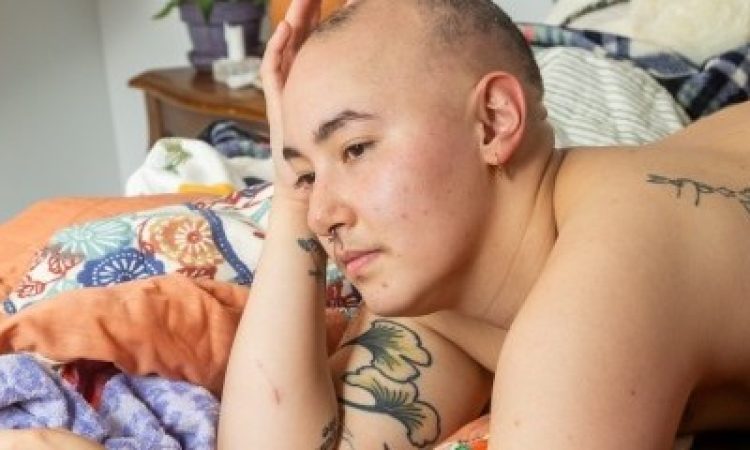
This is the moment I feel most entranced: Ada Fujita stands behind the top right corner of their orange quilt, which they’ve spread like a ceremonial stage. They wrap their arms around their waist, touch their shirt hem, and glacially shave the blush pink cotton t-shirt up their torso. I see their tattoos, then their top surgery scars, thick and purply red. Their face disappears.
I’ve been told performers like to get naked in Fringe shows–in fact, three of three shows I’ve seen so far involved degrees of undressing. So it’s not remarkable that Ada takes their clothes off. But I’d like to note the way they do it. Like a patient love, they behold their own body. Their shirt becomes an heirloom through their delicate, time stretching slip of the fabric from their forearm. They fold forward over themselves to place it at their feet, showing us their naked, tattooed back. They gleam with sweat, it drips from the top of their head.
I wonder then about their relationship to their body. Is this the source of their title, Body By September: alongside the dog and other important things? Whose Body? September the month? “September” the song? September the name of a person or a cat or a dog?
Though the devotion of Ada’s undressing sequence captivates me, I’m unsure how it’s relevant to the video that follows. A projection of their dog, Linda, fills the entire wall. Linda dozes–on the couch, on blankets, on her belly, on her back. Ada watches with us, lounging in their black thong. I get sleepy and start to hear the creek of people shifting in their chairs, cracking their knuckles, crossing and uncrossing their legs.
In their solo show produced by Cannonball, Ada Fujita rests, luxuriates in circular movements, shares a gummy snack with some audience members, and gives a eulogy to shelter dogs and cats who’ve been euthanized.
In the beginning, I relax into witnessing Ada Fujita glide through resting shapes that grow into slow stretches and rolls. A playlist of Motown songs is upbeat compared to their slinking, unhurried movements. Spread, fall, swing, roll, open, linger– they follow the weight of their head, suspend their falls and meet the ground like puddy. This dance, which lasts about the first half of the piece, and the closing one, seems to be for their own pleasure. They look down to the quilt, at their own body, rarely at the audience, rarely at any one place with force. Their face is soft, relatively expressionless, sad maybe, pensive maybe, or simply resting.
During the eulogy part, in which they wear a silky black suit coat, Ada tells of many last meals, most involving McNuggets, they shared with Minnie, Allie, Lynette and other shelter animals. Each taught Ada a lesson and gifted them the opportunity to love and to mourn. I wonder then, if their opening playlist consists of one song for each animal. Regardless, their ceremony prompts me to ask: how does our attention to rest and our attention to animals with chronic health and traumatic behavioral patterns relate? I think it has something to do with patience? And I’m certain Ada Fujita has much passion to tell you about it.
Body By September: Alongside the dog and other important things, Ada Fujita, Icebox Project Space Gallery, September 7