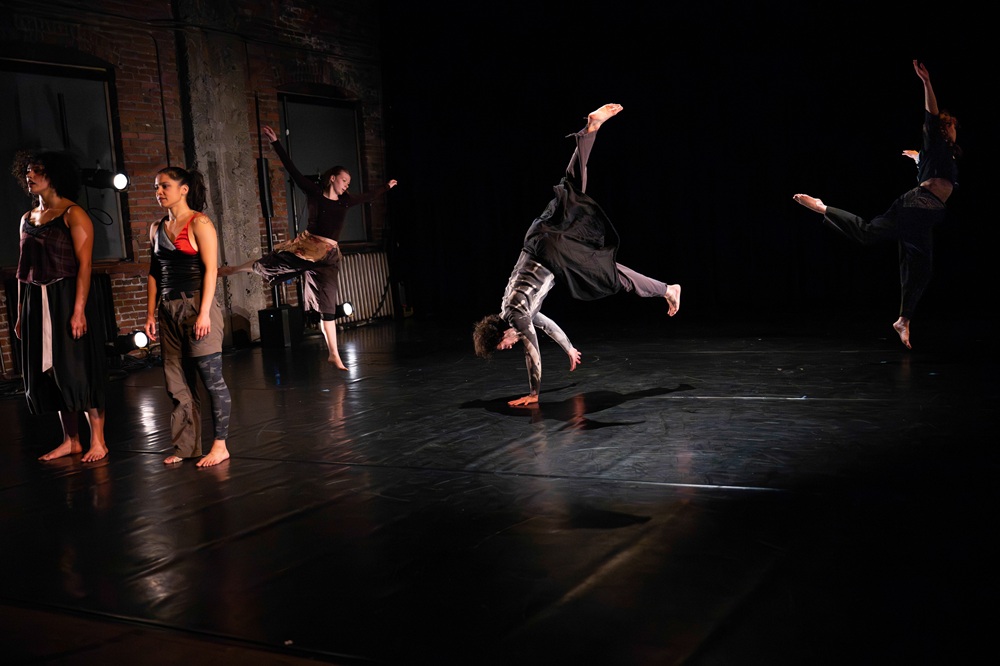
The Whole Shebang in South Philadelphia feels more like a cozy living room than a theater—wood floors, a grounding carpet, a lone indoor plant, and no mirrors. The intimacy suits Dispatches, a program that grants artists studio time for research before asking them to share the results. August 31st’s double feature belongs to Lu Donovan and Jungeun Kim, two movers who push the jagged fullness of being human into frame.
Donovan floats in, microphone in hand. He begins by serenading us with O Mio Babbino Caro–that seraphic melody is unmistakable. No shirt, long black skirt, bare feet, small silver mic: I sense a Catholic theme.
To sing O Mio Babbino Caro in a space this small is risky, but it is achingly beautiful. For a moment, the studio becomes a miniature cathedral. Whatever you believe in—the Holy Spirit, the Divine, the Flying Spaghetti Monster—it feels present here.
This piece isn’t about worship. It’s about wrestling—faith as beauty, burden, and question mark. There’s also a verbal wink to Mr. Mistoffelees by name—the magical black cat from Cats, a trickster who conjures dazzling change out of nothing. Hope in sleight of hand. In a work already steeped in Catholic gravitas, the nod reframes holiness: not only solemn, but slightly mischievous, hard-to-pin-down, alive–and always, always in motion.
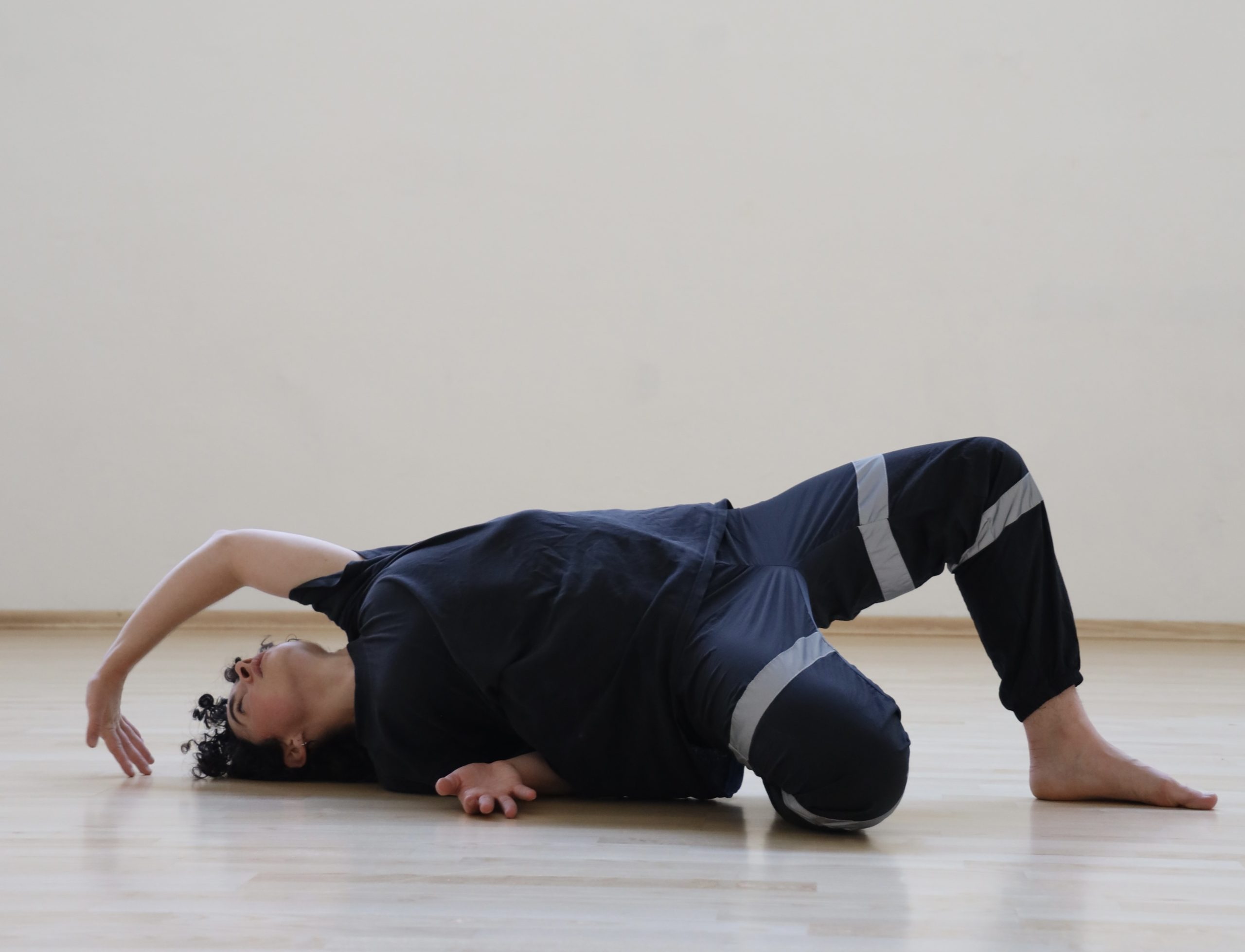
A keyboard chord swells, sending shivers down my spine. The sound holds as a tonal drone—sustained notes forming a steady anchor, more trance than forward motion. Similar to a sound bath or ASMR–this is transcendentalism embodied.
A low, buzzing hum underpins everything, the anchor for what Donovan has called “repetition, relief, and release.” With each cycle, he sinks deeper, and the room drifts with him. The movement begins understated, repetitive, always angled upstage left. Each gesture lands like a prayer-loop, part ritual, part groove. Circular port-de-bras give the choreography a cyclical quality–perhaps, a nod to Eternity.
As a mother who lives in loops—rock, feed, change, repeat—I recognize the sacredness of repetition. The mundane becomes holy. At one point, Donovan rises into a first arabesque on demi-pointe and holds–and holds. What he is doing is technically difficult, and the balance held reminds us that in both life and dance–balance is hard.
Where Donovan fills the space with sound, Kim begins with silence. She stands facing forward, feet parallel, hands over her eyes. Palms out: shielding. Later, palms in: hiding (some religious traditions might argue, praying). It’s storytelling through movement–simple and hypnotic. The room holds its breath.
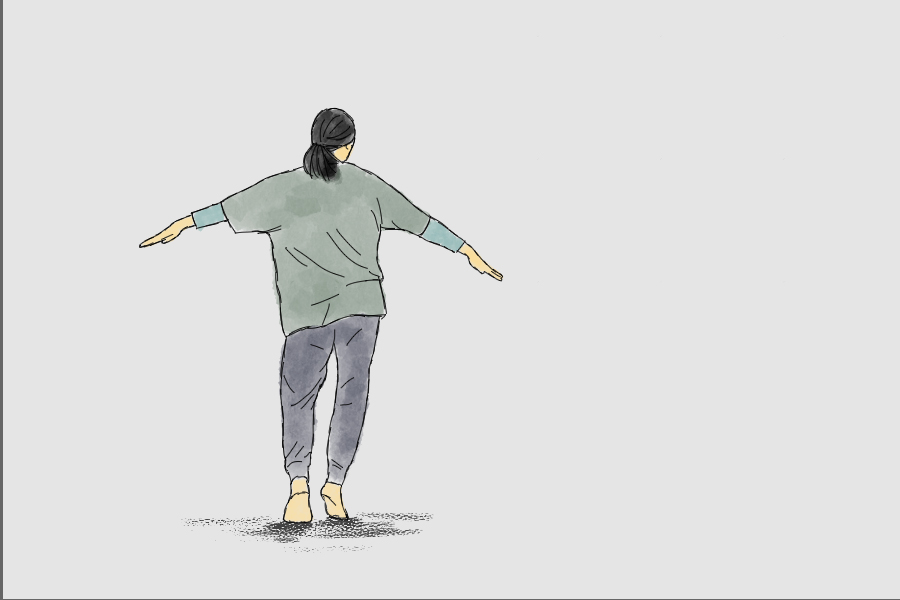
Minutes stretch. Stillness grows louder. When Kim finally tilts forward, the air shifts. She becomes more hurried, more frantic, more explosive. We see her face–but only in moments. It’s like watching someone argue with herself in slow motion: afraid to look, too curious not to. Her restraint is deliberate. Every micro-shift feels seismic. Kim is safe behind her hands, but only barely. She moves in bursts—extension, collapse, a sudden shift of weight—reaching toward something just out of reach, then pulling back into herself. Watching her is like watching the body wrestle with the soul’s impulse: to seek what we fear, to reveal, then retreat.
Wanting it, fearing it, wanting it again: I’d argue that this is a paradox that belongs to all of us.
The two works unfold as opposites, but together they act like mirrors at odd angles. Donovan cracks open Catholic iconography, suspending viewers between reverence and rebellion. Kim holds us captive in stillness, mapping the tug-of-war between desire and fear. One is maximal—singing Ave Maria in an intimate, shoebox studio. The other is minimal—barely moving for long stretches. Both circle the same truth: being human is complicated, messy, occasionally (if you are paying attention) divine.
As Donovan closes, he speaks: “Ave Maria is not just for December. I’m pretty sure the saints have rotten teeth.” The words land like a benediction and a dare. Beauty and awe cannot be confined to ritual calendars or glossy icons. In the end, a captive audience is reminded that Sacredness can arrive in the grit of an August Sunday in South Philly just as surely as in a crowded church in December.
Dispatches: Reports from the Interior, Lu Donovan and Jungeun Kim, The Whole Shebang, August 31.