When we think about hustle culture, frogs don’t usually come to mind. But the life cycle of this amphibious creature is steady and growth-oriented: one day you have a tail, the next you’re ingesting it and spewing legs to move deftly between water and land. Swimming to kicking to jumping. You’re nimble, adaptable, versatile. There’s measurable growth. Aren’t artists all of these things––and don’t they need to be to survive?
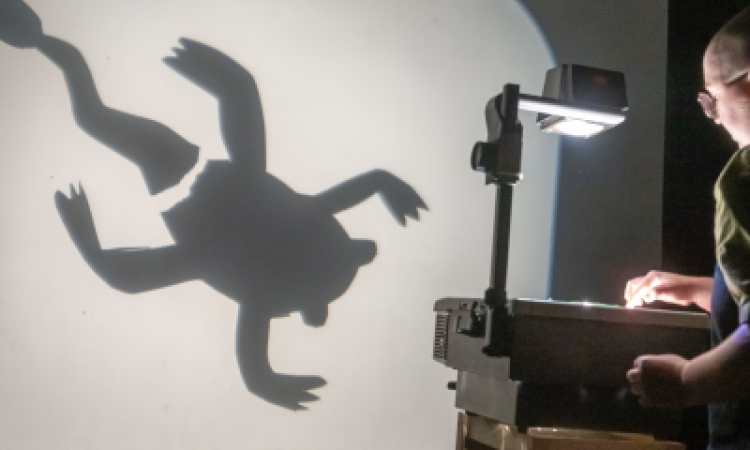
Madeline Shuron probes these questions in i don’t have the right words for it yet, a one-person show that switches regularly between modalities and props, from auto-harps to old-school overhead projectors to audience discussions about success vs. failure to a large frog puppet. Stay with me.
Shuron posits that artists must pay a price for their long-term ambitions. For the practice of putting themselves, vulnerably, in front of an audience and hoping/expecting/striving for a positive response. They demonstrate this longing via a faux acceptance speech to the words of Anne Baxter’s breathy-yet-commanding monologue from All About Eve, a 1950s film tracking Eve Harrington’s shadowy ascent to fame (which, coincidentally, made Baxter a star in real life). One of the most transcendent lines of the script: “If there’s nothing else, there’s applause… it’s like waves of love coming over the footlights and wrapping you up.”
Shuron desires this love. They exude genuine warmth, and their poignancy seeps through most when they share vulnerable memories from childhood: all they’ve wanted their entire life is for people to see them, acknowledge them, and like them.
Shuron’s loose and tender movement is set against a vintage PowerPoint presentation on the life cycles of frogs. This leads into another vignette which depicts an imagined memory of a High School biology dissection. As a frog is cleaved in two, exposing glistening viscera on the backdrop, Shuron holds and then places a large frog puppet over their head.
The piece’s abrupt ending leaves the audience with imagery of change in many forms: on screen, in a body, through dialogue. It would have been interesting to see the opening sequence rolled through once more: how do we view a metamorphosis in a new way, through the lens of an artist continuing to make work as they age? Is hustle inherent in every stage? Does the frog winding up in the jar mean that Shuron reached the it that the title alludes to? And what is it exactly? Stability? Love? Belonging? Shuron might not have the right words for it yet, but as a young artist, they have many years to find them.
i don’t have the words for it yet, September 11-25, Asian Arts Initiative Black Box Theatre, Philadelphia Fringe