Ritual and performance have been friends for a long time. Performance as ritual. Ritual as performance. India is a master of this relationship. Each breath of ritual on the subcontinent—from the religious to the personal—contains careful symbolism, emotion, and history. Classical Indian art forms, including Kuchipudi (a multi-pronged dance-theater odyssey full of subtle expression and notoriously challenging footwork), showcase these rituals for the masses. Kasi Aysola’s company, Prakriti Dance, emulates this precision and mastery with humor, devotion, and a reliably dramatic flair in Ritual of Identity, punctuating each physical moment with lineages of mythic emotion that never curdle.
One dancer in a black-and-gold saree with silver accents begins seated on a stage cube, creating something with her hands. Sometimes, the creator plops down muddy earth, invisible to the eyes, but audible to the ears. Sometimes, she plays with fire, hands flitting above imagined flames that lick her fingertips. It’s already entrancing to watch this careful craftsmanship, but what transpires after another dancer emerges downstage, lying on the ground by the creator’s feet, makes it nearly impossible to look away.
In a moment of unbelievable synchronicity and tight animation, the creator breathes spirit and movement into this seemingly lifeless body. The marionette miraculously awakens with careful eyes that glance at each corner of the room. She adjusts to her new body as a puppet on invisible strings that seem to lengthen and contract, moving her limbs through new imaginations. From this character unfolds a life story of solemn death, gregarious birth, sass-driven adolescence, and blessed marriage, consecrated by a deity-driven fight for the ages.
Through a life-cycle of crying eyes and pouting lips that ages into love and betrayal, each stage of performance told by an ensemble of four captures the fleeting spirit of time. One moment, however, seems to stop time entirely. The ensemble leaves just a soloist onstage, looking through a stack of drawings—caricatures of suitors for marriage. She stops at the last picture, looking up to see Aysola, a spitting image of the drawing in her hand. I laugh, imagining that Aysola must have enjoyed choreographing this part—both because of the cartoonish self-depiction but also because sliding through matrimonial profiles is such an Indian, arranged marriage way of finding love.
My laughter stops as the performers circle each-other in a center pool of light. Their loving tears brim over, two souls entranced by their found love— saccharine romance made incredibly believable and heartwarming with a precise, practiced expression of transfixed awe. The moment is spellbinding, and like the Hindu rituals that pepper the show, it is sacred.
Ritual of Identity, Prakriti Dance, Icebox Project Space Gallery, September 25.
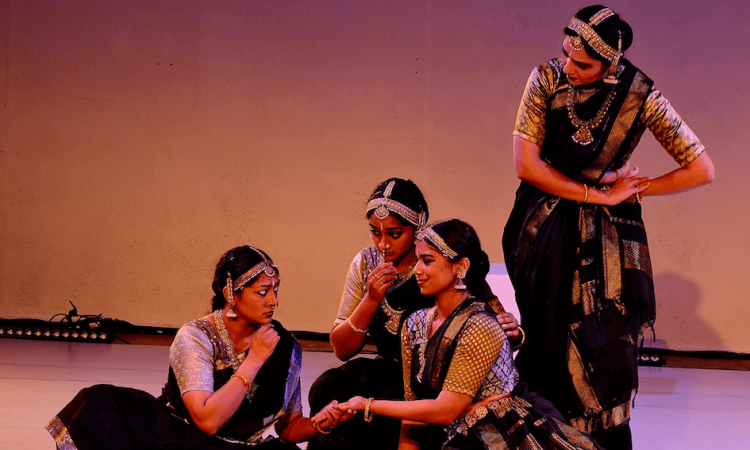
Homepage and Article Page Image Description: Four women gather onstage, three seated and one hovering above, creating a palm-reading tableau together. They wear black-and-gold metallic sarees and ornamental jewelry that adorns the crown of their heads. The dancer whose palm is being read wears a smug smile on her face while her two friends and the palm-reader seem puzzled, hands to their chins in contemplating her fate.