I graduated with my MFA in Dance on May 10th. I flew from Texas to New Hampshire on May 12th. On May 13th, I started my seasonal job leading trailwork events for volunteers in the White Mountains and, on that same day, I referred to my dancerly identity in the past tense for the first time.
Seasonal work comes with a lot of newness, many “who are yous?” and “what’s your deals?” and “where did you come froms?” in their various forms. If the job is seasonal, then there is an understanding that there are other seasons and that, presumably, the seasonal workers are doing something during those other seasons. And, people are curious.
The question came up on day one. “What do you do during the rest of the year?” a soon-to-be friend asked me.
“I was in school. I just finished my Master’s Degree.”
“In environmental science?” (This is always the first assumption since I work in the woods, which tickles me deeply. I in no way have a graduate degree in environmental anything).
“In dance.”
“Oh! Are you going to be a dancer after this?”
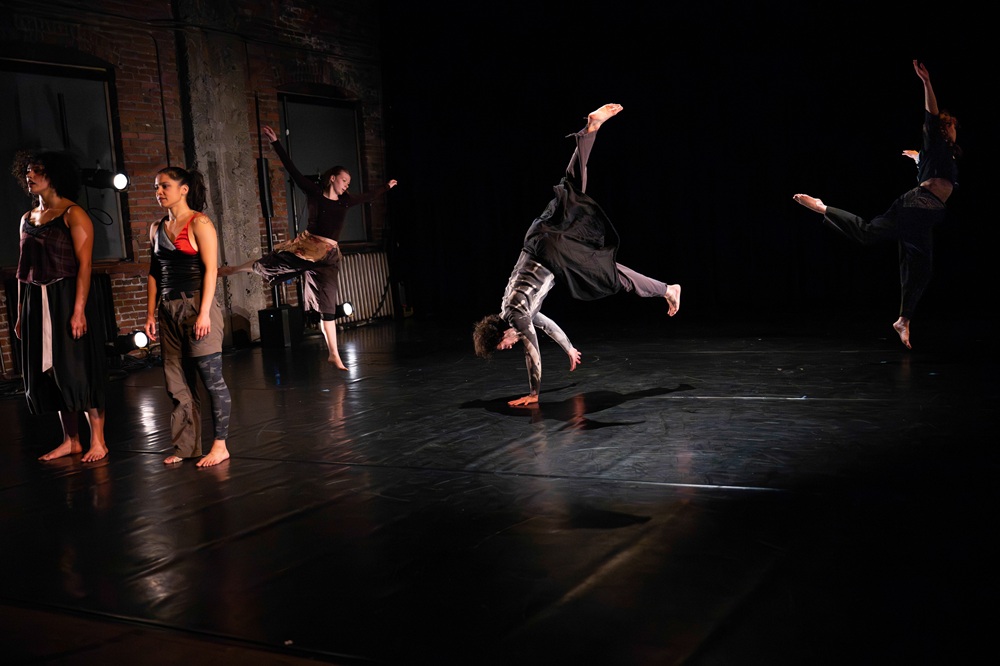
“I was a professional dancer for a decade. Right now, I’m here. After? I don’t know yet.”
There it was.
—
The past tense was supposed to mark the end. Downfall reached. Soul combustion evident. But the past tense didn’t bother me. Which was confusing. Because I was sure that it was supposed to bother me.
I started my career thinking that a pause (god forbid an actual stop) was a proverbial death sentence to be marked by the convergence of two separate events:
1) The actual not dancing anymore part
2) The identifying as having “danced” in the past tense part
Avoiding the latter matter was, and remains, preserved in the many uplifting articles of the “once a dancer, always a dancer” variety peppering the internet. There is something beautiful and hopeful in that messaging, but also a sense of grasping. The writings remind (urge) those of us who have lost, or paused, or given up, or otherwise stopped dancing for whatever reason, to keep calling ourselves dancers. Because we are. Always. Aren’t we?
But what if, when we aren’t dancing, we aren’t dancers? And what if that isn’t a crisis?
The title itself has become the trophy. It’s shiny and too important.
—
My friend Mitzi called herself a dancer right away. I goggled at her, dazzled by her daring. I wanted to bow to this confident, talented, younger-than-me wizard who had no problem stating that her job was her job.
I had been performing professionally for nearly five years before I was willing to admit to my job title. When someone would ask about my work, I would say “I dance” intentionally refusing to turn the verb into a noun despite the stack of 1099s I had sitting at home in a pile suggesting otherwise. In the twisted mental nightmare I’d so meticulously concocted, identifying myself as a dancer meant that I was calling myself a “good” dancer. If I called myself a good dancer, then I was opening myself up for debate about whether or not I was actually good enough to call myself good. I didn’t want to be wrong.
I tried out “dancer” instead of “I dance” for the first time at a campground in Virginia Beach, testing the title on strangers who had no say on whether or not I was correct. The strangers asked, So, what do you do? I gathered up my courage (it now feels absolutely ridiculous that it took resolve to answer this question with the truth) and answered:
“I’m a dancer.”
The secret was out. I had to live up to it. I made the living up to it a very big deal. Dancer I was, and dancer I would stay, until I wasn’t.
And when I wasn’t?
I didn’t want to think about that.
—
For a large part of my career, I operated under a set of imagined, yet reinforced fears:
1) That my worth was wrapped up in my ability to keep a self-imposed title, the validity of which I also assumed was dictated by the number of people-who-might-or-might-not-hire-me one day telling me I was doing a great job of being good at dancing.
2) That my life in dance had to be continuous and that, if I stopped, even for a little bit, I would fall behind my peers to such an extent that I would never be able to catch up, and nobody would want to hire me.
Dancer Then. Dancer Now. Dancer Always. If not that, then failure. Once I felt I had the right to call myself a dancer, I had to protect the accuracy of that assertion at all costs. And I did, for a while.
—
Ten minutes before class on a disconcertingly mild fall day in New York City, a man in his late twenties stepped into the studio at 280 Broadway where I was catching up with a friend. The man did his “confident walk”—whatever you are picturing, it’s probably correct—over to the two of us. He smiled. Talking was clearly about to happen.
The three of us began what I thought was going to be a conversation. Instead, the dancer-man began regaling us with a list of all of the choreographers with whom he had worked lately, and which parts he would surely be dancing soon, and had we ever heard of this great up and coming artist that he knew?
Hustle. Grind. Chase. Validate. Validate. Validate. Promote.
I walked away and did a wall squat.
The instructor came in. Class began. The resume didn’t matter.
—
Week five of the semester at my university marked the start of injury season. It was like that all six semesters I was in the MFA program. Not dancing caused panic. A lot of panic. I was a student, but I was also teaching and it became evident from week one casting on that my students had also absorbed the embodied impression that being dancerly is very important.
They inherited a legacy blueprint dictating that, to “earn” dancing, one must commit fully to dancing during their on hours; think about dance during their off hours; and ignore that such an existence doesn’t actually leave for off hours at all. Even as freshmen, many already had the habit of oversaturating their schedules with every-single-dance-they-were-cast-in-ever. Anything less was getting behind, and getting behind was bad. “I can’t, I have rehearsal” wasn’t just a funny quip on a t-shirt, it was the thing keeping them from getting enough sleep and doing their homework.
The mental and social pressures of “making it,” doled out alongside three to nine hours of dancing per day turned many of them into shaken soda cans—ready to explode, terrified of going flat, bubbling over, overcompensating without having the chance to realize what simply existing even looked like.
I don’t want this for them. I want them to fall in love with moving, to have time for friends, to eat good food, to exhale. To take a break. To put “dancer” on a shelf and to call themselves by their own names first.
—
It’s October.
My days consist largely of sitting in an Adirondack chair, sipping tea before hiking ten miles to clear downed trees with a saw. Along the way, I pick up snakes and marvel as the leaves change from green to red to on-the-ground. At night, I read stories. My roommate furiously knits a bonnet. We giggle about how I used to date her cousin.
There’s pleasure in filing the ‘dancer’ title away for a bit; it’s the ease of that choice—the chance to live beside dance rather than tethered to it—that I didn’t know I was missing while I was fighting to earn ‘dancer’ as the mainstay of my identity. I ignored the fact that pursuing the “right” to be a dancer wasn’t making me excellent, it was turning me into that soda can about to burst.
Grasping for dance forever asks us to grieve indefinitely for something–validity, significance, acceptance–that, perhaps, we never lost in the first place. While we grasp, the thing we seek remains just out of reach. I’m tired of pretending that things are only valuable while they’re far away. I want a life that delights in more than striving. There are too many other things to do: walks to take and lovers to kiss, stars to gaze upon and dogs to pet, hands to hold, messes to clean up, strawberries to eat.
Pursuits interlock. They shapeshift and collide. They live in episodes, constellations, stories, rather than a straight line with GO one one end and DOOM on the other.
Dancing is in the doing. So, perhaps, while we dance, we are ‘dancers,’ and when we don’t dance, we are ‘not dancers,’ if only for a little while. Both states can exist. There is no corresponding metric for goodness or worth or significance.
Time is no longer an emergency.
The first star of the night winks on, a postcard comes in the mail, one sock goes missing in the dryer, someone honks a horn, a tea bag steeps, autumn runs its course. Present turns to past and the future keeps coming.
The doing continues.
Perhaps it really is that simple.