How does one begin again after losing everything? How does a movement artist allow themselves to find their voice? Amidst personal, social, and political upheaval, what role does art play today? Is New York City still a place where artists can create and thrive?
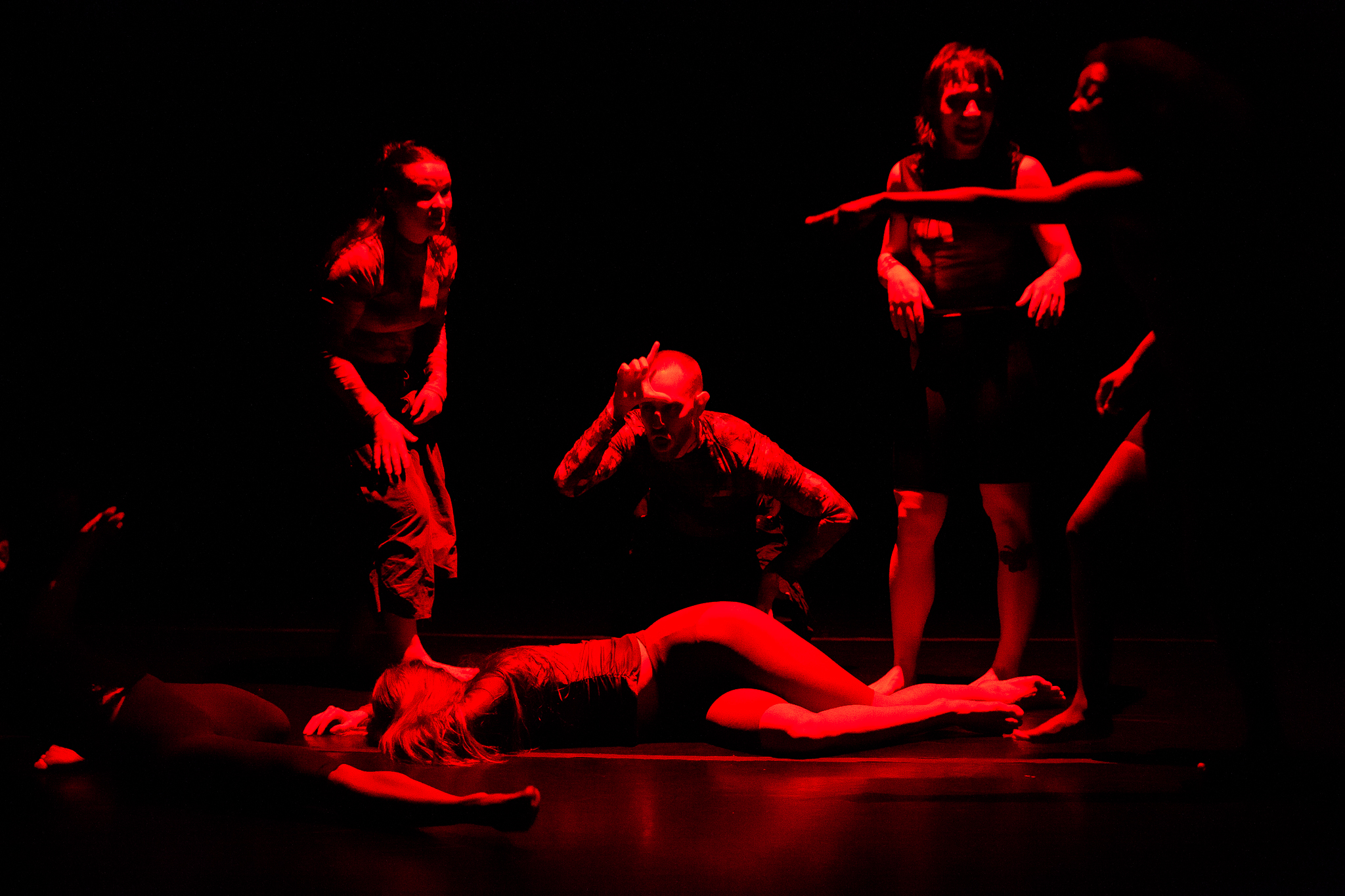
These are some of the key questions ayo ohs poses through their multidisciplinary performance A Minor Relief, a mix of live music, dance, and storytelling. During the ninety-minute evening, we (the audience) are led through four adjoining spaces at Culture Lab. Sometimes, ayo dances alone in an empty area, while other times they perform and sing with three talented musicians (treya lam, Jamila “Jam” Ravel, and Arel Sekiguchi). Viewers stand, sit in chairs, or on the floor; we glimpse ayo under bright theatrical lighting or by candlelight. Fused fragments of their life and art are each given a distinct physical location and mood, making A Minor Relief subtly sensorial as the audience travels through its geography.
Part of this theatrical landscape includes ruins and painful memories. Originally, A Minor Relief was to be a release party for a new EP, but that plan had to be altered. ayo´s studio, which contained all of their equipment and archives, was completely destroyed during the Red Hook fire at the artists’ co-op in Brooklyn. Despite this devastating loss, ayo remained steadfast in keeping this engagement in Long Island City one month later. The resulting performance is an uneven yet deeply personal selection of pieces showcasing ayo´s various gifts, interests, and questions. Rather than a finished dance or concert, A Minor Relief feels more like an extended conversation with a vulnerable artist at a crossroads.
ayo started playing with sound and learning to compose music while still touring as a professional dancer (they worked on a number of projects with Andrew Schneider and Faye Driscoll). “After dancing all day and night, I was too tired physically to create any choreography of my own,” ayo explains at one point. “But I realized I could make some sounds on my computer.” Over a number of years and online courses–including a particularly influential workshop taught by Brian Eno– ayo slowly began their transition into becoming something more than a dancer.
An early musical number in A Minor Relief is the first song ayo ever composed, a playful and quirky techno number about jealousy that they introduce as a “polyamorous queer love song.” More recent tracks contain lyrics struggling to make sense of a world gone mad. “We´re in a war zone/I’m getting it off my ringtone,” goes one chorus. The songs are earnest yet unsentimental, sincere in their quest to find a remedy to the pervading sense of hopelessness. Vocally, ayo´s style reminds me of early Tori Amos, especially when their voice switches from singing to speaking, or effortlessly turns from a sonorous wail to a whisper. ayo´s songs seem to center on whether art still provides any consolation these days. While some of the musical themes and lyrics feel repetitive in A Minor Relief, this could be a choreographic strategy on ayo´s part: sometimes a phrase or idea needs to be spoken more than once. Sometimes repetition is the meaning.
A highlight is when ayo combines dance with sound, showing an inventive and powerful fusion of the two forms. During one section in the middle of A Minor Relief, ayo hums into a microphone, which they then “loop” into a series of recordings. As these hums repeat in unusual and fascinating ways, a soundscape is formed for them to perform a powerful dance solo. At first, their gestures are smooth and muscular, evidence of years of training. But then, as if conscious that the audience is having this thought, ayo begins moving their body in jagged, jerky steps, replacing the grace of their earlier gestures with clumsiness. Next, they move their lower torso seductively, pushing their hips out and looking at us directly, before returning to twitching and lurching through the space. Just as the sound-phrases repeat in our ears, so does ayo´s movement vocabulary before our eyes. Throughout, their facial expressions shift between a spectrum of emotions–confusion, fear, hopefulness. Is ayo asking us who they are, what they will be, what to do? Is the answer somewhere here, in the space, with us?A Minor Relief is not a finished work, nor does it claim to be. Instead, it´s ayo´s invitation for their community to bear witness as they share intimately about processing loss, an experience that is spiritual as well as material. This artist doesn’t pretend to possess all of the answers (who does?), but ayo´s steely resolve to continue forward is more than commendable. Hopefully, all of us could display such strength if we were in their shoes.
ayo ohs´ A Minor Relief at Culture Lab, October 17-18, 2025