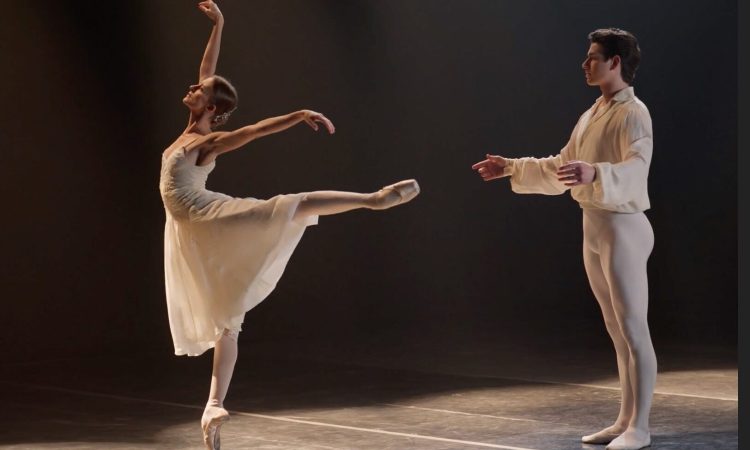
It’s a rare opportunity to sit down with three extraordinary ballet artists: Charles Askegard, renowned choreographer and former dancer with American Ballet Theatre and New York City Ballet; Oksana Maslova, principal dancer with Philadelphia Ballet, originally from Ukraine; and Sterling Baca, fellow principal and distinguished partner. Maslova and Baca perform Askegard’s evocative pas de deux, embodying his choreography with elegance and emotional depth.
Air on the G String (For Ukraine) is more than a pas de deux. Choreographed by Charles Askegard and performed by Oksana Maslova and Sterling Baca, this collaboration, set to Johann Sebastian Bach’s Air on the G String, was born from war, grief, and resilience. Alive with hope, humanity, and the transformative power of art, it demonstrates how dance can rise above suffering.
The work will next be performed alongside a dance film screening at Performance Garage on Thursday, November 6.
—
Lauren Berlin: Charles, can you describe your vision for this work and how the collaboration began?
Charles Askegard: It started about two months after the war in Ukraine began. I was deeply affected, and Oksana, of course, was even more so. I asked if she wanted to do something together, and she said yes immediately.
Oksana Maslova: At first, I thought it would be an escape, a way to move through the pain. But it became much more.
LB: Did you talk about what was happening in Ukraine during that time?
OM: We did, but the feelings were overwhelming. At work, I often had to compartmentalize. Terrible things were happening back home every day––every hour, even.
LB: Tell me about your early training in Ukraine.
OM: I’m from Nikopol and started in rhythmic gymnastics before discovering ballet through Irina Sycheva, a former ballerina of the St. Petersburg Ballet. At sixteen, I moved to Kyiv to train at the Kiev Choreographic College, later earning my master’s in choreography from the Institute of Culture and Arts. Ballet became part of me—it’s in my blood.
LB: Why face the war directly through this piece?
OM: Actually, this has become the most meaningful work of my career. This is the true purpose of art. As dancers, we don’t just entertain. We have the capacity to transform pain into something beautiful. Through this piece, we remind audiences that Ukrainians are resilient. I hope that when Ukrainians see this performance, they feel pride.
Art uplifts and gives hope. Even in tragedy, we fight and connect through shared humanity.
CA: This piece was made for Oksana. She represents the spirit—the angel rising above what’s happening on the ground. Sterling represents the physical––the anchor. It can be hard to reconcile the physical with the spiritual, but in the context of the war and in this piece, you need both.
LB: Sterling, what is it like supporting Oksana in this process?
Sterling Baca: I am literally and figuratively a support system in the choreography. I ground her so her spirit can rise. Oksana’s strength is remarkable, but my job is to support so that she can be vulnerable. The partnering is very nuanced, and requires trust as well as sensitivity to timing and weight.
LB: What goes through your mind when you perform this piece?
OM: Every movement carries meaning. Every step is like a word, and each phrase is poetry. Charles built the movement with an image and feeling in mind. Our connection was strong from the beginning, and we could see what he was imagining and feel what he was feeling, bringing that into our execution of the choreography.
LB: Describe the rehearsal process.
CA: It was very special and deeply collaborative. We’d build, step away, then return and reshape. It wasn’t just steps; it was emotional exploration. Moving through this intensity has given us space to process the horror rather than escape it.
LB: Did essence and inspiration come before the choreography itself?
CA: Definitely. Feelings came first, and choreography followed.
LB: Oksana, is it exhausting to embody this ongoing tragedy?
OM: It is, but its purpose drives me. Knowing that the work is bigger than me boosts my adrenaline. During rehearsals, we’re not just dancing—we’re processing grief. There is power to this work, especially for Ukrainians. There is pride. There is resilience.
CA: The process of creation was cathartic, in a way.
LB: The opening lift looks excruciatingly difficult. It feels like you’re carrying the weight of the world.
CA: Oksana represents the spirit that rises above the tragedies of this war. That first suspended jetésets the tone. It embodies breath, strength, and vulnerability. Once we had that opening phrase down, the rest followed naturally.
OM: It’s technically very difficult, but Sterling embodies Charles’s vision perfectly.
SB: In other moments, the partnering might not look as hard as it is, but it’s very nuanced and subtle. You feel the weight of what’s being held.
LB: That moment when Oksana does a double soutenu and collapses into Sterling’s arms—what does that signify? In a word–
CA: Bereft. It’s the surrender after struggle. The collapse isn’t defeat, though. It’s grounding. It’s connection. It’s the spirit finding support.
OM: That sequence—suspension, spin, release (she gestures in “ballet”)—holds the soul of the work.
SB: My short time away from the stage due to injury has allowed me to see ballet from a different perspective. I’m reminded now more than ever that our art is more than just steps. I’m reminded that it’s not about what you do, but how you do it. That is our job as dancers, as artists.
CA: There was enormous trust in this process. It had to be distilled—we had to walk the fine line of exploring the strong emotions behind the context of the piece without exploiting them.
OM: The process of creation was magical. The three of us created something deeply human, rooted in hope.
SB: Though it was made in the context of the war in Ukraine, the pas de deux is timeless in itself.. One of the most emotionally impactful moments was when we performed in Brooklyn. There were Ukrainian soldiers and veterans, some without limbs, crying in the audience.
LB: Sterling, you mentioned Winston Churchill earlier…
SB: Yes. During World War II, Churchill had to justify funding the arts—he asked, “What are we fighting for?” He believed art was essential. This pas de deux is a reminder that, even in war, the arts maintain the enduring power to transform pain into beauty and hope.
LB: What do you hope audiences feel when they watch Air on the G String?
OM: I hope they are reminded that beauty can heal the world. Art conveys something that words alone cannot, and you can sense that truth through this piece.
LB: Do you believe that art can change the world?
CA: Absolutely. That is always the ultimate goal. Despite all that is happening in the world, there is hope.
OM: There is always hope.
—
Lauren Berlin in Conversation with Charles Askegard, Oksana Maslova, and Sterling Baca (in person). October 27.
Air on the G String (For Ukraine) Screening & Performance, Charles Askegard, Performance Garage, November 6.
Note: Sterling Baca, who typically performs this pas de deux, is recovering from an injury. On November 6th, the role will be danced by Arian Molina Soca.