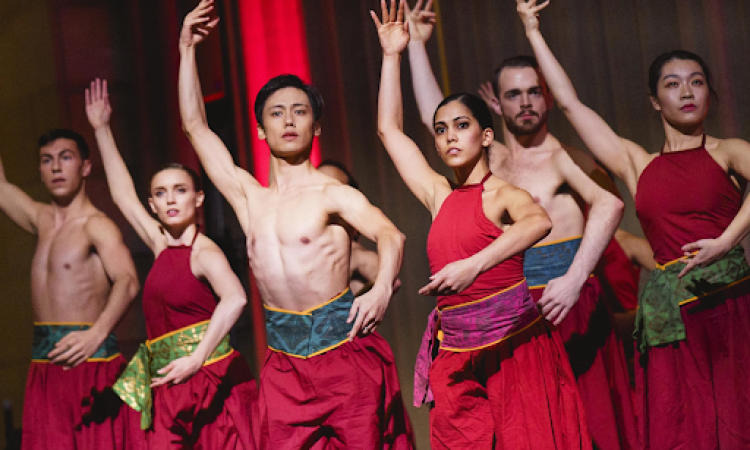
When Kun-Yang Lin speaks, his words unfold like poetry—measured, deliberate, never rushed. He is an artist, in every sense of the word.
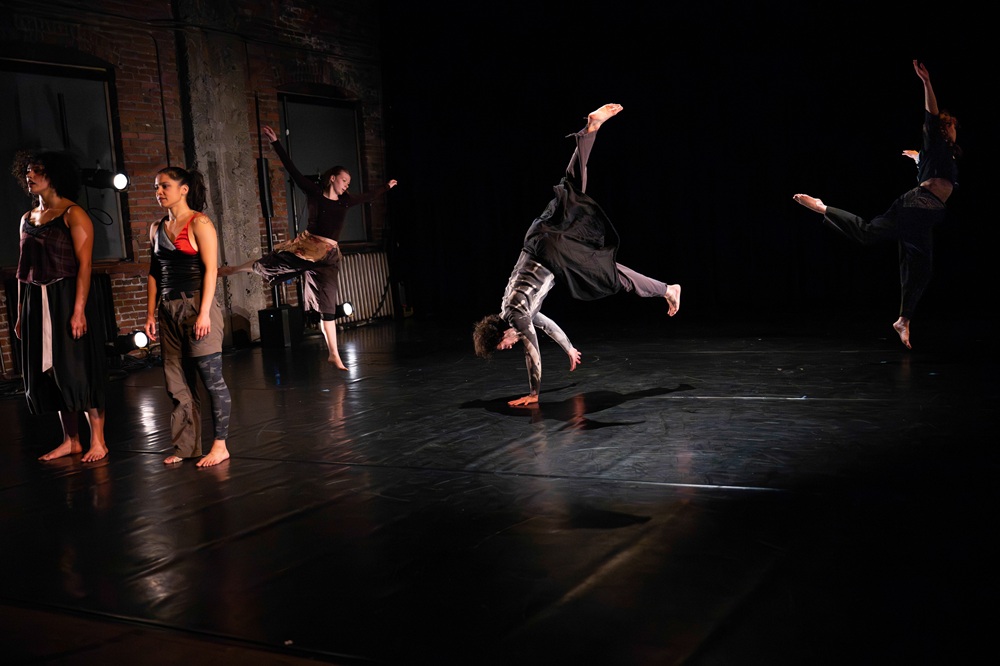
Based in Philadelphia, Lin’s company, Kun-Yang Lin/Dancers (KYL/D), has spent twenty-eight years bringing Asian perspectives and philosophies rooted in ritual, mindfulness, and the flow of chi, into contemporary dance. Now entering its final season, kicking off with a benefit concert on November 8th and culminating with a last home season performance in March 2026, the company leaves a vital legacy in Philadelphia’s artistic landscape—a continuation of the rebirth and creative renewal cycle that marks moments of evolution. While he prepares for KYL/D’s sunset season, Lin reflects not on endings, but on transformation and the beauty of becoming.
Lin founded his company in New York in the late 1990s, drawn to the city’s intensity and its history of reinvention. He resists labels like “Eastern” or “Western,” but finds meaning and inspiration in the way “Martha Graham treated dances as sacred ground.” He notes, “That idea resonates with me.”
But a decade that began with creative momentum was shadowed by loss. Lin’s father died in 2001. The twin towers fell. Lin was diagnosed with a brain tumor. “I was walking the line of life and death,” he says.
“I asked myself, ‘What if I have one more day to live?’”
Confronted by this existential question, Lin felt a deep sense of urgency — a realization that we must share our gifts.
Two years later, Lin moved to Philadelphia to teach at Temple University. There, KYL/D evolved into one of the city’s cultural treasures—a company that embodied Lin’s belief in dance as both practice and prayer.
—
Lin’s life has always been centered in the in-between. Born in Hsinchu, Taiwan, the Wind City, he grew up between languages and faiths— his father spoke Mandarin, and his mother spoke Taiwanese; Catholic hymns ringing beside Buddhist chants. “My mother said Taiwan was my home,” he recalls. “But my father’s family is still in China.” His parents, Lin tells me, never spoke the same language.
Movement, he realized, was the only language that could bridge these contradictions. “Dance is my first language,” he says. “My body can always say something.”
Lin’s world has always held such contrasts: tradition and innovation, light and dark, life and death. Similarly, the sacred and the physical both find their balance in his choreography. It is the space “in-between” that most inspires Lin.
“If you think of the cross,” he explains, raising his hands, “the vertical is heaven and earth. The horizontal is contrast—light and dark. That’s life.”
As a child, Lin choreographed in secret, directing his sisters in the living room. “I wasn’t allowed to study dance because I was a boy,” he says, laughing. Instead, he found inspiration in the streets and temples near train stations. “The first dance I saw was a Confucian ritual. They carried feathers. There was music. I didn’t understand it then, but it left an imprint. I thought, is that a dance, or a ritual?”
Inspiration for Lin does not come from any single person or source; it can emerge from anything and everything around him. The natural world, everyday experiences, cultural rituals–even a pet, he says, can contribute to his creative imagination.
This openness reflects the essence of his Chi Awareness Practice—a practice attuned to energy, presence, and the subtle currents of life that connect all things, no matter how small or seemingly ordinary. “Chi is self-cultivation,” he says. “It’s not any one thing. Practicing Chi is a lifetime process. It’s about what’s inside. It’s how we become.”
His dancers move between those poles, their bodies carving out the invisible space between stillness and explosion. The result is work that feels both ancient and immediate, spiritual yet human—a harmony born from tension.
—
For Lin, the cycle of rebirth and creation is something to be fully embraced. As he transitions from the company, he often returns to the image of the 鳳凰 (fènghuáng)—the Mandarin phoenix, symbol of balance, renewal, and harmony between yin and yang, heaven and earth.
“Phoenix,” Lin says. “Self-repair, self-cultivation, self-transformation.”
Some fear his departure signals a loss of East Asian representation in Philadelphia’s dance scene. Lin disagrees. “The work,” he says, “is out there. It’s here. It’s ready to be transformed by a new generation of dancers.”
He speaks of gratitude—for the dancers who brought his vision to life, for the audiences who embraced it, and for the community that will carry it forward. His legacy is not a conclusion but a continuation—a living energy still in motion.
Asked why he calls this moment a “sunsetting,” Lin smiles.
“Because,” he says simply, “sunsets are beautiful.”
Lauren Berlin in Conversation with Kun-Yang Lin (via Zoom). October 16.
On November 8th, KYL/D will present their benefit concert Igniting the Flame at the Performance Garage. The show will include a preview of the work that will mark the company’s final home season program, Echo & Flame: Fenghuang Awakens, presented at Drexel University’s Mandell Theater March 27-28, 2026.