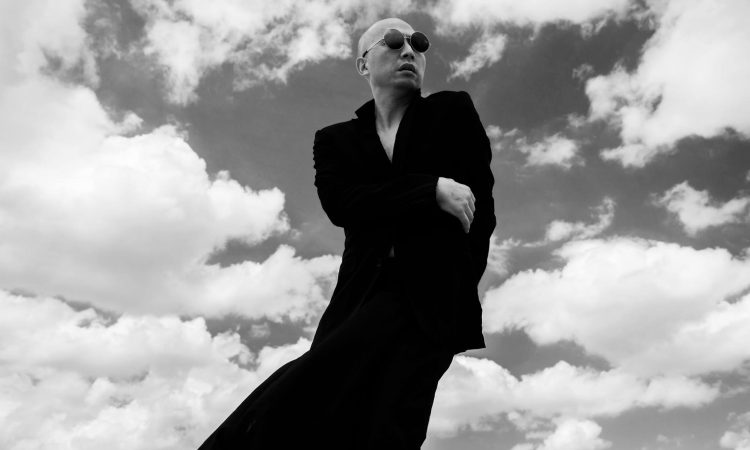
Michael Sakamoto revels in intercultural and intersectional mixology. He discovers shared energies and parallel origin stories of the seemingly disparate performance art forms of butoh and street dance. Through his work as an artist, educator, scholar, and curator, Sakamoto provides an alternative viewpoint for a world where separate identities and histories often suggest more division than solidarity.
Sakamato, a Japanese-American interdisciplinary performer who began his dance life as a teenage popper in East LA, last performed in Philadelphia a decade ago alongside hip-hop master Rennie Harris. The pair joined together to create Flash, a memorable hip-hop and butoh conversation and dance at the old Painted Bride. Their performance revealed parallel origins of ankoku buto (“dance of darkness”) in the societal upheavals and malaise of post-war Japan, and of hip-hop and 60s and 70s street dance forms from alienated and disenfranchised African-American and Latino youth. During the performance Sakamoto defined butoh as “chaos, contradiction and crisis,” Harris replied “that’s hip-hop.”
Drawing on discoveries from his experiences melding hip-hop and butoh alongside Harris, Sakamoto has returned to Philly for the first time in ten years for his new work, time/life/beauty—a multimedia performance inspired by the legacy of pioneering Japanese electronic pop composer/musician/actor Ryuichi Sakamoto (1952-2023) created in collaboration with hip-hop composer/musician/writer Paul D. Miller aka DJ Spooky, and co-choreographed with Palestinian hip-hop artist, Mohammed “Barges” Smahneh.
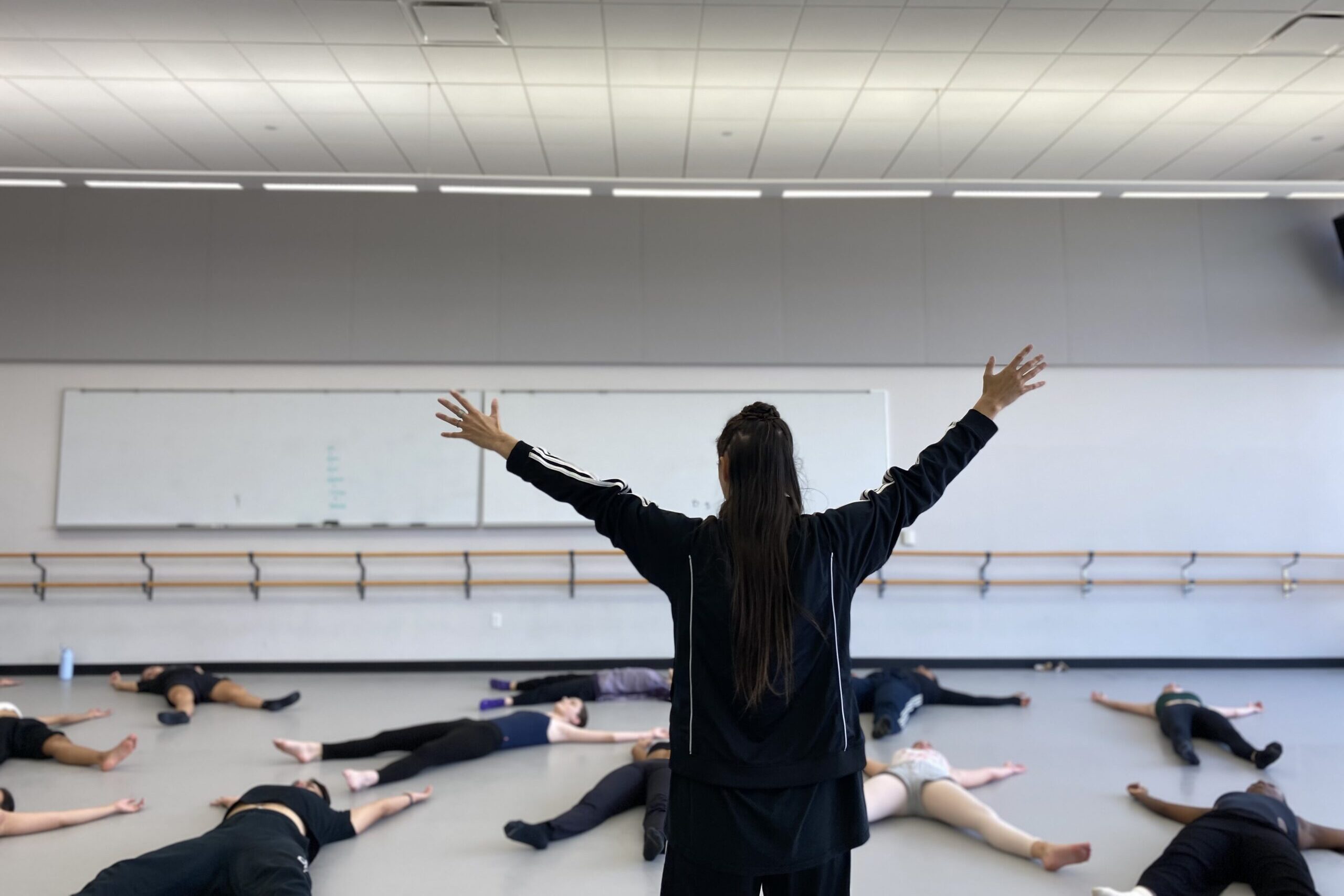
Leading up to the premiere of time/life/beauty at Duke University in January 2026, Sakamoto, with the facilitation of Philly’s performance art pollinator and catalyst, Germaine Ingram, offers two weekend events beginning with Body/Mind/Funk/Time, a butoh and house dance workshop at Studio 34. Here Sakamoto introduces core elements of first butoh and then house (focused on the Jack) to a diverse array of Philadelphia dancers. Sakamoto puts his mixology to work, creating a butoh-house hybrid. Dancers’ energies flow through both dance forms from the ground up, rippling up through the body, shared rhythms weaving into a spirited collective dance.
Butoh’s unique mix of contradiction and expressive anguish is best illustrated in the brief image exercises at the close of the workshop. In one, Sakamoto asks participants to “react” (and “not respond”) to the prompt of “standing without standing.” In another, partners face each other, transforming an extreme smile (or frown) to an extreme frown (or smile) over the course of three minutes. As a participant, my own facial muscles and self-discipline are sorely tested by this exercise, suggesting to me that only years of practice could result in mastery of this exercise.
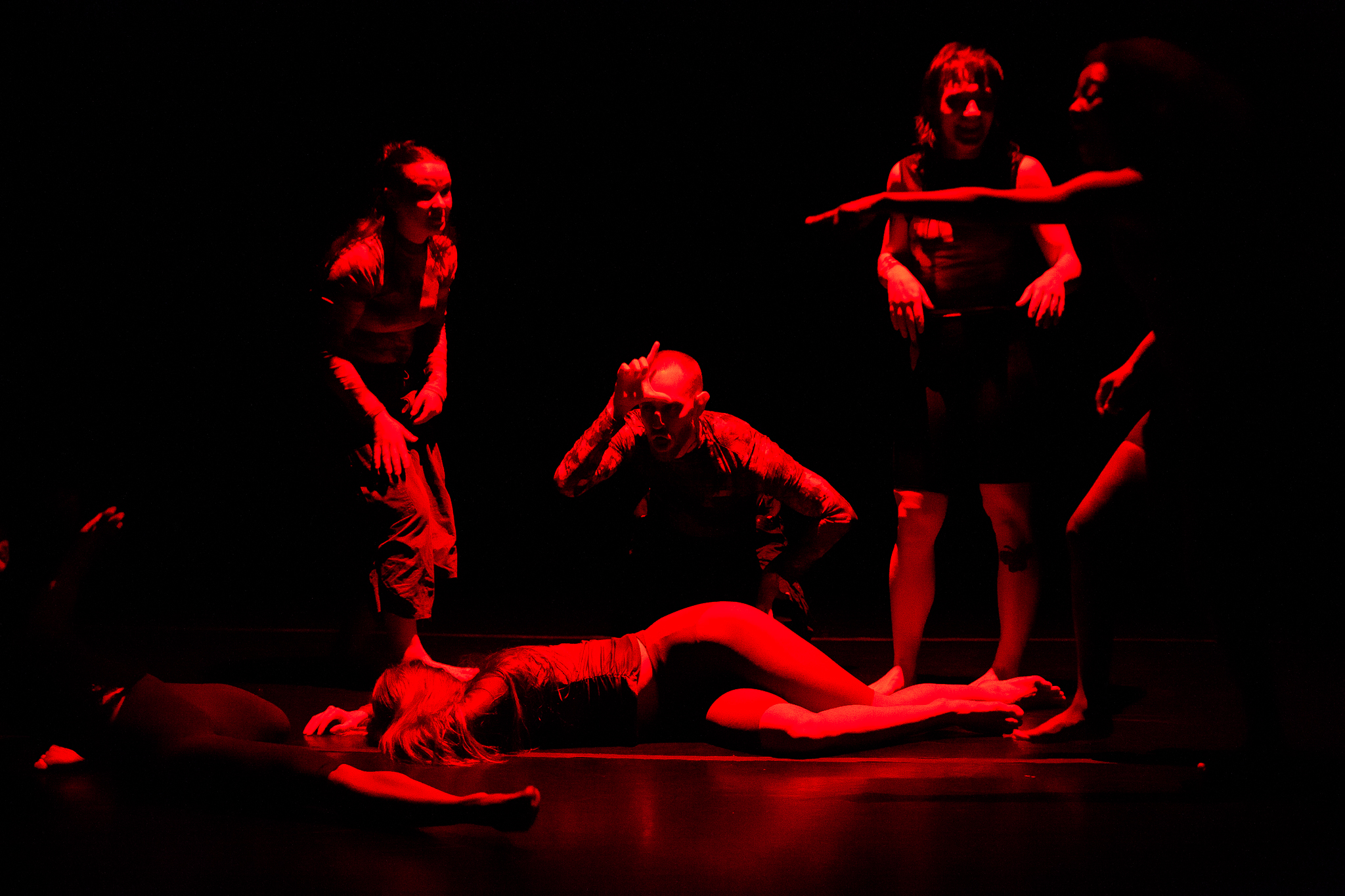
The next evening, Sakamoto, DJ Spooky and Barges present excerpts from time/life/beauty. Barges bursts into vocalized electronic booms and clicks before offering an array of fast footwork, popping, and gestures of gathering and supplication. Barges, a self-taught Palestinian hip-hop, folk and contemporary dance artist, is transfixing here, echoing his stand-out performances with the Palestinian international Yaa Samar! Dance Theater.
With the resonating crisp tone of a struck metal bowl, Sakamoto enters to begin an autobiographical solo exploring identity, histories and connections through spoken word and butoh, set to a backdrop of photographs and film excerpts. Responding to the question “who are you?,” Sakamoto’s close-to-the-body striking arm gestures and abbreviated torso twists emanate from an internal expressive force responding to polestars of his life, especially the racism that led to his family’s internment in concentration camps for Japanese-Americans in World War II, and the visionary influence of Ryuichi Sakamoto’s activism. Those “smiles” and “frowns” from the workshop now appear in context. As mask-like archetypes of emotional states or characters (I am thinking of Commedia dell’arte characters), they now “reveal” inner ambiguities or contradictions: is the “smile” one of joy, or of madness; is the “frown” one of anger, or of grief.
In a duet between Sakamoto and Barges where a butoh and hip-hop divide is initially apparent in their respective dances, Barges slowly shifts (out of awakened curiosity or comradeship?) into adopting the articulated gestures of Sakamoto, offering his own interpretation of Sakamoto’s moves with tempos ramping up from calm and waltz-like to high-speed. The duet ends with a shattering, simultaneous cry and laugh on Sakamoto’s face.
DJ Spooky, a Black composer, multimedia artist, and writer whose Japanese connections include collaborating with Ryuishi Sakamoto and participating in the annual Hiroshima Peace Boat project, speaks after the performance of the “geopolitics of sound” and the Japanese post-war innovations in electronic sound and recording technologies rendering Japan “a hub of hip-hop technologies.” He creates an intense and color-rich sonic landscape on a synthesizer for a final duet between Sakamoto and Barges. Their slowed walking and gestures, and gazing up and afar, render them sonic travelers, probing and searching for what they (and we) cannot see.
Body/Mind/Funk/Time, a movement primer with Michael Sakamoto, Studio 34, Nov. 1, 2025.
time/life/beauty, Michael Sakamoto, dancer, choreographer, performer, Paul D. Miller aka DJ Spooky, composer, multimedia artist, DJ, and Mohammed “Barges” Smahneh, dancer, co-choreographer, ars nova workshop’s Solar Myth, Nov. 2. The work will premiere Jan. 30, 2026 at Duke University’s Reynolds Industries Theater, and on March 7, 2026 at Mahaney Arts Center Dance Theater, Middlebury, VT.