For audiences eager to identify words in movements, Anh Vo’s works offer ample references. Political motifs span from communist-era Vietnam to neoliberal capitalism, as well as playful illustrations of embodied gender roles and queerness, cultural hallmarks such as shamanism and pho broth. Layers and layers of meaning sediment into Vo’s performances, and excavating these interrelated themes gives shape to the idiosyncratic sensibility of an immigrant Vietnamese queer dancer mediated by macro- and micro-cultural political landscapes.
Yet one can hardly claim these themes to be the content of Vo’s works without feeling they are missing what is truly happening in the performances. When Vo states that the body is a vessel, they mean much more than “dance mirrors life,” as if the latter is not itself something whose significance remains largely unpronounced until pushed to the point of rupture. In the series of three performances that accompany Vo’s first solo exhibition Punish, Perform, Possess, held at Asian Arts Initiative in Philadelphia, the audience is invited, often forcefully, into Vo’s frenzied inversion of the field of experience as such. With firm yet hypnotic chants, accompanied by punitively repeated movements that seem endlessly stuck in themselves, Vo’s performance sets up its own space-time, one that seems so self-obsessed that it neither flows to a resolution nor suggests a way in. Audiences are left stranded in the ever-delayed fulfillment of an “experience,” forced to shift their role between an active interpreter, a porous receiver, and a cautious witness, without inhabiting any of them fully. As the performances go on and on, one becomes as enchanted as they are confused. The moment of confusion, if not frustration, is indispensable in experiencing Vo’s work. In place of an exchange of display and attention between the performer and the audience erects the specter of that which exceeds the presence of its participants, that which retrospectively reconfigures their presence. Vo’s performances make a statement through their very form: instead of sharing a crafted experience with the audience, the pieces rather use the presence of the experiencing body of the audience no less than that of Vo’s own. A heteronomous experiential field is summoned—possession is indeed the key term in Vo’s practice.
Possession, once liberated from its origin in cult and exorcism, utters the simple fact that we are not fully ourselves. In this sense, we are always possessed. Gestures, languages, norms, and ideologies shape us and live in us, and we live through them. What necessitates Vo’s performance, however, is not chiefly the curiosity to reveal the origins of our lived experience, to search for and spell out their roots. Ho Chi Minh is ubiquitous in Vo’s works, not as a reference point but almost as the Muse. Rather than cathecting onto what possesses us, Vo’s strategy is rather to remain as close as possible to the heightened experiences themselves, indifferent to their literal inception, and in so doing to recover the archaic idea of being possessed: to reaffirm the connection between the real and the ecstatic. To perform is to overcome the symbolic with the symbolic, to summon the impossible through nothing but the reconfiguration of what itself remains hopefully deceptive and deceivingly hopeful.
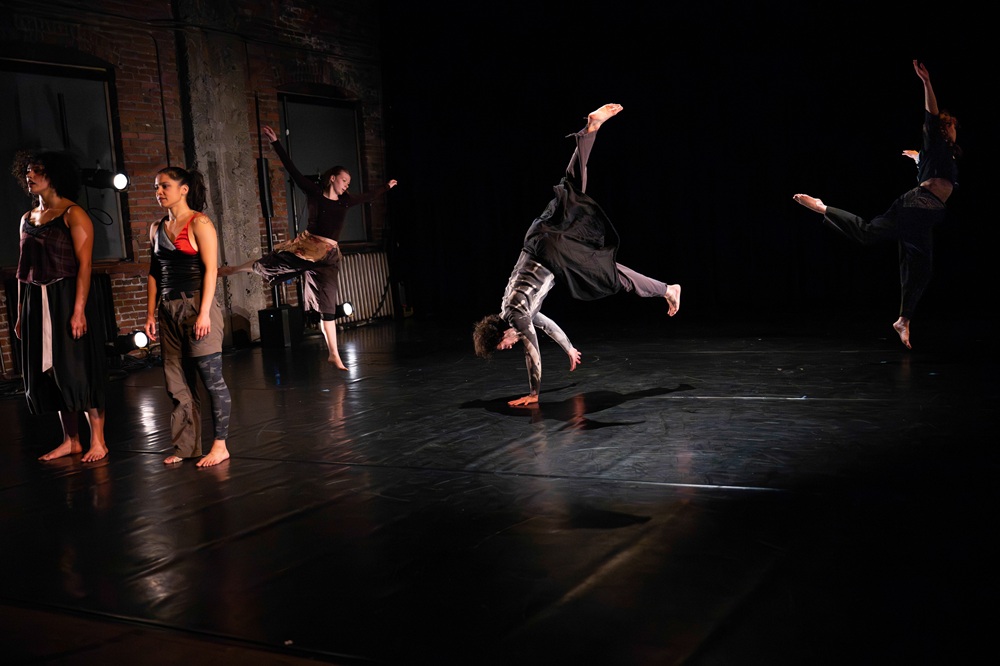
The use of language in Vo’s performances affirms this. Often so repeated to the extent that language becomes rhythmed sound, the meaning of the uttered sentences nevertheless does not simply vanish into tones. The repeated chants become indistinguishable from the equally repeated bodily movements. Unconcerned with the communicative function of language and bodily gesture, the chant-movement revolves around nothing but itself. In extreme cases, as in Vo’s second performance in the series, Possessed by…, the chants collapse to a simple subject-predicate form: “Form is a feeling,” laboriously repeated as three dancers repeat backward circular movements in the elevated rail park. As one witnesses the same chant-movements arduously sustained for ten minutes (how did they not fall from dizziness?), one sees the form that is a feeling that is a sentence that is the backward circular movement. Then comes the change of site and the new chant-movements—“I am open to ideology.” Movements do not render the words cryptic; rather, what is cryptic in words shows itself as it becomes movements, in the same way a concept only starts to make sense when one is able to chew it in one’s mouth.
A longer chant that appears both in Possessed by… and the final performance Untitled exemplifies Vo’s ruse of inversion between ideology and possession:
One. This country is mine, these people are mine, this dance is mine, what is mine I vow to love/ Two. I devote my life to study and labor/ Three. Discipline is god. Unity is good./ Four. Hygiene is of utmost importance/ Five. I stay humble. I stay honest. I stay courageous. It takes the belief in god to be courageous.
The chant, adapted from Ho Chi Minh’s five teachings for teenagers (Love the Fatherland, love the compatriots / Study well, work well / Good solidarity, good discipline / Maintain good hygiene / Humility, honesty, courage), redeems what is true in ideology, whose truth we are often too canny to admit. The atmosphere of holiness in the original teachings is reconfigured toward the love and belief in dance and god through devoted labor and discipline. The repeated movements accompanying the chant redeem what is in the image of the dedicated eyes of the children in school uniform, reciting the teachings while standing straight. We do not simply inhabit ideology, passively possessed by narratives and webs of material reproduction; we are endowed with the eyes and body that yearn to be possessed, the same eyes and body that are harmed when possessed. Hence the inversion: instead of disowning and relinquishing it, Vo’s attitude toward ideology, the passive status of being possessed, is a redemptive internal explosion. This is also why, despite flirting with possession and religiosity all the time, Vo’s works avoid the accusation of slipping into sorcery. They elicit no spirit that is not in this world. The ecstatic, as it appears in Vo’s works, is thematically ex-static; it bursts out from the always already possessed self—from the enigmatic ur-experience of the mutilated that nevertheless doubts the dissolution of mutilation—that which cannot speak unless being mutilated again.
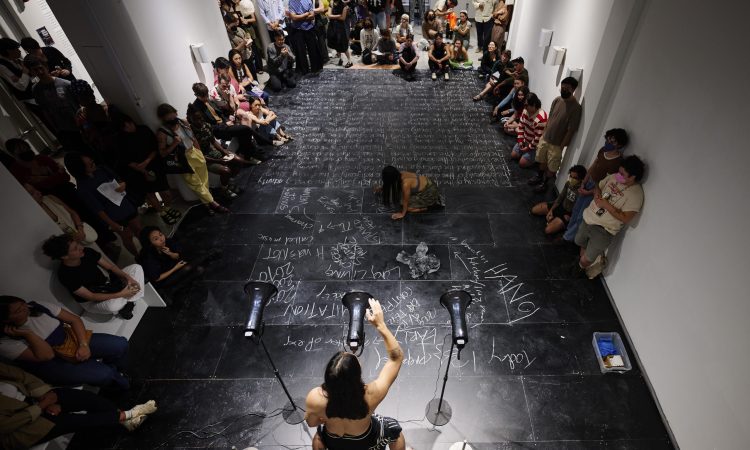
Self-punishment, often through exhausting repetition of movements or utter stillness, puts down the deposit for the redemptive ecstasy in Vo’s perverse economy of performance. In their opening performance of the series, Untitled (Break Fast), Vo half-squats over a pot of boiling pho broth—or barely so, with their legs wide open, in high heels, holding still for half an hour—shouting what sounds like a chaotic artist’s manifesto into a black megaphone, while Kristel Baldoz, the “ritual assistant,” drags her knees across the floor made of chalkboards covered densely with the same sentence “The religiosity of the dancing activity,” wipes these sentences with a damp cloth as she strives to transcribe what Vo utters in a frenzy, with much hassle and limited success. Mixed with the two megaphones on the side playing layered voices and the live drummer Isaac Silber’s attentive improvisation that gets louder whenever Vo’s voice rises, much of what Vo preaches remains a continuous indiscernible racket, although one hears scattered accusations of the repression of artistic freedom in Vietnam, the claim to a new musical language, a confusing call for a new composer oligarchy, and suspicious comments on colonialism. It is a loud and exciting performance, yet it isn’t until the spirit wanes and Vo attempts to remove themselves from the pho pot, still steaming, we realize that at this point they can barely move at all, with Baldoz out of breath. Vo takes off their clothes until fully naked, before being taken care of in a slow dance with Baldoz who irons a towel wrapped around Vo’s body. The ambivalences of supremacy and care, of frenzy and vulnerability, of tradition and devotion, prove to be variations of the ambivalence of punishment and redemption. The reconfigured terrain of ecstatic experience would cease to maintain itself and collapse into fantasy without the humility expressed in continuous bodily torture. The steaming pot of pho broth has to be boiling right under Vo’s genitals, as much as Vo has to maintain themselves in the awkwardly uncomfortable position above it. The necessary component of humiliation makes a vow, a promise that by shattering the guard of being comfortably possessed ecstatic possession will happen.
Ecstatic possession resembles catharsis, as it cleanses the unbearable by reinitiating it in semblance. Yet it is more than catharsis, for the psychological undertone must be replaced by a metaphysical one to become worthy. The exchange is not between unruly emotions and peace of mind, but between the uninhabitable moments of ecstasy and the equally uninhabitable nothingness that we nevertheless inhabit. The closing performance, Untitled, what initially seems a failed attempt to elicit punishment, proves the economy of punishment and redemption is never a formula but, in a strict sense, a feeling. In the apparently unfortunate situation in which a selected audience member refrains from participating for the entire duration of the performance despite Vo’s continuous plea (in this instance, to participate means to press the button on a remote control that sends electric shocks to the collar that Vo wears), frustration transcends its psychological meaning and becomes itself the portal into the ritual of punishment. As Vo races back and forth in their high heels in the center of the gallery space, the repeated chant— “There could never / an assurance that life / indeed it does go on without form”—becomes harder to bear with each repetition. Belief, anger, disappointment, and unfiltered attentions feed Vo’s murmuring and yelling that interrupt the chant, whereas the chant itself becomes the walking body of Vo that literally speaks for itself. The form that life goes on without is the form that the performing body feels on the stage. In sacrificing its definite form, Vo redeems what renders the overwhelming nothingness celebratory with an uncashable assurance.