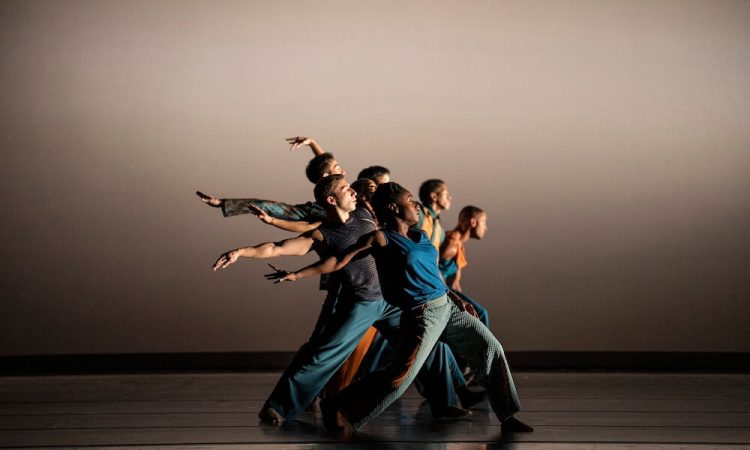
Matthew Neenan, acclaimed choreographer and co-founder of BalletX, is presently premiering his first work for Alvin Ailey American Dance Theater as part of the company’s 2025/2026 New York City Center Season. A prolific dance maker, he has created works for many prestigious companies including the New York City Ballet, Pacific Northwest Ballet, Ballet West, and Parsons Dance. I sat down with Neenan to discuss his new work and his choreographic process.
Caedra Scott-Flaherty: How did this commission with Ailey come about?
Matthew Neenan: About ten years ago, Ailey Associate Artistic Director Matthew Rushing said he would love to bring me in to work with the company, but that Ailey books its guest choreographers many years in advance. More recently, he saw a piece of mine that he wanted to bring into the repertoire, but we couldn’t because another company had exclusive rights for five years. That piece had a Heather Christian song in it, and I told Mathew that I’d been wanting to do a whole work set to her music and that I had an idea that I thought would be great for the company. He agreed!
Sometimes you just have to put it out there. Then Alicia [Graf Mack] stepped in as Artistic Director, and luckily, she agreed too. I just feel very fortunate. I always believe that timing is everything.
CS: What was the inspiration for Difference Between?
MN: It really was inspired by Heather’s music. I met with her last April and told her about the songs that I was thinking of and how they could all make sense together as a suite. They come from various albums, and one hasn’t even been released yet. So, we dove into those particular songs and their libretto. Her lyrics are so poetic. I didn’t want the dancers to dance each lyric, but I wanted the choreography to mimic the mood of each song.
There’s a little bit of everything in there—some boldness, a bit of grief. And I think a lot of my work recently has been a celebration of life, but almost in a melancholic way. Heather references the fragility of life a lot in her music and it definitely triggered something in me while creating.
I’ve gone through a lot of personal things that have forced me to reevaluate why we are here: Why do I choreograph? What’s the point?
It’s part of the midlife crisis—you take in everything you’ve done. I’ve looked back at the work that I’ve choreographed so far and critiqued it, seen where I want to go and how I want to change up my vocabulary. I’m sick of relying on my old tricks. I’m trying to stay true to myself while creating a new vocabulary, and find I’m going back to form and repetition, so there’s a lot of that in there.
When I work with a company for the first time, I don’t necessarily go in and say, “Okay, I have this concept and we have to stay true to it.” I may do that the second time I go back, because I know the dancers and the environment and what I’m up against. But when I’m new, I really want to be inspired by the company itself, the vibe in the room, and make sure I pick music that they can relate to. I had a feeling that the Ailey dancers would love Heather’s music, and they did.
CS: When you’re choreographing, does music usually come first for you?
MN: For the most part, yes. While working with BalletX, I’ve had experiences where I started without the music and just tried things—a pop song, a classical piece. I can take those risks when I know the artists really well. So, yes, music usually is the front runner, but not all the time. Sometimes I have a very strong concept, or I’m basing it off a book I just read or a film I just saw.
But with this piece, it was about the songs that I picked. And then it was “Let’s see what we come up with. What does this mean to us?” And again, the libretto, the poetry, was very inspiring to me.
CS: Now, coming out the other side of it, what do you think the piece is about?
MN: Quiet loves and potent griefs. It’s celebratory, too. There’s definite hope in there.
CS: Could you give us a sense of what to expect with Difference Between?
The piece starts pretty fierce. The first song is only a minute long, so it begins with a bang. And then we chill out again. We get a little melancholic, then we get a little more hopeful with the song “Tomorrow.” Midway through the work, I choreographed a duet between two men to a song called “Holy Roller,” and there’s definite sexual tension there. I don’t want to give away the ending, but I’ll say that when the curtain comes down, there’s still some movement going and you’re left wondering what will happen to these people now. I like to conclude things that way.
CS: Had you worked with the costume and lighting designers before?
MN: I have worked with the lighting designer, Brandon Sterling Baker. He’s the best around right now. He’s working with everybody, and he’s all over the world. I love his energy, and he stirs me in new directions. If I say something like, “What if we had an ombre cyc going on in the back?” he’ll say, “Haven’t you done that already? What if we do something else instead?” He has so many fresh ideas. I would work with him all the time if I could.
Difference Between was my first time working with the costume designer, Karen Young. I’ve seen her work before and loved it. She does a lot for Kyle Abraham, and I always love his costumes. Working with her has been great, and she’s going to design my new BalletX piece too. Through this experience, I’m forming new relationships with collaborators that I’ll have for the future.
CS: Speaking of the future, what are you working on in the coming months?
MN: I’m working on a new piece for BalletX’s Spring Series in March, which will also feature two existing works of mine. The new work will be a bit more epic. We’ve got live music and a minor set design as well. To conclude 2026, Ballet Tucson is doing a work of mine, Bacchus, that I premiered at Pacific Northwest Ballet. Ballet Tucson’s Artistic Director Margaret Mullin was one of the original cast members of this work.
And my next few commissions for the next few years are with companies I’ve wanted to work with for the past 20 years, since I started, but haven’t yet. So, I’m very excited. It’s the beginning of a new chapter, a chance to connect with new people and find new voices within myself.
Difference Between, Alvin Ailey American Dance Theater, New York City Center, December 11-January 4.